Year 3 -31 July 2026 –Hermanus -Cape Town-South Africa
We woke at a reasonable time and had a great breakfast overlooking Walker Bay. I looked out for whales but could not see any. We decided to go to the whale museum in the town which we saw yesterday but did not go in. It was interesting and mostly talked about Southern Right Whales, Humpbacks and Bryde Whales as those are the main whales you see in this area. There was a complete skeleton of a Southern Right Whale and the mouth bones are huge and interestingly there are no bones in the tail. What it did not mention was whaling which took place along this coastline.
We returned to the hotel, packed the car and left to head toward Cape Town. This took us along the coast mostly but the Clarence Drive route and Chapmans Peak routes were absolutely stunning.
Clarence Drive is a mountain pass crossed by the R44 road between Gordon's Bay and Rooi-Els. The tourist route is 22 km long and provides a panoramic view of False Bay, the coastline, Table Mountain, and parts of the Cape Peninsula.
The drive follows the east coast of False Bay in Western Cape, South Africa, and connects Strand with Hangklip to the south, similarly to Chapman's Peak Drive. The road begins near Gordon's Bay, winds south over the mouth of the Steenbras River and proceeds past Kogel Bay, Sparks' Bay, and Rooi-Els to near Pringle Bay. Here the pathway forks, with one road going near Cape Hangklip and the other lifting it to Betty's Bay.
You look down at the stunning coastline with the mountains behind and the sparkling blueness of the sea. This is such a beautiful country. We continued on toward Bettys Bay and stopped at Stoney Point where there is a colony of Penguins. We stopped and walked around and saw a lot of penguins on the rocks and shoreline with holes in the grass. There are small penguins here in South Africa. This used to be a major whaling station.
We continued on through Betty’s Bay and on toward Fish Hoek and Simon’s Town. We came across a Shanty Town which covered the sand dunes and it must have gone on for 3 miles or more. It was a reminder of the haves and have nots.
We ultimately came to Simons Town which has a large marina. We parked and walked along and through some of the town. It was quite an old town with old colonial style buildings. We walked down to the marina and in front of it were seafoods restaurants so we had some lunch and the sun came out and it was lovely.
After lunch we walked around to the marina entrance and the chandlery was closed for lunch so we walked on and saw a submarine on the hard which was a museum.
SAS Assegaai, formerly known as SAS Johanna van der Merwe, was a Daphné-class submarine of the South African Navy. Decommissioned in 2003, SAS Assegaai is the only one of the former three Daphné-class submarines to have been retained for preservation as a museum boat, the other two have been cut up and sold for scrap. The Daphné-class submarines have since been replaced by the Type 209, or Heroine-class submarines.
On 10 February 1967, after nearly two years of negotiations, an order was placed with the French Government to provide three Daphné (Dolphin)-class submarines in addition to providing the training and infrastructure to run and maintain them. The first of these submarines, SAS Maria van Riebeeck, was launched on 18 March 1969. The second boat was SAS Emily Hobhouse, and the last of the three, SAS Johanna van der Merwe. In 1999 the three boats were renamed SAS Spear, SAS Umkhonto and SAS Assegaai respectively. In 2003, SAS Spear was cut up for scrap, followed by SAS Umkhonto in 2008 while SAS Assegaai is being preserved as a museum exhibit.
SAS Assegaai was launched on 21 July 1970. Commissioned under command of Lt Cdr Theo Honiball on 21 August 1971, she completed her workup training in the Mediterranean, operating out of Toulon, before sailing for home on 4 May 1972. During the long passage, she was escorted by the frigate SAS President Steyn, before arriving in Simon's Town on 19 June 1972. Her arrival in South Africa marked the successful culmination of five years of construction, trials and training to establish South Africa's first ever submarine capability. It was not long before the submarines were involved in operations, and in 1975, just before Operation Savannah (Angola), SAS Johanna van der Merwe was deployed into Angolan waters under Operation Yskas to prepare for the evacuation of SA military personnel. During the South African Border War, she took part in some ten clandestine special operations.
During her career, she underwent four refits, which included installing additional fuel tanks, and the fitting of a locally developed RAKA combat suite in the 1980s, which replaced a cumbersome plotting table. In the late 1990s she received the South African developed NICKLES fully integrated software-based combat suite and two state of the art rebuilt periscopes. With the acquisition of the new Type 209 submarines for the SA Navy, SAS Assegaai was paid off on 23 November 2003.
We were shown round the submarine by someone who had been an engineer on this submarine and we had a very interesting tour. They had a crew of 60 men and they shared bunks and only had 2 toilets for the whole submarine. The living quarters was very small and living conditions on board must have been very difficult.
We got back in the car and headed on to Cape Town and went to the Chapmans Peak drive.
Chapman's Peak is a mountain on the western side of the Cape Peninsula, between Hout Bay and Noordhoek in Cape Town, South Africa. The western flank of the mountain falls sharply for hundreds of metres into the Atlantic Ocean, and a road, known as Chapman's Peak Drive, hugs the near-vertical face of the mountain, linking Hout Bay to Noordhoek. Tourists and locals often stop at viewpoints along this road, which offer views of Hout Bay, The Sentinel peak and surrounds, as well as over Noordhoek Beach.
The official opening of Chapman's Peak Drive, Cape Town, on the 6 May 1922 by Prince Arthur of Conaught. Chapman's Peak is named after John Chapman, the pilot of an English ship becalmed in today's Hout Bay in 1607. The skipper sent his pilot ashore to find provisions, and the name was recorded as Chapman's Chaunce.
Chapman's Peak Drive was hacked out of the face of the mountain between 1915 and 1922, and at the time was regarded as a major feat of engineering. The road was closed in the 1990s, after a rockfall caused a death and a subsequent lawsuit and subsequently reopened after being re-engineered to protect motorists from falling rocks. It was reopened in 2005 as a toll road, part of the M6.
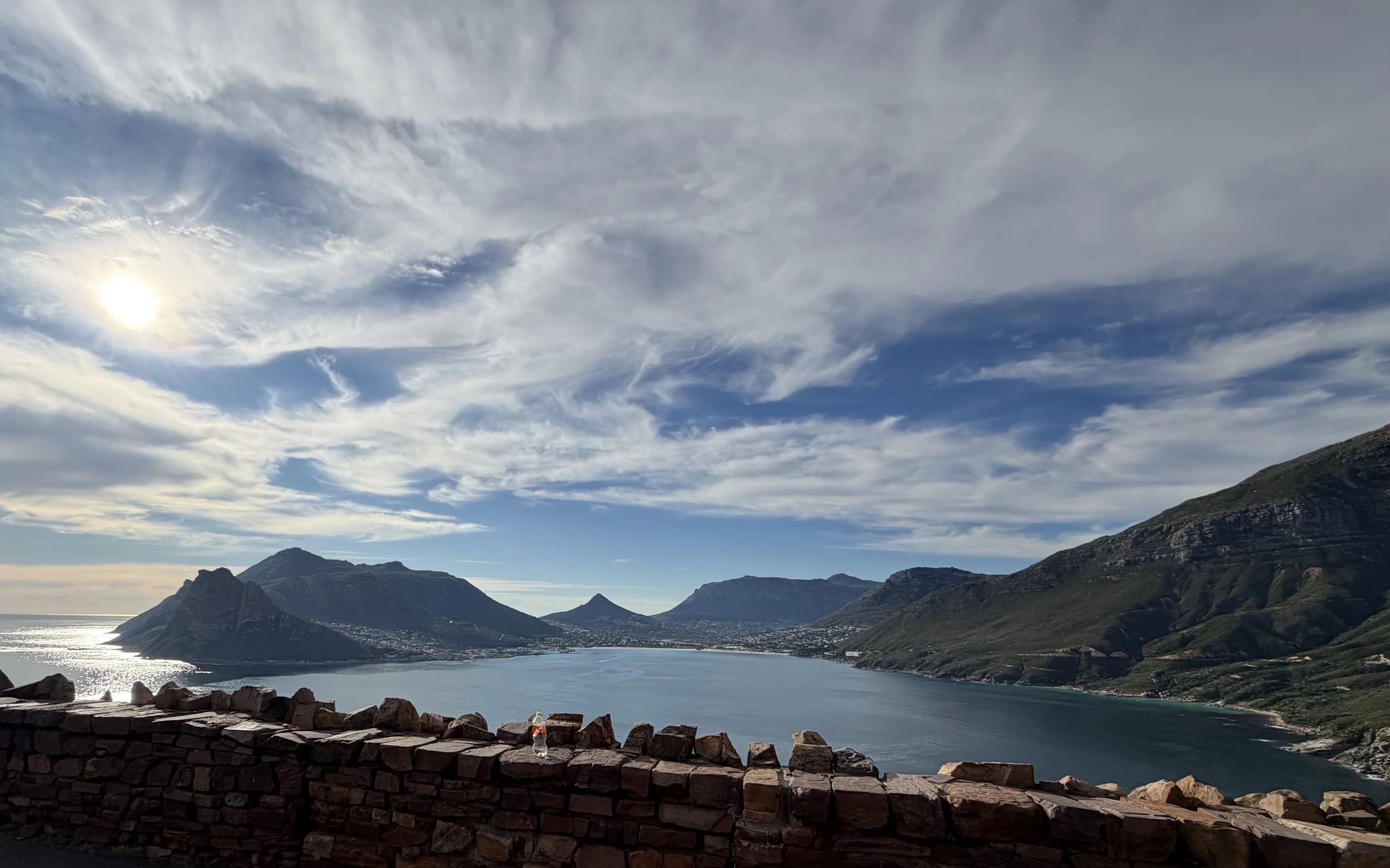
The sun was out and the views were stunning looking over Haut Bay with Lion’s Head clearly overlooking it. We saw as we were driving a whale breaching and a few sprays from whale blow holes. It is a lovely route, quite narrow and there are lots of stopping points from which to take great pictures.
We carried on and did the same route as the hop on hop off bus route and through Camps Bay and the coast to Cape Town. We filled the car up with fuel and then went to the marina car park and took all our wine and goodies back to Stormbird. She was there all still and quiet without her mast.
We then drove to the Commodore Hotel again and met the car man to give the car back and found our room.
We had a final supper at La Pareda – a Spanish restaurant which was nice.
Alex flies home tomorrow but we have booked a Robin Island tour in the morning.
The picture of the day is the view of Haut Bay from Chapmans Peak.
Need/Opportunity Year Three
I am now on the way to Durban and will then head for Cape Town and then on to St Helena, Azores and back to the UK.
The blog will continue as we continue the journey. If you have any comments or suggestions about the blog then do email me on hine.nick9@gmail.com