Year 3 -30 July 2026 – Wine Country -Stellenbosch -Hermanus -South Africa
We woke early as we were going on a Water Buffalo Safari. This started at 7.45am and although there was supposed to be another couple with us they did not show so we had the tour to ourselves. We were met by the guide who got us to get into the Safari Jeep and she drove us out of Babylonstoren across the main road into the Rietvlei – which is their animal side of the estate.
They have chickens here, Chiana Cattle, which we eat some of last night and of course Water Buffalo. We came to the milking station and they showed us a video about the Water Buffalo. The Buffalo they have are from Asia and are domesticated in that they are used to humans. They have about 270 Water Buffalo here and we saw the maternity field where new Buffalo are born and we saw some new Buffalo’s – some possibly a few hours old. They are taken away from their mothers at 5 days and are then reared separately and are released to the herd at 3 years of age.
The Buffalo have dry periods – which means that their milk dries up for 3 months or so. They milk those that have milk each day in a modern milk machine but they wash the teats first and then check the milk to see if it has any bacteria in it before they start the milking. Once they are satisfied they milk the Buffalo and once done they open the gate and the Buffalo walks out of its own accord. It is used to this routine.
Once we had seen the milking process we were then asked to help feed the young calves and they have a milk formula we fed them with and you can stroke the calves but not the adults. They use the milk to create mozzarella, other cheeses, butter, yoghurt and butter.
We returned to the hotel and to breakfast. They had specially made for us a dish of pastel del nata – the Portuguese custard tarts but they were made with Buffalo milk which was delicious. The plate also had a cheese which tasted like Pecorino and we also tasted the yoghurt, mozzarella and butter. This was all delicious.
They advertised about a Buffacino which was a coffee with Buffalo milk. We therefore had to try one and we did and it was good and more creamy than normal. As a result we were impressed with the coffee and bought some as it was quite reasonable. I also bought some Almond Butter and some Olive oil. The produce is so good here.
We checked out and packed the car and then headed off to Hermanus which is on the coast by Walker Bay and is a major whale area. The drive took us about 2 hours and through the wine and agricultural area and through the mountain ranges to the coast.
Hermanus originally called Hermanuspietersfontein, but shortened in 1902 as the name was too long for the postal service), is a town on the southern coast of the Western Cape province of South Africa. It is known for Southern Right whale watching during the southern winter to spring seasons, and is a popular retirement location.
Hermanus Pieters (c. 1778 – 1837) was a Dutch teacher who arrived in Cape Town in 1815. He was recruited by Dutch-speaking farmers who disliked that English was the only language used in all government schools. He settled in Caledon, but taught Dutch to farmers in a wide area around that town, including the Hemel-en-Aarde Valley. He often vacationed at the spring ("fontein") in present-day Hermanus, where he fished and grazed his sheep, the place eventually became known as "Hermanus Pieters se Fonteyn". He died before the village Hermanuspietersfontein existed. 65 years after his death the postmaster decided to abbreviate the name to Hermanus.
Hermanus lies along Walker Bay on the south coast of the Western Cape. It is located about 115 km southeast of Cape Town.
Hermanus is classified as having a warm-summer Mediterranean climate. It receives roughly 520 mm of rain per annum, the majority of which falls during the winter months of June to August in the form of frontal precipitation. Average midday temperatures range from 25 °C in February to 16 °C in July. Extremes above 30 °C and under 10 °C are not uncommon. Summer and Winter months are characterised by strong south-easterly and north-westerly winds respectively.
The town is noted for the presence of whales that often swim within sight of the coastline of the town. Although the Southern Right whale is the most prolific species in Hermanus bay, it is not the only species in the area. The whales can be seen from the cliffs all along the coast from as early as June and usually depart in early-December. They were once hunted in the nearby town of Betty's Bay, but are now protected. The Old Harbour Museum contains several exhibitions that explain the local whaling industry. The Whale Museum houses a skeleton of a whale.
We drove into the town and saw a number of art galleries and shops and restaurants and it felt quite chique. We parked the car and walked around. Walker Bay is huge and there is a lovely 12.5km walk along the coast. We saw some Dassie’s on the rocks which I have referred to before. It was a lovely day and the ocean look fantastic.
We decided to go and do a whale tour and booked some tickets. We found a hotel and left our luggage and the headed off in the car to the New Harbour where we checked in with the Hermanus Whale Cruise company. We had 30 minutes to wait and so we got some food.
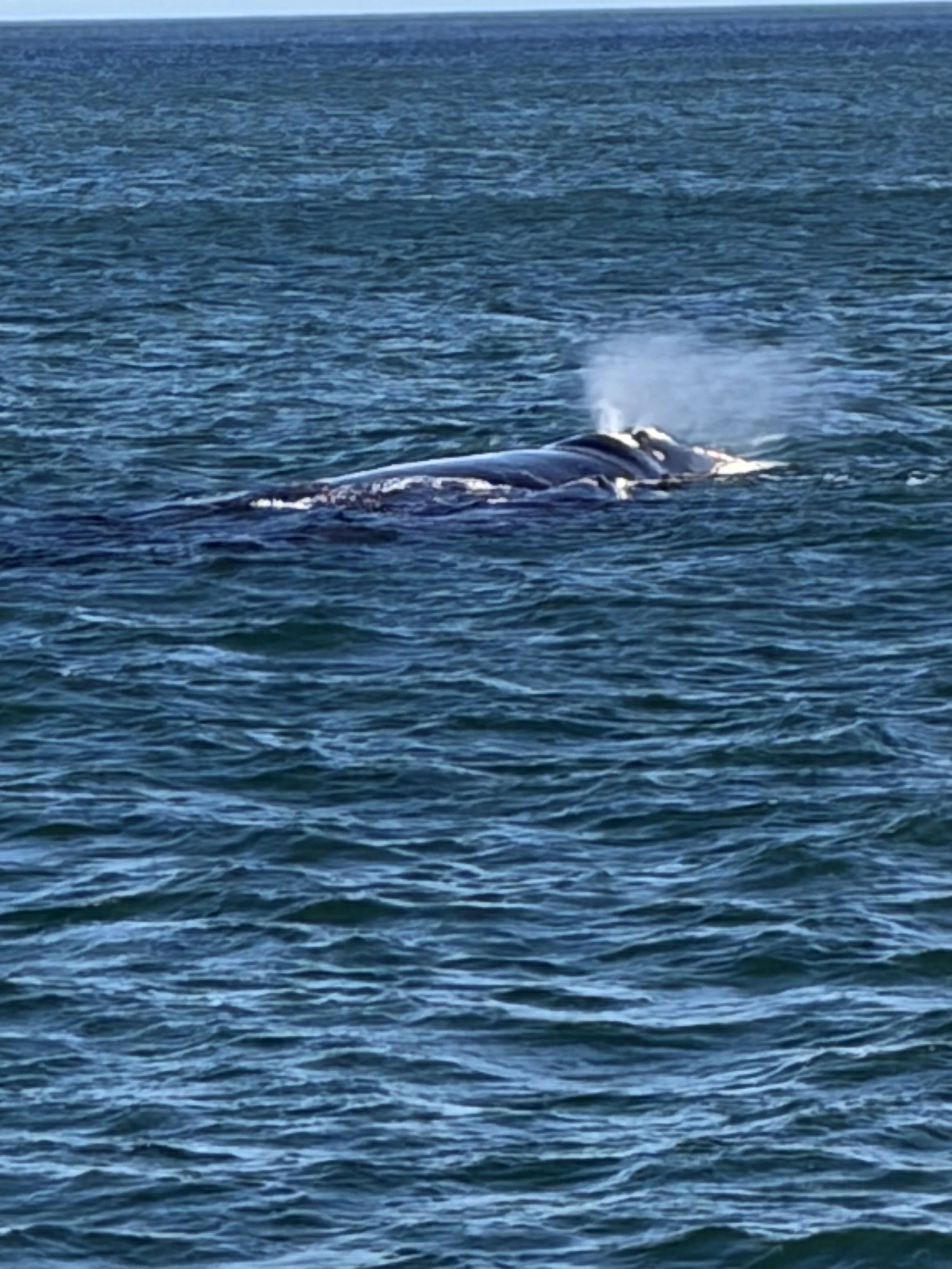
We then had a briefing from a guy called Eric who said the last group saw an Albino Whale. My expectations were not that high but we headed out into Walker Bay going South and not out to sea. Well we had an exceptional trip and must have seen up to 20 whales in total. We saw some Southern Right Whales which have no dorsal fin, and Humpbacks.
The Southern Right whale is a large baleen whale and one of three species of right whale belonging to the genus Eubalaena. Found throughout the Southern Hemisphere, it inhabits oceans between the latitudes of 20° and 60° south. Like its northern relatives, the southern right whale is noted by its broad back without a dorsal fin, a long, arching mouth, and white growths on its head known as callosities. Previously hunted for hundreds of years, almost to extinction, the species is now protected and its global population was estimated to be around 13,600 (2009).
Each year, the southern right whale migrates. During the summer months, it feeds on zooplankton and krill in the cold waters of the Southern Ocean, often near Antarctica. In the winter, it travels northward to the warmer coastal waters off Argentina, Australia, Brazil, South Africa, and New Zealand to breed and calve. The whales are known for their active behaviour at the surface, which includes breaching and a unique practice called "tail sailing," where they use their flukes to catch the wind. An adult female is 15 m (49 ft) and can weigh up to 47 tonnes (46 long tons; 52 short tons), with the larger records of 17–18 m (56–59 ft) in length and up to 80 tonnes (79 long tons; 88 short tons) for males in weight, making them slightly smaller than other right whales in the Northern Hemisphere. On each side of the upper jaw are 200–270 baleen plates. These are narrow and approximately 3 m (9.8 ft) long, and are covered in very thin hairs. The pectoral fin is 1.7 m (5.6 ft) long.
The oldest living southern right whale was 70 years old. However, a 2024 study found that the median lifespan is around 73, with some individuals surviving to over 130.
Historically, southern right whales were the primary target for whalers (thus the "right" whale to hunt), who killed tens of thousands from the 18th to the 20th century, decimating the population.
We also saw Humpback Whales and some mothers with calves. We also saw an Albino Whale with its mother and apparently only 4% are albino.
We were out for about 2 hours and saw these whales in a lovely environment. We saw one whale breaching a number of times and having fun it seemed. We also saw a number of seals. It did not disappoint and it was a special experience.
Once we got off the boat we drove back to our hotel and got the room and rested. I went for a walk along the cliffs and Alex read. We then went for a steam in the steam room and I had a swim in the pool.
We then showered and then went for supper in the restaurant which was enjoyable and we had some very nice cape salmon.
The coastline looks spectacular with the beaches and the mountains behind. We will drive along this coast back to Cape Town tomorrow.
The picture of the day is of course one of the whales we saw.
Need/Opportunity Year Three
I am now on the way to Durban and will then head for Cape Town and then on to St Helena, Azores and back to the UK.
The blog will continue as we continue the journey. If you have any comments or suggestions about the blog then do email me on hine.nick9@gmail.com