Year 3 -1 August 2026 -Cape Town-South Africa
We woke quite early and had an early breakfast as were going on a trip to Robben Island and had to be at the departure point by 8.30am which we were. There were already a lot of people ahead of us but we got through check in boarded the good ship Jester, a motorised catamaran, which left on time at 9.00am.
Robben Island is about 7.5nm from Cape Town and as were travelled we had great views looking back at Cape Town, Table Mountain, Devils Rock. Lions Head and Signal Hill. It took us about 45-50 minutes to get there and Alex and I sat out on the back and enjoyed the views as well as seeing the odd seal and many sea birds.
We came into the harbour at Robben Island and were directed to various buses. On the wall as we walked were the names of all the people who had been imprisoned on Robben Island – it looked like a memorial wall.
Robben Island is west of the coast of Bloubergstrand, north of Cape Town. It takes its name from the archaic Dutch word for seals (robben), hence the Dutch/Afrikaans name Robbeneiland, which translates to Seal(s) Island.
Robben Island is roughly oval in shape, 3.3 kilometres (2 miles) long north–south, and 1.9 km wide, with an area of 5.08 km2. It is flat and only a few metres above sea level, as a result of an ancient erosion event. It was fortified and used as a prison from the late-seventeenth century until 1996, after the end of apartheid.
During the late 20th century, it was used to imprison political prisoners who opposed the postwar apartheid state. Political activist and lawyer Nelson Mandela was imprisoned on the island for 18 of the 27 years of his imprisonment before the fall of apartheid and introduction of full, multi-racial democracy in South Africa. He was later awarded the Nobel Peace Prize and was elected in 1994 as President of South Africa, becoming the country's first black president. He served one term from 1994 to 1999.
Two other former inmates of Robben Island, in addition to Mandela, have been elected to the presidency since the late-1990s: Kgalema Motlanthe (2008–2009) and Jacob Zuma (2009–2018). Other former prisoners have held a variety of political positions in the democracy. Robben Island is a South African National Heritage Site as well as a UNESCO World Heritage Site.[4]
Located at the entrance to Table Bay, 11 km from Cape Town, this island was 'discovered' by Bartolomeu Dias in 1488. For many years, it was used by Portuguese navigators, and later by English and Dutch sailors, as a refuelling station.
Since the end of the 17th century, Robben Island has been used for the incarceration of chiefly political prisoners. The Dutch settlers were the first to use Robben Island as a prison. The island was also used as a leper colony and animal quarantine station. During the Second World War, the island was fortified. BL 9.2-inch guns and 6-inch guns were installed as part of the defences for Cape Town.
In 1948 the National Party came to power and instituted a formal program of apartheid. Over time, black Africans and allies began to organize against this policy. From 1961, Robben Island was used by the South African government as a prison for political prisoners and convicted criminals.
The maximum-security prison for political prisoners closed in 1991. The medium security prison for criminal prisoners was closed five years later.
Since the end of apartheid, the island has become a popular tourist destination. It is managed by Robben Island Museum (RIM), which operates the site as a living museum. In 1999, the island was declared a World Heritage Site for its importance to South Africa's political history and development of a democratic society. Every year, thousands of visitors take the ferry from the Victoria & Alfred Waterfront in Cape Town for tours of the island and its former prison. Many of the guides are former prisoners. All land on the island is owned by the nation of South Africa, with the exception of the island church. Administratively, Robben Island is a suburb of the City of Cape Town. It is open all year around, weather permitting.
As a tourist attraction in South Africa's national consciousness, today Robben Island is often regarded as "a symbol of oppression" by many black South Africans.
Due to the maritime danger of Robben Island and its near waters, Jan van Riebeeck, the first Dutch colonial administrator in Cape Town in the 1650s, ordered that huge bonfires were to be lit at night on top of Fire Hill, the highest point on the island (now Minto Hill). These were to warn VOC ships that they were approaching the island. In 1865, Robben Island lighthouse was completed on Minto Hill. The cylindrical masonry tower, which has an attached lightkeeper's house at its base, is 18 metres (59 ft) high with a lantern gallery at the top. We saw this light when we came into Cape Town.
We arrived and got on the bus and we had a guide called Murassy who had been imprisoned on the island for 5 years from 12 February 1978. He explained that as a student he rebelled against Apartheid and was politically peacefully active and as a member of a banned party he was arrested and sentenced to 5 years imprisonment for terrorism.
He said one of the laws the coloureds (yes that is an acceptable term here) did not like was a passbook which you had to carry, which limited your life and you were punished if you did not carry it. He remembers the Police when he was 11 coming to the township and waking them all up at night for no reason and beating their father for nothing. The bus went first past the prison which we would return to and then past the island graveyard which was full of those who died of leprosy. We then passed Robert Sobukwe’s house. Robert Mangaliso Sobukwe was a South African anti-apartheid revolutionary and founding member of the Pan Africanist Congress (PAC), serving as the first president of the organization.
Sobukwe was regarded as a strong proponent of an Africanist future for South Africa and opposed political collaboration with anyone other than Africans, defining "African" as anyone who lives in and pays allegiance to Africa and who is prepared to subject themselves to African majority rule. In March 1960, Sobukwe organized and launched a non-violent protest campaign against pass laws, for which he was sentenced to three years in prison on grounds of incitement. In 1963, the enactment of the "Sobukwe Clause,” allowed an indefinite renewal of his prison sentence, and Sobukwe was subsequently relocated to Robben Island for solitary confinement. At the end of his sixth year at Robben Island, he was released and placed under house arrest until his death in 1978.
We then came to the end of the island where there was a penguin colony and lots of cormorants and we passed on the way the former governors house and the houses of those who worked in the prison. We then came to the Lime Quarry where the prisoners had to lime quarry which affected their eyes and lungs.
We were then taken to the prison and met by another former inmate which had been imprisoned in the same way for being a member of a banned party. He took us to B block where he showed us quite a large room which just was a stone floor with blankets on the floor and a few cupboards on the wall. He explained that he had been in this room with 60-70 other prisoners. Initially Indians used to get different food to Africans and to wear long trousers and Africans had to wear shorts. However, this changed over time and the dress and food became the same. They had 4 toilets, sinks and showers to share between them. He had initially been a tailor sowing for prisoners and then he was moved to the kitchens.
He took us to the kitchens and this was how they used to communicate as they used to hide messages in bread. He said his block was for general prisoners. However, those who were leaders, like Mandela, were put in C Block which was single cells and he took us to that block. Here, prisoners were let out at 7.00am to a courtyard where they had to break up rocks and were put back in their cells by 4.00pm and the lights were left on all night and they had to use a bucket which they emptied in the morning. As leaders they had no contact with other prisoners.
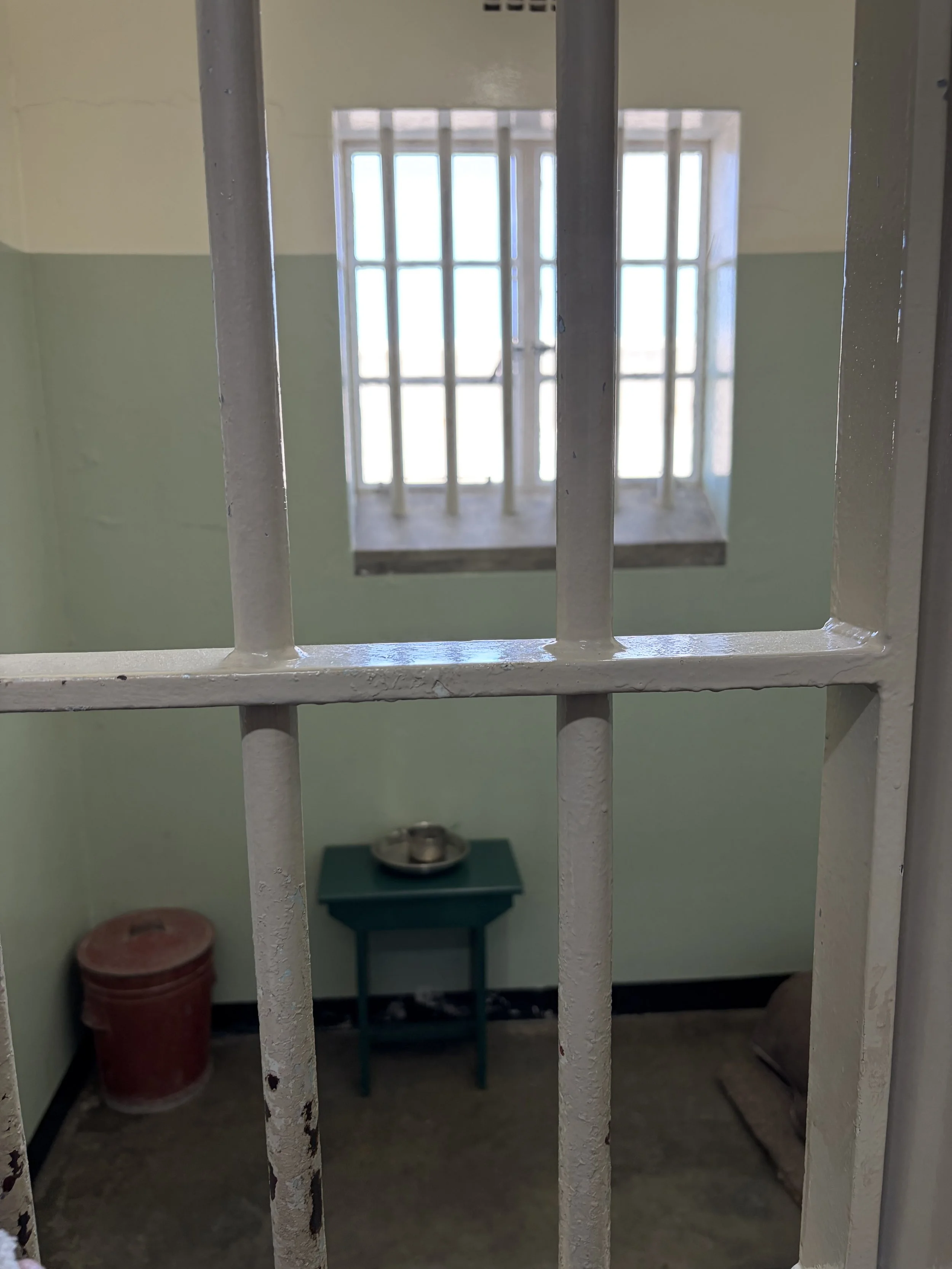
Each prisoner was given a number which was used the year they arrived. Mandela’s was 466/64 (1964 which is when he arrived). We saw his cell which was 6 foot by 6 foot with a blanket on the floor with a small wooden seat and a bucket. He stayed at Robben Island for 18 years before he was moved elsewhere and released in 1991.
It was a very interesting and sobering visit. We walked back from the prison to the boat Jester and returned to Cape Town where we had a good lunch at the Fish Market. We then returned to Stormbird and relaxed for a while and then Alex got a taxi to the airport. We had had a good packed full week and it seemed to go so fast.
I returned to Stormbird and within a short time it was dark and back to watching a film and having a snack. I will get on with some jobs tomorrow and will then meet the riggers at 9.00am on Monday to check on progress.
The picture of the day is Mandela’s cell on Robben Island.
Need/Opportunity Year Three
I am now on the way to Durban and will then head for Cape Town and then on to St Helena, Azores and back to the UK.
The blog will continue as we continue the journey. If you have any comments or suggestions about the blog then do email me on hine.nick9@gmail.com