Year 3 -21 July 2026 – Departure Day for some -Cape Town -South Africa
It was a lovely morning when we woke and it uplifted the spirit. We had a good breakfast of poached eggs on toast and coffee. It felt only right to give a good breakfast for Jenny, Keith and Mark who were all flying home after some time on the boat.
The guys got on with cleaning their cabins and heads and getting themselves packed, showering etc.
I had the usual admin- the water maker guy comes tomorrow to replace the membranes as after 3 years they need replacing. The battery man was being slow so I asked Eric, Cape Town Yacht Services, and he found me some replacement 6v batteries which make up my 24v system and they will come and be fitted tomorrow. The riggers will come on Friday to prep the boat for the mast removal. The man for the hot water tank will come next week when I am away with my son as they will need to drain the tank and so I may have no water if he came before. The cleaning team were continuing to clean and polish and Stormbird was getting the best and most thorough clean and polish she has ever had by the looks of it. She deserves it.
By midday all was ready so we went off for lunch in the sun to the Fish Seafood Restaurant we had been to before and we found a table outside. It was lovely in the sun but there was still a cool breeze. We had an enjoyable last lunch and then returned to Stormbird for a final cup of tea. I then walked the guys up to the office and after farewells Jenny, Keith and Mark got in a taxi to the airport. I was sorry to see them go.
I returned to Stormbird and it was all quiet- after months of crew being around I was now on my own for a few days before Alex comes out.
I tidied up and got all the washing ready to be taken and then had a sundowner on the aft deck and it was lovely and quiet apart from the odd murmur from the seal pontoon opposite the aquarium. More about seals below.
I had cheese and biscuits for supper and enjoyed watching the film “Every Which Way but Loose” with Client Eastwood and an Orangutang. I had not seen the film for many years and it was good fun.
I need to be up at a reasonable time to prepare for the water maker man.
What about the seals I see in the marina. The Cape fur seal, Afro-Australian fur seal, or brown fur seal is a species of fur seal. It is the largest and most robust member of the fur seals. It has a broad, flat head with a pointed snout that may be slightly upturned. It has external ear flaps and its whiskers are long, possibly extending past the pinnae, especially in adult males. The fore-flippers are covered with sparse hairs over about three-quarters of their length. The hind flippers are short relative to the large body, with short, fleshy tips on the digits. The size and weight of the brown fur seal depend on the subspecies; the Southern African subspecies is, on average, slightly larger than the Australian subspecies. Males of the African subspecies are 2.3 m (7.5 ft) in length on average and weigh 200–300 kg (440–660 lb). Females are smaller, averaging 1.8 m (5.9 ft) in length and typically weighing 120 kg (260 lb).
Adult male Cape fur seals are dark grey to brown, with a darker mane of short, coarse hairs and a lighter belly, while adult females are light brown to grey, with a light throat and darker back and belly. The fore-flippers of the fur seal are dark brown to black Pups are born black, moulting to grey with a pale throat within 3–5 months. The skull of the African subspecies has a larger crest between the mastoid process and the jugular process of the exoccipital.
The African fur seal inhabits the southern and southwestern coast of Africa, from Cape Cross, Namibia to around the Cape of Good Hope and from Black Rocks, near Port Elizabeth in the Eastern Cape province. Brown fur seals prefer to haul-out and breed on rocky outcrops and small islands, rock ledges and exposed reefs, as well as on rocky, pebble or boulder beaches. However, some larger colonies can be found on sandy beaches, such as in South Africa. Fur seals spend most of the year at sea, but are never too far from land. They have been recorded 160 km from land, but this is not common.
The African fur seal's diet is made up of up to 70% fish, 20% squid, and 2% crab. Also eaten are other crustaceans, cephalopods, and sometimes seabirds. In rare instances, they have even been documented attacking and eating sharks. A recent incident occurred off Cape Point, South Africa, where a large male was observed attacking and killing five blue sharks between 1.0 and 1.4 m long. Observers concluded that the seal likely killed the sharks to eat the fish-rich contents of their stomachs, as well as their livers, for energy. The brown fur seal dives for its food. The African subspecies can dive as deep as 204 m (669') for as long as 7.5 minutes.
The brown fur seal's main predators are great white sharks, orcas, and occasionally vagrant southern elephant seals. African land-based predators, primarily of pups, include black-backed jackals, brown hyenas and occasionally lions on the Skeleton Coast in Namibia. In addition, seagulls and other seabirds are thought to peck the eyes out of baby seals, especially sick or injured individuals, to render them helpless and disabled, as they begin to feast on their flesh.
In False Bay, the seals employ several defensive strategies while in shark-infested waters, such as:
· Swimming in large groups and harassing sharks in the vicinity.
· Low porpoising, to increase subsurface vigilance.
· Darting in different directions to confuse when attacked.
· Using their agility to stay out of reach.
· Swimming near the dorsal fin to stay clear of the shark's jaws, when pursued.
Fur seals are social animals that use vocalizations in a broad range of contexts. These vocalizations have been shown to possess unique properties that enable individual recognition. This is particularly important for the reunion of mothers and pups that experience repeated separations whilst mothers are out at sea foraging, sometimes for days at a time. Upon their return, mothers need to locate their pups. This reunion process may also be facilitated through a combination of smell and spatial cues.
In males, increases in testosterone and calling rates are seen in conjunction with the onset of the breeding season. Males can also differentiate neighbouring males from stranger males, responding more aggressively to the vocalizations of strangers. This difference in response is suspected because the threat posed by a stranger is unknown and potentially greater than their neighbour, which they would have previously encountered while establishing their territories.
Brown fur seals often gather into colonies on rookeries in numbers ranging from 500 to 1500. While fur seals spend most of the year at sea, they never fully evacuate the rookeries, as mothers and pups return to them throughout the year. No dispersal from a colony is established, although some fur seals from one colony have been found at another. True boundaries do not exist between the colonies. When at sea, they travel in small feeding groups. Brown fur seals begin to breed in the middle of October, when males haul out on shore to establish territories through display, vocalizations, sparring, and sometimes actual combat. They fast at this time and do not eat until after mating in November or December. When the females arrive, they fight among themselves for territories in which to give birth. Female territories are smaller than those of males and are always located within them. Females within a male's territory can be considered part of his harem. However, males do not herd the females, who are free to choose their mates and judge them based on the value of their territories. Copulation between the male and his females begins 6 days after they give birth to their pups, conceived from the previous year. However, a delay occurs in the implantation of the blastocyst, which lasts 4 months in the African subspecies and 3 months in the Australian subspecies. Gestation for the brown fur seal typically lasts a year, or a few days less.
After mating, females begin alternating brief periods of foraging at sea with several days ashore nursing their pups. Foraging trips last about 7 days in winter and about 4 days in summer and autumn. When a mother returns from sea to feed her pup, she emits a loud call that attracts all the nearby pups, but she responds only to her own pup. She may be able to recognize her pup by smell. When left alone, pups gather in groups and play during the evening. Pups are usually weaned at 4–6 months old.
This species is an inquisitive and friendly animal when in the water, and often accompanies scuba divers. They swim around divers for periods of several minutes at a time, even at a depth of 60 m. On land, they are far less relaxed and tend to panic when humans come near them. Breeding and haul-out sites are protected by law. South African fur seals have a robust, healthy population. Seal hunting was outlawed in South Africa in 1990. Brown fur seals are still harvested in Namibia. Permits are issued for the killing of pups for their luxurious fur and adult males for their genitalia, which are considered an aphrodisiac in some countries. It is also considered necessary to limit seal numbers in Namibia because of the supposed effect seals have on the country's fish harvest. Research by environmental groups disputes this.
In January 2023, media reports indicated that seals have been attacking humans in South Africa, particularly in the Cape Town area. Scientists believed it was due to a brain-altering poison in the fish they consumed. The poison affects their behaviour making them more aggressive towards humans. Some attribute the aggressive behaviour to the surge of toxic red tide algae, fuelled by pollution and climate change. The incidents have increased recently, prompting concern and calls for further investigation.
In July 2024, it was confirmed that 17 seals along a 650-km stretch of coastline between Cape Town and Plettenberg Bay tested positive for rabies, and that could be the cause of the attacking behaviour in fur seals. The hypothesis is the rabies was acquired from black-backed jackals who prey on the seals; rabies is endemic among southern African jackals.
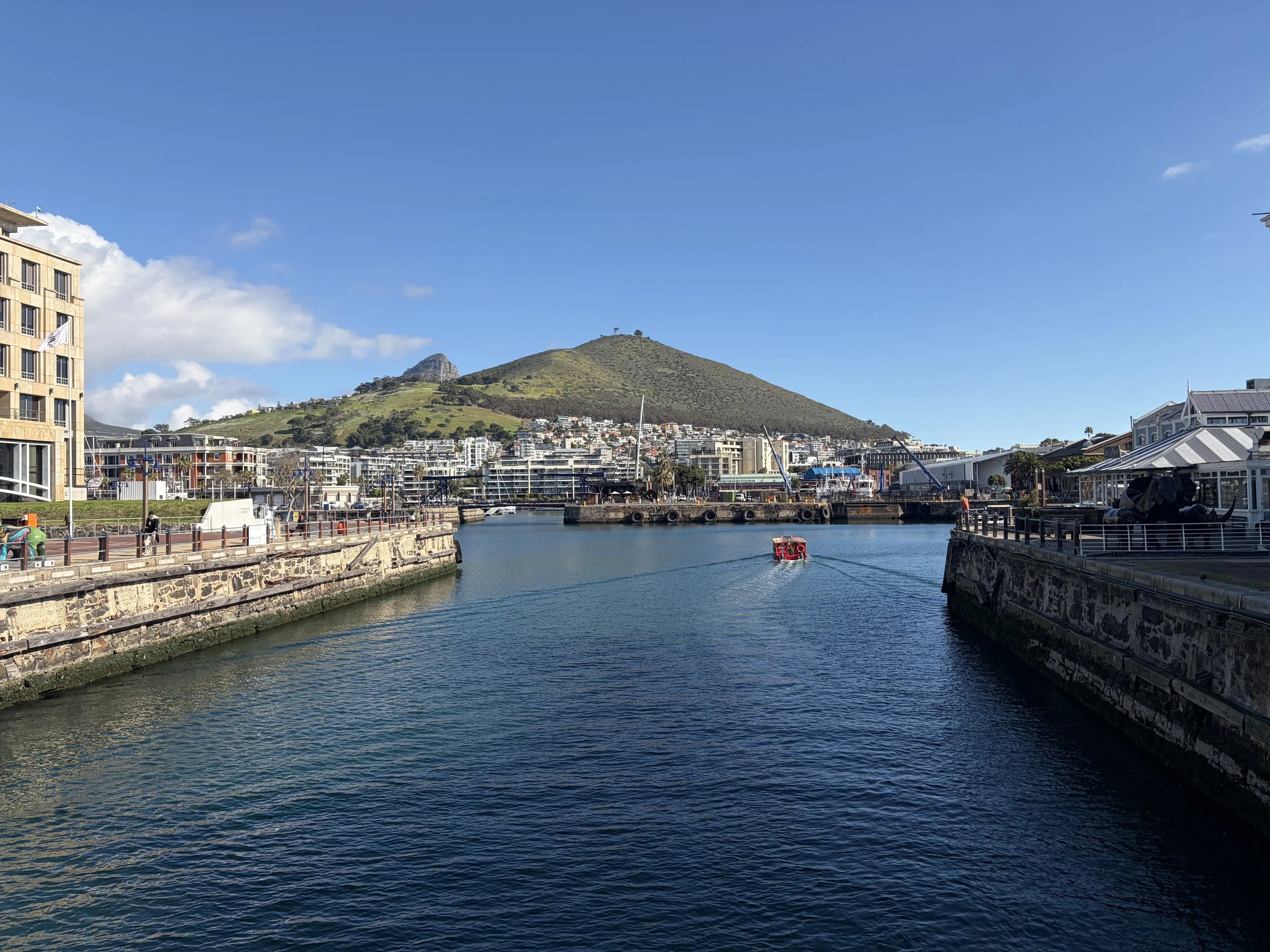
The picture of the day is a picture of the V&A looking toward Signal Hill.
Need/Opportunity Year Three
I am now on the way to Durban and will then head for Cape Town and then on to St Helena, Azores and back to the UK.
The blog will continue as we continue the journey. If you have any comments or suggestions about the blog then do email me on hine.nick9@gmail.com