Year 3 -20 July 2026 – Another Day out in Cape Town -South Africa
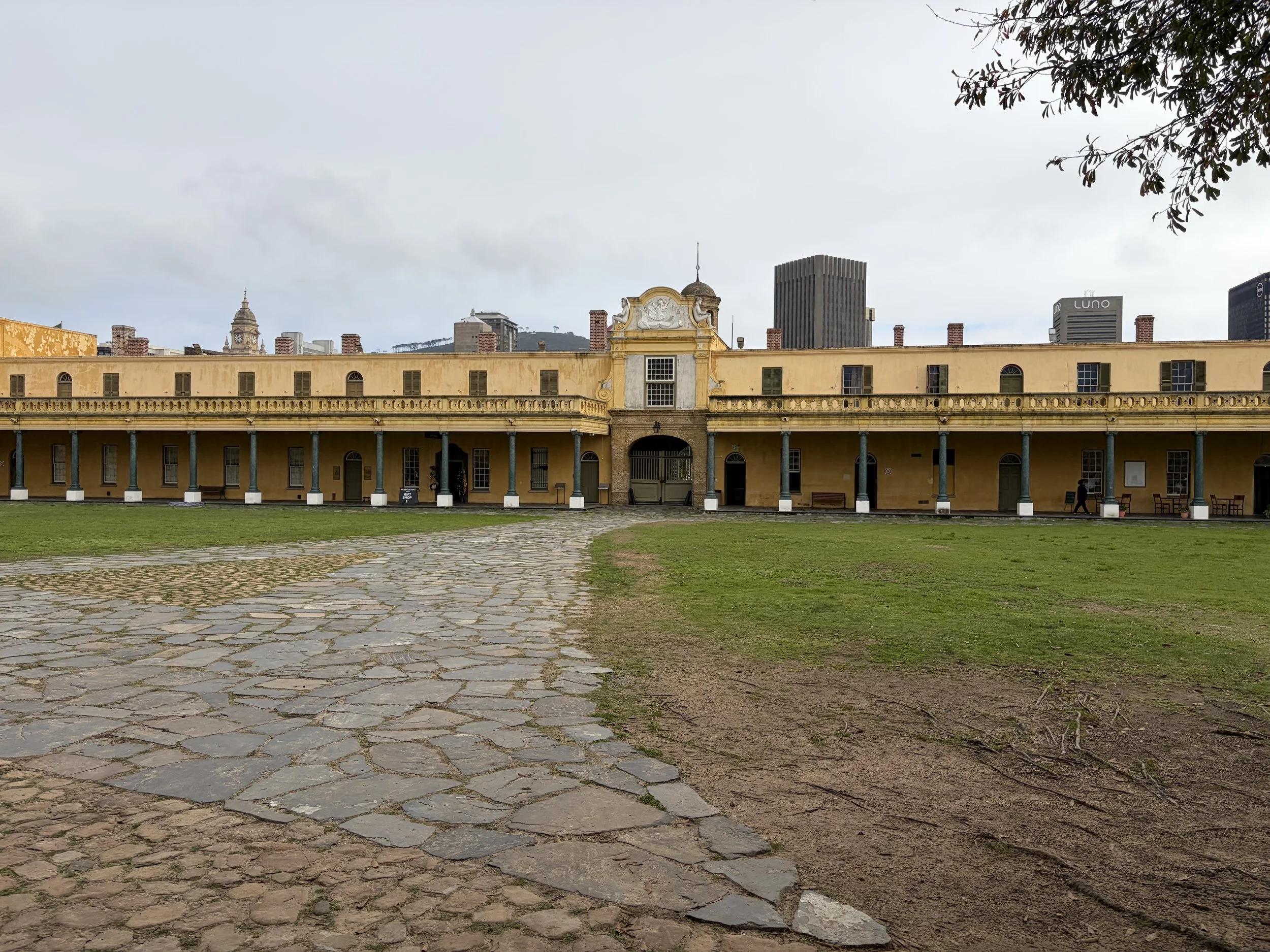
We woke to yet another grey day but there was hope as there was some blue sky as well. We had papaya and granola and yoghurt for breakfast. We decided we would go off to the Castle of Good Hope and also to the Mandela Museum. As it would be Mark, Keith’s and Jenny’s last night we would go out for supper.
We walked to the Castle which took about 35 minutes.
The Castle of Good Hope is a 17th century bastion fort in Cape Town, South Africa. Originally located on the coastline of Table Bay, following land reclamation the fort is now located inland. In 1936 the Castle was declared a historical monument (now a provincial heritage site) and following restorations in the 1980's it is considered the best-preserved example of a Dutch East India Company fort.
Built by the Dutch East India Company between 1666 and 1679, the Castle is the oldest existing building in South Africa. It replaced an older fort called the Fort de Goede Hoop which was constructed from clay and timber and built by Jan van Riebeeck upon his arrival at the Cape of Good Hope in 1652. Two redoubts, Redoubt Kyckuit (Lookout) and Redoubt Duijnhoop (Duneheap) were built at the mouth of the Salt River in 1654.The purpose of the Dutch settlement in the Cape was to act as a replenishment station for ships passing the treacherous coast around the Cape on long voyages between the Netherlands and the Dutch East Indies (now Indonesia).
During 1664, tensions between Great Britain and the Netherlands rose amid rumours of war. That same year, Commander Zacharias Wagenaer, successor to Jan van Riebeeck, was instructed by Commissioner Isbrand Goske to build a pentagonal fortress out of stone. The first stone was laid on 2 January 1666. The fortress was partially built by slave labour. The VOC was unsure about the size of the local population groups and thus feared a revolt if they enslaved them; instead they brought in up to 60,000 enslaved people from Madagascar, Mozambique, the Dutch-Indies, and India. Work was interrupted frequently because the Dutch East India Company was reluctant to spend money on the project. On 26 April 1679, the five bastions were named after the main titles of William III of Orange-Nassau: Leerdam to the west, with Buuren, Katzenellenbogen, Nassau, and Oranje clockwise from it. The names of these bastions have been used as street names in suburbs in various provinces, but primarily of Cape Town, such as Stellenberg, Bellville.
In 1682 the gated entry replaced the old entrance, which had faced the sea and was susceptible to flooding. A bell tower, situated over the main entrance, was built in 1684—the original bell, the oldest in South Africa, was cast in Amsterdam in 1697 by the East-Frisian bellmaker Claude Fremy, and weighs just over 300 kilograms (660 lb). It was used to announce the time, as well as warning citizens in case of danger, since it could be heard 10 kilometres away. It was also rung to summon residents and soldiers when important announcements needed to be made.
The fortress housed a church, bakery, various workshops, living quarters, shops, and cells, among other facilities. The yellow paint on the walls was originally chosen because it lessened the effect of heat and the sun. A wall, built to protect citizens in case of an attack, divides the inner courtyard, which also houses the De Kat Balcony, which was designed by Louis Michel Thibault with reliefs and sculptures by Anton Anreith. The original was built in 1695, but rebuilt in its current form between 1786 and 1790. From the balcony, announcements were made to soldiers, slaves and burghers of the Cape.
The balcony leads to the William Fehr Collection of paintings and antique furniture. The collection is administered by Iziko Museums of South Africa.It was briefly home to Lady Anne Barnard, after whom one of the Castle function rooms is named.
During the Second Boer War (1899–1902), part of the castle was used as a prison, and the former cells remain to this day. Fritz Joubert Duquesne, later known as the man who killed Kitchener and the leader of the Duquesne Spy Ring, was one of its more well-known residents. The walls of the castle were extremely thick, but night after night, Duquesne dug away the cement around the stones with an iron spoon. He nearly escaped one night, but a large stone slipped and pinned him in his tunnel. The next morning, a guard found him unconscious but alive.
In 1936, the Castle was declared an historical monument (from 1969 known as a national monument and since 1 April 2000 a provincial heritage site), the first site in South Africa to be so protected. Extensive restorations were completed during the 1980s making the Castle the best-preserved example of a Dutch East India Company fort.
The Castle acted as local headquarters for the South African Army in the Western Cape, and today houses the Castle Military Museum and ceremonial facilities for the traditional Cape Regiments. The Castle is also the home of the Cape Town Highlanders Regiment, a mechanised infantry unit.
During the 2000s, the Castle Control Board increasingly utilised the fortress's courtyards, grounds, and function spaces as venues for private functions, cultural events, and music festivals, generating additional revenue for the maintenance and preservation of the historic site.
Prior to being replaced in 2003, the distinctive shape of the pentagonal castle was used on South African Defence Force flags, formed the basis of some rank insignia of major and above, and was used on South African Air Force aircraft.
We went on a guided tour and were shown the Military Museum which described the battles with the English, which the English won in the end. We went then shown the torture room where people were tortured and made to confess their guilt and the dark room next to it. We were then taken to the jail house where we saw the cells and the originals carving on the wooden doors remain.
We then walked up on to the bastions and you can walk between the 5 bastions on the roof from which you can now see quite a lot of the city as when the fort was built it overlooked the sea. The reclaimed land has put paid to that.
The castle is laid out like the pentagon and around the inner walls are buildings with a set right through the centre which house the governor’s and deputy governor’s residences which we could visit. One was laid out as it was with the original antique furniture and the other as the William Fehr art collection but the Lady Barnard room was an impressive dining room with a ling table with 100 chairs so large dinners could be held.
We wondered round and visited what there was to see and it is an impressive fort and you could get a sense of what it may have been like to live there if you were of a good rank. When we finished we walked over to City Hall where statue of Mandela is and where there is the Mandela Museum. Unfortunately it was closed but we did visit the Attic Museum. The "Attic Museum," officially called The Attic Exhibition, is a free museum located in the Cape Town City Hall on the Grand Parade in the CBD. It showcases over 400 years of the city’s civic history through art, ancient postal stones, and historical artifacts. It dealt with a number of historical things which I have referred to in various blogs. The City Hall also houses the Philharmonic Orchestra of South Africa.
Once we were done we had a snack at the Woolworth’s Café and then head back to Stormbird for some tea. Keith, Jenny and I went to the Two Oceans Aquarium which is right near where we are moored.
The Two Oceans Aquarium is an aquarium located at the Victoria & Alfred Waterfront in Cape Town, Western Cape, South Africa. The aquarium was opened on the 13 November 1995 and comprises several exhibition galleries with large viewing windows: The aquarium is named for its location, where the Indian and Atlantic Ocean meet and contains a number of exhibits including:
-Diversity Gallery - This gallery showcases marine life of South Africa's two oceans, and the major Benguela and Agulhas Currents that dominate its shores. Notable species include Knysna seahorses, moray eels, anemonefish, cryptic klipfish, sea stars, compass jellyfish, shysharks and temporary exhibitions of foreign species.
-Save our Seas -Shark Exhibit - This exhibit holds 2 million litres of seawater. Ragged-tooth sharks, as well as various other fishes, are found in the exhibit.
- I&J Ocean Exhibit - This exhibit holds 1.6 million litres of seawater. Various fish, rays, and turtles can be seen in this exhibit.
- Kelp Forest Exhibit - One of the aquarium's biggest attractions, this underwater forest is home to shoals of coastal fishes, such as white musselcrackers, steenbras and spotted gully sharks, and living specimens of South Africa's kelp species, sea bamboo, split-fan kelp and bladder kelp. The northern rockhopper penguin also uses this exhibit for their exercise.
- Penguin Exhibit - African black-footed penguins, northern rockhopper penguins, western leopard toads and African clawed frogs. A river course divided into three sections (upper, middle, and lower) with examples of native and invasive freshwater fishes is also present.
It was a good aquarium and it was clever the way you walked round the large tanks from the top to the bottom and from each side and it was very well done.
We came back when we finished and then headed out for supper to Den Anker, which is a Belgium restaurant on the front. We had a great meal which we all enjoyed and returned to Stormbird well satisfied. It had been another good day.
The picture of the day is a picture of the Castle of Good Hope.
Need/Opportunity Year Three
I am now on the way to Durban and will then head for Cape Town and then on to St Helena, Azores and back to the UK.
The blog will continue as we continue the journey. If you have any comments or suggestions about the blog then do email me on hine.nick9@gmail.com