Year 3 -22 July 2026 – A day -Cape Town -South Africa
It was a greying morning when I woke and the cleaning guys were back on early to complete their clean. They were being very thorough. I had breakfast and was waiting for the water maker man.
He came about 840am and took out the old membranes and said he would fit the new ones at his factory.
The battery men came at 11.00am and we took out the old batteries which had done more than 3 years of pretty continuous use and I replaced them with a similar type. This was a good thing to do and should mean I have a good set of new batteries.
The cleaners left about lunchtime and I took all the washing up for laundry.
I got a call from Chris Bock who came to do some repairs on my mast in India. He is organising the taking off of the mast here so it can be dye tested and the foil (on which the mast wraps) can be taken out, serviced and checked. It was good to see him and he is thinking of taking the boat on the 27th to the crane and then taking the mast off on the 28th and then the boat will return to the marina until the mast can be put back on again. We chatted about it and the logistics.
Once he left I then decided to go and explore the V&A Waterfront. I had been to parts of it but not others. I therefore had a good look around and there are so many shops – it is as if you have everything here and you do not need to leave.
The V&A Waterfront, often referred to as The Waterfront and The V&A, is a mixed-use suburb in Cape Town, South Africa, featuring upmarket residential apartments, a major shopping mall, a marina, and multiple large hotels. It has over 500 shops and over 80 restaurants.
The Waterfront sits on the site of the oldest working harbour in the Southern Hemisphere. With Table Mountain as its backdrop, the 123-hectare neighbourhood sees millions of people visiting each year. The V&A Waterfront is Cape Town's most popular tourist destination by number of visitors per year.
The mall is one of Cape Town's largest, and the Waterfront features numerous other retail spaces, including the Watershed, and Alfred Mall.
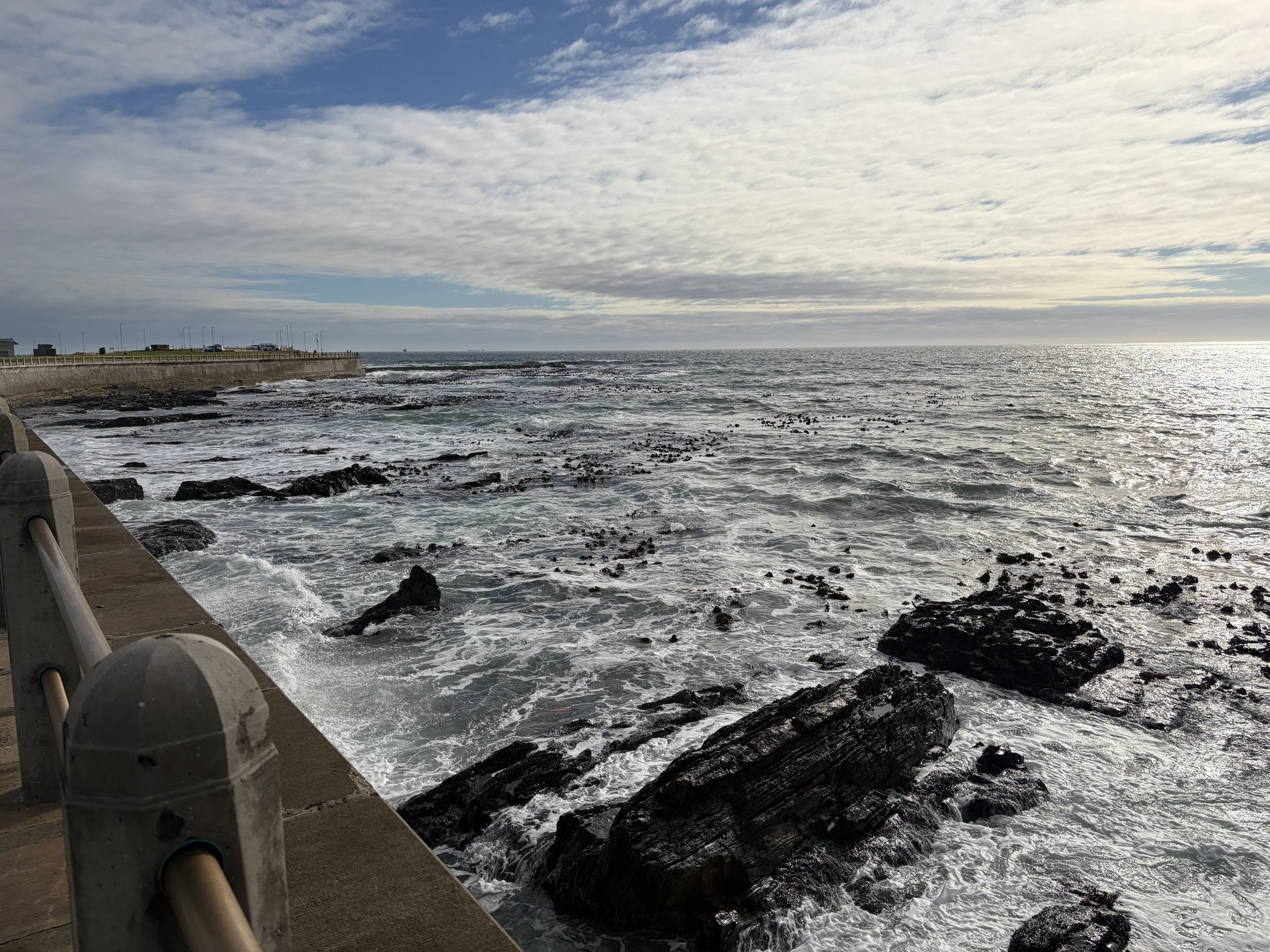
Once I had seen enough I had some lunch and then walked along the road and then beach to reach Green Point and Mouille Point. I passed the Green Point Lighthouse which I have referred to before and the light we saw as we came in at night some weeks ago now.
The coast along here has a lot of Kelp growing.
A kelp forest is a unique underwater ecosystem that’s comprised of a type of large, brown seaweed known as kelp. Just like terrestrial forests, kelp forests are characterized by high levels of biodiversity and complex three-dimensional structures. Kelp, which is a type of macroalgae, can grow remarkably fast in conditions where sunlight, temperature, and nutrient levels are ideal. Some species can grow up to 45 centimetres (18 inches) per day, reaching heights of over 45 meters (150 feet)! They possess a root-like structure called a holdfast that anchors them to the ocean floor, and a stem-like structure called a stipe that connects the holdfast and the leaf-like blades. Some kelp species also have gas-filled bladders that help the blades reach towards the sunlight at the ocean’s surface, forming a canopy. This architecture creates different layers or zones in the kelp forest: the canopy at the top, the understory in the middle, and the bottom layer near the ocean floor. Each zone has distinct light, temperature, and nutrient conditions, and harbours different species of marine life.
South Africa’s kelp forests are dominated by two species of kelp: Ecklonia maxima, also known as sea bamboo, and Laminaria pallida. Sea bamboo, the larger of the two, can grow up to 12 meters (39 feet) tall, creating a dense underwater forest that provides shelter and food for many species. Laminaria pallida tends to grow in deeper or more turbulent waters where sea bamboo can’t thrive.
These kelp forests are found along the western and southern coasts of South Africa, in the Benguela Current. This region is characterized by upwelling, where cold, nutrient-rich water rises from the deep sea to the surface, providing an abundance of nutrients for kelp growth. The kelp forest ecosystem is the most biodiverse ecosystem in the world, where you can find all sorts of creatures in all shapes and sizes. They can range from the minuscule brightly coloured nudibranch to the shy and elusive Spotted Gully Shark. Kelp forests are used by marine creatures mainly as a nursery for their young, protection from predators, and food.
Everything is interconnected. If you remove one component, everything will collapse. For example, overfishing predatory species can lead to an overpopulation of sea urchins, which can then overgraze the kelp, leading to what is called an “urchin barren.” A once rich and diverse kelp ecosystem turns into a sort of semi-desert. So maintaining a balance is vital! Not only is the kelp forest valuable to these amazing marine creatures, but they are also very valuable to us humans. In South Africa there is a growing awareness and connection with kelp forests. With the growth of an already established diving community, we have seen an increase in one-on-one access and connection with our forests in particular. Over centuries kelp forests have been a critical source of food for coastal communities, particularly the small-scale fishing communities which have been active for generations. Fishermen in these communities grew up spending time in the local harbour learning from their elders about ways of fishing, how the ocean works, and how to support their families by making fishing a livelihood. Because fishermen depend on the ocean for their livelihood, they are some of its greatest defenders, ensuring that the oceans are protected and not exploited. Kelp forests are also used as a source of tourism and income by local businesses. Some local businesses such as dive centres use kelp forests as a place to teach their students how to become divers or simply to explore all that can be found in these forests. South Africa has a unique ecosystem that can’t be found anywhere else. As a result, many people visit our country to explore these beautiful underwater forests. With that said, it is crucial that we protect these forests to ensure the longevity of these ecosystems and the economic benefits that come from these habitats.
It was a good walk and good to get some exercise. I walked back and got on to the boat again about 5.30pm. I made a salad and watched the second of the Clint Eastwood films with the Orangutang – Clyde called Any Which Way You Can which was also fun.
I hope the water maker man will come back tomorrow and the electrician is coming to disconnect the electrics from the mast in preparation for its removal.
The picture of the day is the shore off Green Point where the Kelp grows strongly.
Need/Opportunity Year Three
I am now on the way to Durban and will then head for Cape Town and then on to St Helena, Azores and back to the UK.
The blog will continue as we continue the journey. If you have any comments or suggestions about the blog then do email me on hine.nick9@gmail.com