Year 3 -16 July 2026 - Cape Town -South Africa
We woke to a lovely day and it was even beginning to get warm in the sun. I made smoothies and we had our usual fruit for breakfast.
The cleaning team started at 8.00am even waking me with a knock on the hull. We did various jobs and then prepared to leave to go to Table Mountain which looked magnificent in the sun as it dominated the skyline above us.
We heard from What the Fluff (the laundry company) that our washing was done and they said they would leave it at the office. We caught the hop on hop off bus -the red route this time which led us to Table Mountain.
The route took us round the famous dry dock where many ships come to be over hauled. We then passed the Zietz Museum of Contemporary Art.
Zeitz Museum of Contemporary Art Africa (Zeitz MOCAA) is a public non-profit museum in Cape Town, South Africa. Zeitz MOCAA opened on September 22, 2017, as the largest museum of contemporary art from Africa and its diaspora. The museum is located in the Silo District at the Victoria & Alfred Waterfront in Cape Town. A retail and hospitality property, the Waterfront receives around 24 million local and international visitors per year.
The museum’s galleries feature temporary exhibitions and a permanent collection. The institution also includes the Centre for Art Education, a fellowship programme, an atelier artist residency, a retail shop, a rooftop restaurant, and a coffee shop.
The museum building was constructed from the conversion of the 57m tall historic grain silo, originally built between 1921 and 1924 by indentured labourers.
The architects, Heatherwick Studio, were introduced to the Grain Silo complex in 2006, and again in 2011, by Ravi Naidoo, founder of Design Indaba. They aimed to conserve and celebrate the original structure's industrial heritage, while simultaneously excavating large open spaces from the 42 densely packed concrete cylinders from which it was comprised. Using a variety of concrete-cutting techniques, the interior of the building was carved out to create a number of galleries and a large central atrium. The remaining concrete shafts were capped with strengthened glass in order to allow natural light to enter and create a "cathedral-like" interior. From the exterior, the most noticeable change to the original structure was the addition of pillowed glass panels in the building's upper floors.
Overall the 9,500sqm museum consists of nine floors with 6,000sqm of dedicated exhibition space, as well as a sculpture garden on the lower roof, restaurant, retail shop and coffee shop. The higher part of the building operates as The Silo Hotel, which opened its doors in March 2017. It makes me want to visit at some point. It was also interesting to learn that a lot of the harbour area was built on reclaimed land. They also call traffic lights Robots here.
Bartolomeu Dias (d. 29 May 1500) was a Portuguese mariner and explorer. In February 1488, he became the first European navigator to round the southern tip of Africa and to demonstrate that the most effective southward route for ships is in the open ocean, well to the west of the African coast. His discoveries were later used by Vasco da Gama to establish a sea route between Europe and Asia.
On 10 October 1486, he received an annuity of 6,000 reis from King John II of Portugal for "services to come". Sometime after this, probably about July or August 1487, rather than July 1486, the traditional date, he left Lisbon with three ships to carry on the work of African exploration so significantly advanced by Diogo Cão.
The small fleet left Lisbon in or around July 1487. Like his predecessor, Cão, Dias carried a set of padrões, carved stone pillars to mark his progress at significant landfalls. Also on board were six Africans who had been kidnapped by Cão and taught Portuguese. Dias planned to drop them off at various points along the African coast so that they could testify to the grandeur of the Portuguese kingdom and make inquiries into the possible whereabouts of Prester John.
The expedition sailed directly to the Congo and proceeded more carefully down the African coast, often naming notable geographic features after saints honoured on the Catholic Church's calendar. When they weighed anchor at what today is Porto Alexandre, Angola, Dias left the supply ship behind so that it could re-provision them later on their return voyage. By December, Dias had passed the farthest point reached by Cão. On 8 December 1487, he arrived at the Golfo da Conceição, modern-day Walvis Bay, Namibia. After slowly progressing along the Namibian coast, the two ships turned southwest, away from land.
Historians have debated whether this happened because they were driven offshore by a storm, or because they were deliberately trying to find more favourable winds. Whatever its cause, the change of course brought them success: the ships traced a broad arc around the tip of Africa. On 4 February 1488, after 30 days on the open ocean, they reached Africa's southern cape and entered what would later become known as Mossel Bay.
The ships continued east for a time and confirmed that the coast gradually trended to the northeast. Dias realized they had accomplished Portugal's long-sought goal: rounding the southern cape of Africa. Dias's expedition reached its furthest point on 12 March 1488, when it anchored at Kwaaihoek, near the mouth of the Boesmans River—where they erected the Padrão de São Gregório. By then, the crew had become restless, urging Dias to turn around. Supplies were low, and the ships were battered.
Although Dias wanted to continue, the rest of the officers unanimously favoured returning to Portugal, so he agreed to turn back. On their return voyage, they sailed close enough to Africa's southwestern coast to encounter the Cape of Good Hope for the first time in May 1488. Tradition has it that Dias originally named it the Cape of Storms (Cabo das Tormentas) and that King John II later renamed it the Cape of Good Hope (Cabo da Boa Esperança) because it symbolized the opening of a sea route from west to east.
The Dias expedition had explored a thousand more miles of the African coastline than previous expeditions had reached. It had rounded the southern tip of the continent, and it had demonstrated that the most effective southward ship route lay in the open ocean, well to the west of the African coast - a route that generations of Portuguese sailors would follow. Despite these successes, Dias' reception at court was muted. There were no official proclamations, and, at the time, Dias received little in recognition of his accomplishments.
No record has yet been found of any adequate reward for Dias. On the contrary, when the great Indian expedition was being prepared for Vasco da Gama's future leadership, Bartolomeu only superintended the building and outfit of the ships. When the fleet sailed in 1497, he only accompanied da Gama to the Cape Verde Islands, and after this was ordered to São Jorge da Mina.
Vasco da Gama-Portuguese; c. 1460s – 24 December 1524) was a Portuguese mariner, explorer and nobleman. His discovery of the first direct maritime route between Europe and India via the Cape of Good Hope and across the Indian Ocean from Malindi in Kenya to Kozhikode was to open up European exploration of, and commerce with, India, and is considered a landmark event and a turning point in world history.
Da Gama's first voyage (1497–1499) was the first to link Europe and Asia using an ocean route that rounded the southern tip of Africa, although he was not the first Portuguese mariner to round the Cape. This route allowed the Portuguese to avoid sailing across the disputed Mediterranean Sea and trading with Arab Eastern Mediterranean ports that embarked goods from land routes across the dangerous Arabian Peninsula. A milestone in Portuguese maritime exploration, his voyage marked the beginning of a sea-based phase of international eastern trade and an age of global imperialism. The Portuguese later established a long-lasting colonial empire along the route from Africa to Asia at the expense of the existing Arab eastern trade network. His outward and return voyages constituted the longest known ocean voyages ever completed at the time.
Sailors had been trying to reach the Indies for decades, with thousands of lives and dozens of vessels lost in shipwrecks and attacks. Da Gama finally accomplished the feat when he landed at Kozhikode on 20 May 1498. Unchallenged access to the Indian spice routes boosted the economy of the Portuguese Empire, which was previously based along North and coastal West Africa. The main spices first obtained from Southeast Asia were pepper and cinnamon, but other commodities new to Europe were soon included in trade. Portugal maintained a commercial monopoly of these commodities for several decades. It was not until a century later that other European powers were able to challenge Portugal's monopoly and naval supremacy in the Cape Route.
Da Gama led two of the Portuguese India Armadas, the first and the fourth. The latter was the largest, and departed for India three years after his return from the first. As reward for his accomplishments, da Gama was appointed Governor of India in 1524, with the title of Viceroy, and was ennobled the Count of Vidigueira in 1519. He remains a leading figure in the history of exploration; homages worldwide have celebrated his explorations and accomplishments.
You may recall that he died in Kochi – and was buried in a church there until his family collected his remains and returned them to Portugal.
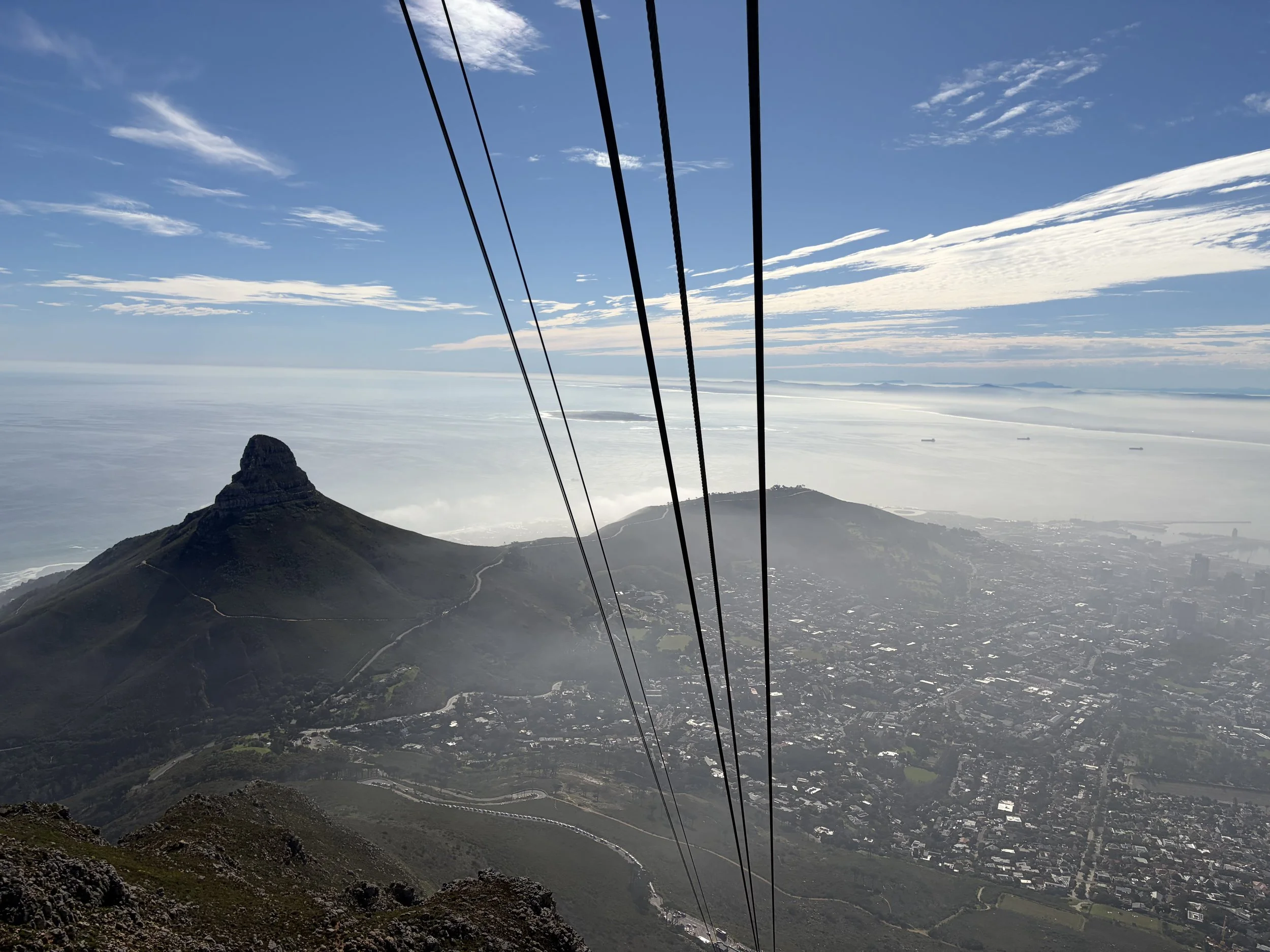
We continued on through the Foreshore and Long Street again and then on and up the hill which led to the Cable Car to Table Mountain. We had a magnificent view of Lions Head on our right and right of Table Mountain as we climbed. Devils Peak was also very evident flanking Table Mountain on its right.
We continued and came to the cable car station which had great views over the city and the ampitheatre around it.
The Table Mountain Aerial Cableway is a cable car transportation system offering visitors a five-minute ride to the top of Table Mountain in Cape Town, South Africa. It is one of Cape Town's most popular tourist attractions with approximately one million people a year using the Cableway.
The upper cable station is on the westernmost end of the Table Mountain plateau, at an elevation of 1,067 metres (3,501 ft). The upper cable station offers views over Cape Town, Table Bay and Robben Island to the north, and the Atlantic seaboard to the west and south.
The "Rotair" cableway was installed by in 1997, the design being based on the Titlis Rotair cableway in Engelberg, Switzerland.
Each car carries 65 passengers (compared to 25 for the old cars), and runs on a double cable making them more stable in high winds, giving a faster journey of 4–5 minutes to the summit. The floors of the cars rotate through 360 degrees during the ascent or descent, giving passengers a panoramic view.
Table Mountain is a flat-topped mountain forming a prominent landmark overlooking the city of Cape Town in South Africa.
It is a significant tourist attraction, with many visitors either using the cableway or hiking to the top. The mountain has 2,285 plant species, of which around 80% are fynbos (Afrikaans for 'fine bush'). Table Mountain National Park is the most visited national park in South Africa, attracting 4.2 million people every year for various activities. It forms part of the lands formerly inhabited by Khoe-speaking clans, such as the (the "High Clan").
Table Mountain is home to a large array of mostly endemic flora and fauna. Its top rises about 1,000 m above the surrounding city.
The main feature of Table Mountain is the level plateau approximately three kilometres (2 mi) from side to side, edged by steep cliffs. The plateau, flanked by Devil's Peak to the east and by Lion's Head to the west, forms a dramatic backdrop to Cape Town. This broad sweep of mountainous heights, together with Signal Hill, forms the natural amphitheatre of the City Bowl and Table Bay harbour. The highest point on Table Mountain is towards the eastern end of the plateau and is marked by Maclear's Beacon, a stone cairn built in 1865 by Sir Thomas Maclear for trigonometrical survey. It is 1,086 metres (3,563 ft) above sea level, and about 19 metres (62 ft) higher than the cable station at the western end of the plateau.
The cliffs of the main plateau are split by Platteklip Gorge ("Flat Stone Gorge"), which provides an easy and direct ascent to the summit and was the route taken by António de Saldanha in the first recorded ascent of the mountain in 1503.
The flat top of the mountain is often covered by orographic clouds, formed when a southeasterly wind is directed up the mountain's slopes into colder air, where the moisture condenses to form the so-called "tablecloth" of cloud. Legend attributes this phenomenon to a smoking contest between the Devil and a local pirate called Van Hunks. When the tablecloth is seen, it symbolises the contest.
Table Mountain is at the northern end of a sandstone mountain range that forms the spine of the Cape Peninsula that terminates approximately 50 kilometres (30 mi) to the south at the Cape of Good Hope and Cape Point. Immediately to the south of Table Mountain is a rugged "plateau" at a somewhat lower elevation than the Table Mountain Plateau (at about 1,000 m or 3,300 ft), called the "Back Table". The "Back Table" extends southwards for approximately 6 km to the Constantia Nek-Hout Bay valley. The Atlantic side of the Back Table is known as the Twelve Apostles, which extends from Kloof Nek (the saddle between Table Mountain and Lion's Head) to Hout Bay. The eastern side of this portion of the Peninsula's mountain chain, extending from Devil's Peak, the eastern side of Table Mountain (Erica and Fernwood Buttresses), and the Back Table to Constantia Nek, does not have a single name, as on the western side. It is better known by the names of the conservation areas on its lower slopes: Groote Schuur Estate, Newlands Forest, Kirstenbosch Botanical Gardens, Cecilia Park, and Constantia Nek.
We had to queue for about 20-25 minutes and were soon in the cable car being whisked up to the top with the floor rotating so you can get a 360-degree view on your assent.
The views from the top were stunning and we were lucky to have such a nice day. You could walk around the top on defined paths and get different views of the whole of the cape area. The city had a little bit of cloud and smog but the views down to Cape Point were very clear and we had sailed right around this cape. It took us some time to take in the beauty and it is described as the 7th wonder of nature. I found some steps which had the distance to various countries and it said 9,570 km – a sober thought and a long way to go.
We looked out for Dassies, which live up here, but did not see any.
The rock hyrax, also called dassie, Rickaz, Cape hyrax, rock rabbit, or coney (in early English Bible translations), is a medium-sized terrestrial mammal native to Africa and the Middle East. Commonly called the dassie in South Africa. Rock hyraxes weigh 4–5 kg (8.8–11.0 lb) and have short ears.
Rock hyraxes are found at elevations up to 4,200 m (13,800 ft) above sea level in habitats with rock crevices, allowing them to escape from predators. Hyraxes typically live in groups of 10–80 animals, and forage as a group. They have been reported to use sentries to warn of the approach of predators. Having incomplete thermoregulation, they are most active in the morning and evening, although their activity pattern varies substantially with season and climate.
Over most of its range, the rock hyrax is not endangered, and in some areas is considered a minor pest. Along with other hyrax species and the sirenians, this species is the most closely related to the elephants. An unrelated, convergently evolved mammal of similar habits and appearance is the rock cavy of Brazil.
Once we had enough of taking in the views we descended and got on the hop on bus and then went to the beautiful Camps Bay. It looked fantastic in the sun with the waves crashing over large boulders and rocks and finally on to the long sandy beach.
We found a nice restaurant on a first-floor terrace which overlooked the beach. We sat in the sun and had a great lunch overlooking the beach and the activities going on it. Mark did not come up Table Mountain and was supposed to meet us but he decided to return to the V&A where we met him when we returned.
I had bought some cheese in Camp’s Bay and we decided to stay in and have cheese and biscuits and watch a film- Gran Torino with Clint Eastwood.
It had been a great day with lovely weather.
The picture of the day is of a view from Table Mountain looking down to the city with Lions Head clearly showing.
Need/Opportunity Year Three
I am now on the way to Durban and will then head for Cape Town and then on to St Helena, Azores and back to the UK.
I am now in need of 1 additional crew from Cape Town to the Azores. The new crew member would need to be onboard by 10 August and it is likely we would get to the Azores by late September or early October. If at all interested in joining me please contact me on my email below or WhatsApp +44 7931360372.
The blog will continue as we continue the journey. If you have any comments or suggestions about the blog then do email me on hine.nick9@gmail.com