Year 3 -17 July 2026 – Another Day out in Cape Town -South Africa
We woke to a rather grey day and the cleaning team started early in terms of polishing the hull. There will be some more coming later to do the stainless steel. The winch man came as I have not really had the winches serviced since I left and I think this would be prudent. The man came to look at the small fridge which is catching when being shut and he also looked at the hatch cover in the aft cabin where the cord has come loose.
We had breakfast and decided to do the wine route on the hop on hop off buses tour. This meant getting the blue bus to Constantia and then the purple bus to the Groot Constantia winery. However we passed a number of things on our way.
A cannon is fired every day other than Sunday at 12.00noon in Cape Town. The Noon Gun is a time signal in Cape Town, South Africa, since 1806. It consists of a pair of black powder Dutch naval guns, fired alternatingly with one serving as a backup. The guns are situated on Signal Hill, close to the centre of the city.
The settlement at the Cape of Good Hope was founded by the Dutch in 1652 and the signal guns were originally part of the regular artillery at the Imhoff Battery at the Castle in Cape Town. The guns, which are still in use today, are 18 pounder smooth bore muzzle loading guns, and were designed by captain Thomas Blomfield in 1786. They were cast by Walker & Co. in early 1794, and proof fired at Woolwich in June 1794.
In addition to the aforementioned port hailing duties, the guns have had the task of firing a time signal since 1806. According to local tradition, the initial purpose of the gun was to allow ships in port to check the accuracy of their marine chronometers (a precision instrument used aboard ships to help calculate longitude). The gun report might be too inaccurate for ships several kilometres away if they did not correctly compensate for the relatively slow speed of sound. For this reason, ships marked their time by the puff of smoke rather than the sound, and this is one reason the guns are sited high above Cape Town Harbour.
We also passed a hospital facility (Groote Schuur Hospital, Cape Town) where Christian Barnard had performed the first heart transplant.
Christiaan Neethling Barnard (8 November 1922 – 2 September 2001) was a South African cardiac surgeon who performed the world's first human-to-human heart transplant operation. On 3 December 1967, Barnard transplanted the heart of accident victim Denise Darvall into the chest of 54-year-old Louis Washkansky, who regained full consciousness and was able to talk easily with his wife, before dying 18 days later of pneumonia, largely brought on by the anti-rejection drugs that suppressed his immune system. Barnard had told Mr. and Mrs. Washkansky that the operation had an 80% chance of success, an assessment which has been criticised as misleading. Barnard's second transplant patient, Philip Blaiberg, whose operation was performed at the beginning of 1968, returned home from the hospital and lived for a year and a half.
We also passed an old, restored windmill. Mostert's Mill is a historic windmill in Mowbray, Cape Town, South Africa. It was built in 1796 and is the oldest surviving complete windmill in South Africa. It was almost completely destroyed by a wildfire on 18 April 2021 but was fully restored by April 2024 and is once more operational and used to grind wheat into whole meal, using the power of the wind. The oldest windmill in South Africa is the De Nieuwe Molen mill in Cape Town, built in 1782.
We arrived at the bus stop in Constantia and there was a purple bus waiting which we took which took us to the Groot Constantia winery.
Constantia is the oldest wine-producing region in the Southern Hemisphere, dating back to 1685. Nestled just 15 minutes from the Cape Town city centre, the valley's cool-climate terroir—shielded by the Constantiaberg mountains and swept by ocean breezes—is globally celebrated for its crisp Sauvignon Blanc and iconic Vin de Constance sweet wine. The boutique route is highly concentrated, featuring exactly 10 premium estates.
Groot Constantia is the oldest wine estate in South Africa and provincial heritage site in the suburb of Constantia in Cape Town, South Africa. “Groot" in Dutch and Afrikaans translates as "great" (as in large) in English.
In 1685, during an annual visit to the Cape, Hendrik Adriaan van Rheede tot Drakenstein granted the grounds of Groot Constantia to Simon van der Stel the VOC Governor of the Cape of Good Hope. Van der Stel built the house and used the land to produce wine as well as other fruit and vegetables, and for cattle farming. Following Van der Stel's death in 1712 the estate was broken up and sold in three parts: Groot Constantia; Klein Constantia; and Bergvliet.
In 1885 Groot Constantia was purchased by the government of the Cape of Good Hope and was used as an experimental wine and agricultural estate Following a disastrous fire in 1925 the house was extensively restored.
Groot Constantia is noted particularly for its production of high-quality red wines, including Shiraz, Merlot and blended red Gouverneur’s Reserve. In 2003 the estate began production of a Constantia dessert wine, called Grand Constance, for the first time since the 1880s.
We walked through the estate a little with vineyards either side and passed the old manor house to a modern building where we signed up for a wine and chocolate tour. The tour started by showing us where the barrels were kept where they mature the wine. The barrels are of French Oak and they only use them 4 times. They ask that the barrels when they buy them are lightly or medium toasted. This means how much the barrel was put over the fire once built. It is the toasting which helps the aromas and flavours of the barrel to come into contact with the wine.
It is the terroir of the area which makes its wines special. In other words the effect of the climate, rainfall, geology (soil) and altitude. We passed on through the tank area and then finally it was time for the tasting.
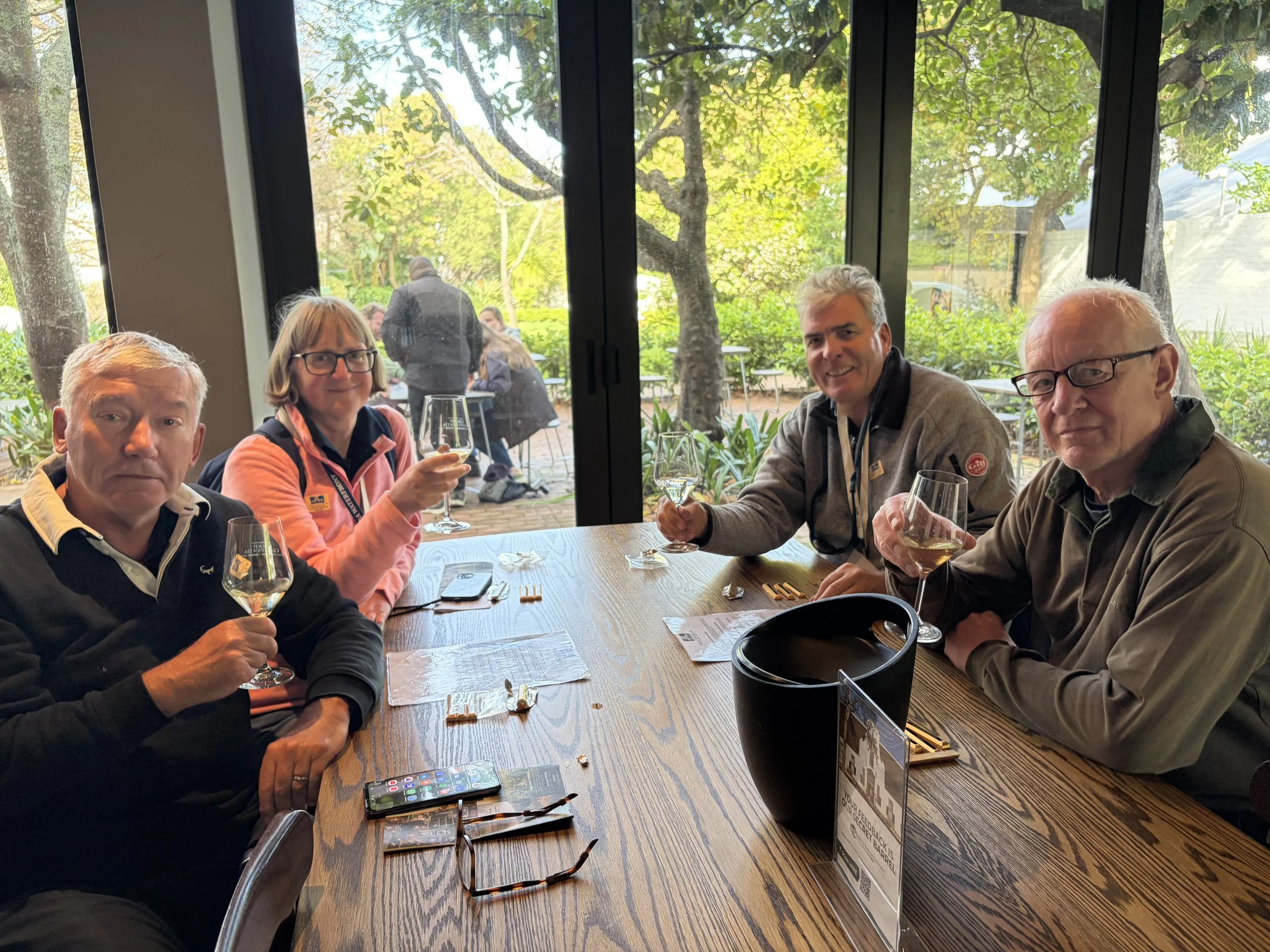
We tasted 5 wines with some chocolate with each which we felt enhanced the flavours. The first was a Rose, the second a Sauvignon Blanc, then a Pinotage, Shiraz and the Grand Connoisseur which is a blend of grapes. They were all good wines and the chocolate enhanced the flavours.
We wondered round the estate and the manor house which had its old antique furniture and enjoyed the location. You would never know you are near to Cape Town.
We got back on the bus and changed back to the Blue Line back to Cape Town. By this time the cloud had come down and it was quite cold. We passed through Haut Bay and then on to Camps Bay. En route we saw the wreck of a crane.
Bos 400 was a French derrick/lay barge that ran aground while being towed by the Russian tugboat Tigr on June 26, 1994. Tigr was chartered to tow BOS 400 from Pointe-Noire in the Republic of Congo to Cape Town, South Africa. The tow-cable broke during a force 9 Northwesterly gale and caused the vessel to run aground off Duiker Point near Sandy Bay, at the same place as the earlier wreck of the SS Oakburn. Despite several towage attempts, the shipwreck was considered a total loss as salvors were able to recover little from the wreck. BOS 400 remains a wreck with a large crane and part of the superstructure visible above sea level. The wreck is slowly disintegrating. Tigr was built in 1987 in Polish shipyards. Following the accident, she remained idle in the Cape Town docks from 1994 to 2000, when she was sold for $625,000.
We also passed the Green Point Lighthouse which we had seen when coming into Cape Town.
The Green Point Lighthouse, Cape Town is an operational lighthouse on the South African coast. First lit on 12 April 1824, it is located on Mouille Point. The lighthouse was the first solid lighthouse structure on the South African coast and the oldest operational lighthouse in South Africa. The lighthouse was commissioned by acting Governor of the Cape Colony Sir Rufane Shaw Donkin and designed by German architect Herman Shutte. Building commenced in 1821 and was completed in 1823. The lighthouse started operating in 1824. The lighthouse cost approximately £6,420 pounds sterling to build. When the lighthouse was first lit, it burned Argand lamps fuelled by sperm whale oil. The light from these lanterns could be seen for 6 nautical miles (11 km; 6.9 mi). The lighthouse was expanded to its present height in 1865. In 1922, the range of the light house was extended to 22 nautical miles when 3rd order dioptric flashing lights were installed. Its present characteristic is a white light flashing every 10 seconds. In 1926, a foghorn was installed in the lighthouse despite a letter of complaint sent to the Mayor of Cape Town in 1923 by Green Point residents. Local Residents call the Green Point Lighthouse "Moaning Minnie".
We returned to our stop at the V&A and went direct to an African Restaurant called Karubu where we had South African delights such as snook pate, biouts, baboote etc. We were quite hungry as we had missed lunch.
It had been a good day but we were tired and retired to bed at a reasonable time.
The picture of the day is of us wine tasting at the Groot Constantia winery- the oldest.
Need/Opportunity Year Three
I am now on the way to Durban and will then head for Cape Town and then on to St Helena, Azores and back to the UK.
I am now in need of 1 additional crew from Cape Town to the Azores. The new crew member would need to be onboard by 10 August and it is likely we would get to the Azores by late September or early October. If at all interested in joining me please contact me on my email below or WhatsApp +44 7931360372.
The blog will continue as we continue the journey. If you have any comments or suggestions about the blog then do email me on hine.nick9@gmail.com