Year 3 -9 July 2026 -Another Day Out in Port Elizabeth-South Africa
I woke at 6.00am having been thinking, as with Hisham leaving this would leave us with one crew member short. We could cope but it is not ideal. I therefore made contact with a South African I had been in touch with before to see if he could come at short notice. Luckily he replied quickly and said he would get a flight from Johannesburg that afternoon. This was lucky and he has done quite a bit of sailing and he is called Robin Paterson. That was a relief and we would therefore be 6 for this tricky passage.
I filed the passage plan with the authorities stating that we intended to leave about 7.00am on Friday 10th July for Cape Town. I emailed Des and he later replied.
Dear Nick Thanks for latest. The latest gribs 0700UTC 9\7 show Port Elizabeth Wind SW20 gusts 28 - swell SW3.8m@10seconds - cloud sat shows 100% but scattered - passing rain from SW possible - no significant current. Tomorrow wind SW18 gusts 25 - swell SSW4.0m@12seconds - cloud f\cast 90% - moderate rain from SW. Midday 1000UTC 1200local time wind SW12 gusts 20 – swell SSW3.5m @12 seconds Offshore at 34 24S wind already shows SSW\S11 indicative of an imminent switch. By 1100UTC 1300local the wind shows S10 gusts 16 - swell S4.2m@ 12 seconds. GFS which is my preferred model very much mirrors the ECMWF f\cast. By sundown tomorrow wind shows SE10+ and overnight turns ESE\E and becomes ESE\E\ENE20 with no significant gusts. This pattern holds good up to Mon morning at Cape Agulhas - 72 hrs for 280nm which should be a doddle. Personally would delay departure to Fri afternoon 1200UTC - 1400local. Ultimately skipper's call. Please keep me posted. Best wishes Des.
I thought that I would review the situation later in the day.
We had decided to go to the Addo Elephant National Park early so that Hisham could come with us and then we could drop him off at the airport. He will then fly to Cape Town and then on to Cairo.
Addo Elephant National Park (AENP) is a diverse wildlife conservation park situated close to Gqeberha in South Africa and is one of the country's 20 national parks. It currently ranks third in size after Kruger National Park and the Kgalagadi Transfrontier Park.
The foundations of the Park lay in the near extermination of the local elephant population. Local fruit farmers had been sold their farms at greatly reduced rates and favourable terms because of the elephant presence. Nevertheless, these farmers complained to the authorities about damage to their crops, broken water pipelines and reservoirs, and even loss of lives. From June 1919 to August 1920, the professional hunter Major P. J. Pretorius was brought into thin out the herd, and shot a figure of "120-odd" elephants, reducing the population from about 130 to 16 individuals.
In 1925 Deneys Reitz, in his capacity as Minister for Lands, stepped in to proclaim the area a sanctuary. In the following years Reitz often stopped by to check in on the elephant population.
Following the passing of the Natural Parks Act in 1926, the Addo forest was formally established as a national park in 1931, in part due to the efforts of Sydney Skaife . The first Park manager, Stephen Harold Trollope (a former Kruger National Park ranger), chased elephants into the Park area using shotguns, firecrackers and fires. Only one bull remained outside the park and it was unfortunately shot by Trollope when it charged one of his men. This would have been the twelfth elephant in the park, leaving only 11.
Over the years the rangers struggled with the elephants' determination to leave the farm to raid neighbouring farms, eventually constructing a barrier made of mineshaft lift cable, and tramlines donated by the Port Elizabeth City Council and City of Johannesburg, which could withstand all but the biggest elephants.
By 1954 there were 22 elephant in the park, and in 1957 eland were introduced. In the 1990s, hippopotamus and rhino were introduced along with Burchell’s Zebra and warthog. Finally in 2003, six Kalahari lions were introduced to the park as were the first hyaenas. Today there are over 600 elephants in the Park.
The original park has subsequently been expanded to include the Woody Cape Nature Reserve that extends from the Sundays River mouth towards Alexandria and a marine reserve, which includes St. Croix Island and Bird Island, both breeding habitat for gannets and penguins, as well as a large variety of other marine life. Bird Island is home to the world's largest breeding colony of gannets - about 120,000 birds - and also hosts the second largest breeding colony of African penguins, the largest breeding colony being St. Croix island. These marine assets form part of the plan to expand the 1,640 km2 (630 sq mi) Addo National Elephant Park into the 3,600 km2 (1,400 sq mi) Greater Addo Elephant National Park. The expanded park contains five of South Africa's seven major vegetation zones (biomes), and is also the only park to house Africa's "Big 7" (elephant, rhinoceros, lion, buffalo, leopard, whale and great white shark) in their natural habitat.
The flora within the AENP is quite varied, and like all plant life, is a central factor to the ecological system in place. Several species of rare and endemic plants, particularly succulent shrubs and geophytes are native to the South African region within the AENP. Many species are under environmental pressure, however, and are facing possible extinction.
The park is home to more than 600 elephants, 400 Cape buffaloes, over 48 endangered south-western black rhinoceros' (Diceros bicornis occidentalis) as well as a variety of antelope species. Lion and spotted hyena have also recently been re-introduced to the area. The largest remaining population of the flightless dung beetle (Circellium bacchus) is located within the park.
Two major environmental issues facing the AENP: extinction and overpopulation, which are interrelated. Since the AENP's original mission was to reintroduce certain megaherbivores, like the African bush elephant and eastern black rhinoceros, primary ecological efforts were made to preserve mammalian species. However, by overlooking the other contributors to this environmental chain, certain plant species have been subjected to overgrazing and trampling, mostly by the elephants of the park. This overgrazing and trampling not only destroys much of the plant life, but also forces it to adapt its physiology to stimuli that are not inherent to its evolutionary progress. Some biologists argue that it is not herbivorizatio alone that is threatening the flora, but a number of other ecological factors including zoochory and nutrient cycling. Up to 77 species of South African endemic plant species have been listed as "vulnerable to elephant browsing.
The Addo Elephant National Park Marine Protected Area and Bird Island Marine Protected Area are associated with the park.
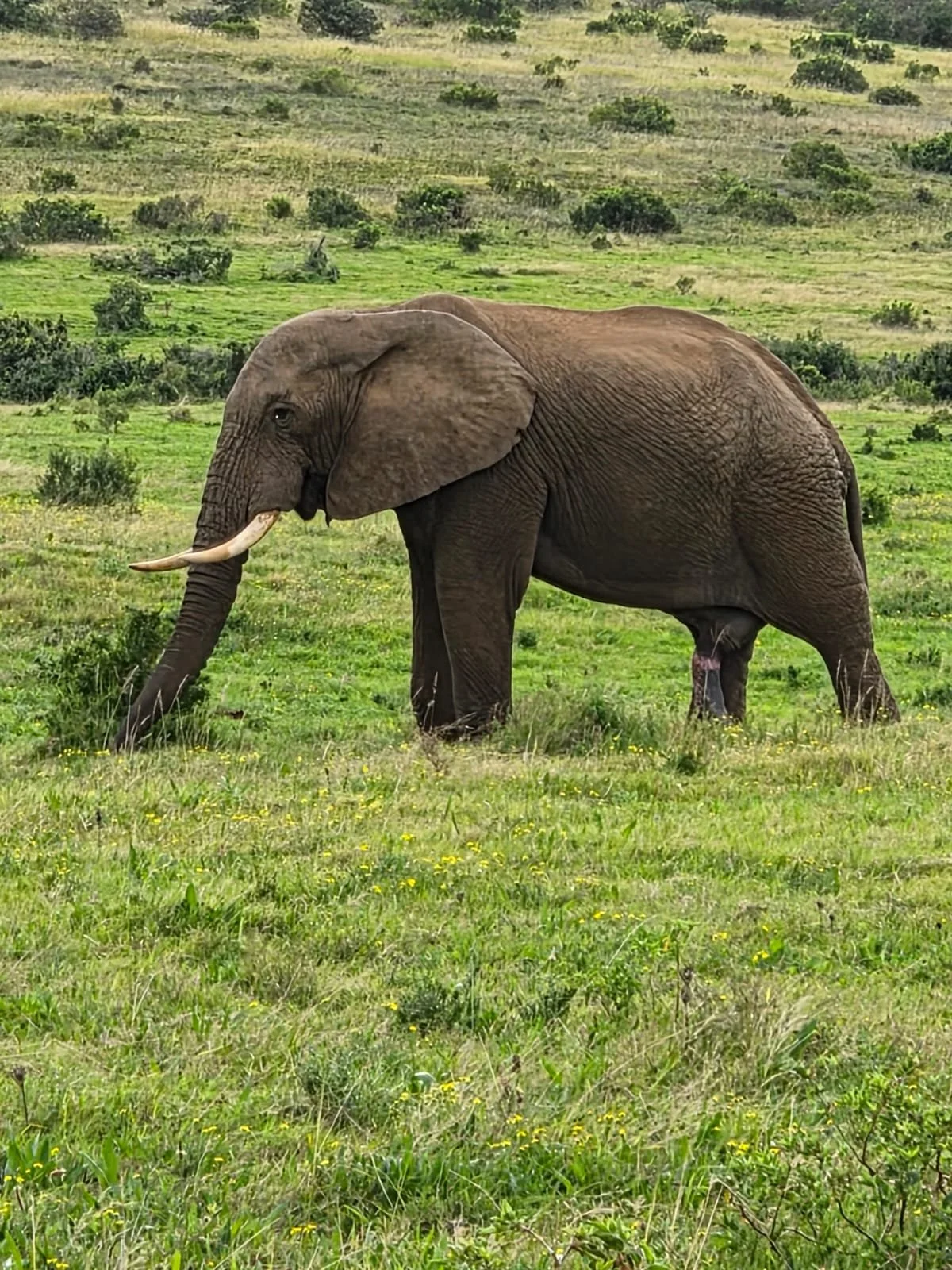
It took us about 30 minutes to drive to the park. I had not realised the diversity of wildlife in the park and once we had paid our fees we drove into the park without any safety briefing at all. We drove on a tarmac road to start with and then it became a dirt track. There was elephant dung everywhere and deep bush/scrub either side of the road. Our first sighting was of a troop of gibbons crossing the road with babies being carried on the mother’s backs. There were a number of large males and they were not interested in us. We continued and saw mongooses, vervet monkeys, ostriches, Zebra’s Kudu deer, Eland Deer and Redheertbeast deer, water buffalo. We also saw a lot of warthogs and of course elephants. We saw one bull on his own first which was huge and then herds in the distance and then we came across a large herd feeding by the road. We saw many different types of birds. They were all magnificent creatures and looked in good health which was good.
We spent about 3 hours driving around which is what we had time for and returned to the same gate we had been in. We had not seen lion but had seen quite a few other animals in those few hours.
We then drove Hisham to the airport and said our goodbyes. We will miss him and he is an interesting character. It is a shame that he decided due to his back that he should get off early.
We returned to Stormbird and had some lunch. I prepared Robin’s cabin for him and then I went through the engine room and all looked good and I topped up some oil in the engine which was needed. We rested a bit and tidied up.
At about 5.30pm we decided to go to the Nelson Mandela Yacht Club to wait for Robin. He had landed and would get a cab. Robin arrived and he was introduced to everybody and we sat down and had a meal together.
Once done we returned to Stormbird and Robin was introduced to her. He was shown his cabin etc and I then did the standard briefing with him. We then decided to have an early night. I had decided we would get up about 7.00am and have a good breakfast. I would then go through the boat with Robin inside and out and that we would leave about 9.00am. There was a patch of light wind I did not want to get caught in.
We will see what the dawn brings.
The picture of the day has to be a South African Elephant we saw in the park.
Need/Opportunity Year Three
I am now on the way to Durban and will then head for Cape Town and then on to St Helena, Azores and back to the UK.
I am now in need of 1 additional crew from Cape Town to the Azores. The new crew member would need to be onboard by 10 August and it is likely we would get to the Azores by late September or early October. If at all interested in joining me please contact me on my email below or WhatsApp +44 7931360372.
The blog will continue as we continue the journey. If you have any comments or suggestions about the blog then do email me on hine.nick9@gmail.com