Year 3 -8 May 2026 –Solomon Atoll -Chagos – part of BIOT (British Independent Overseas Territory).
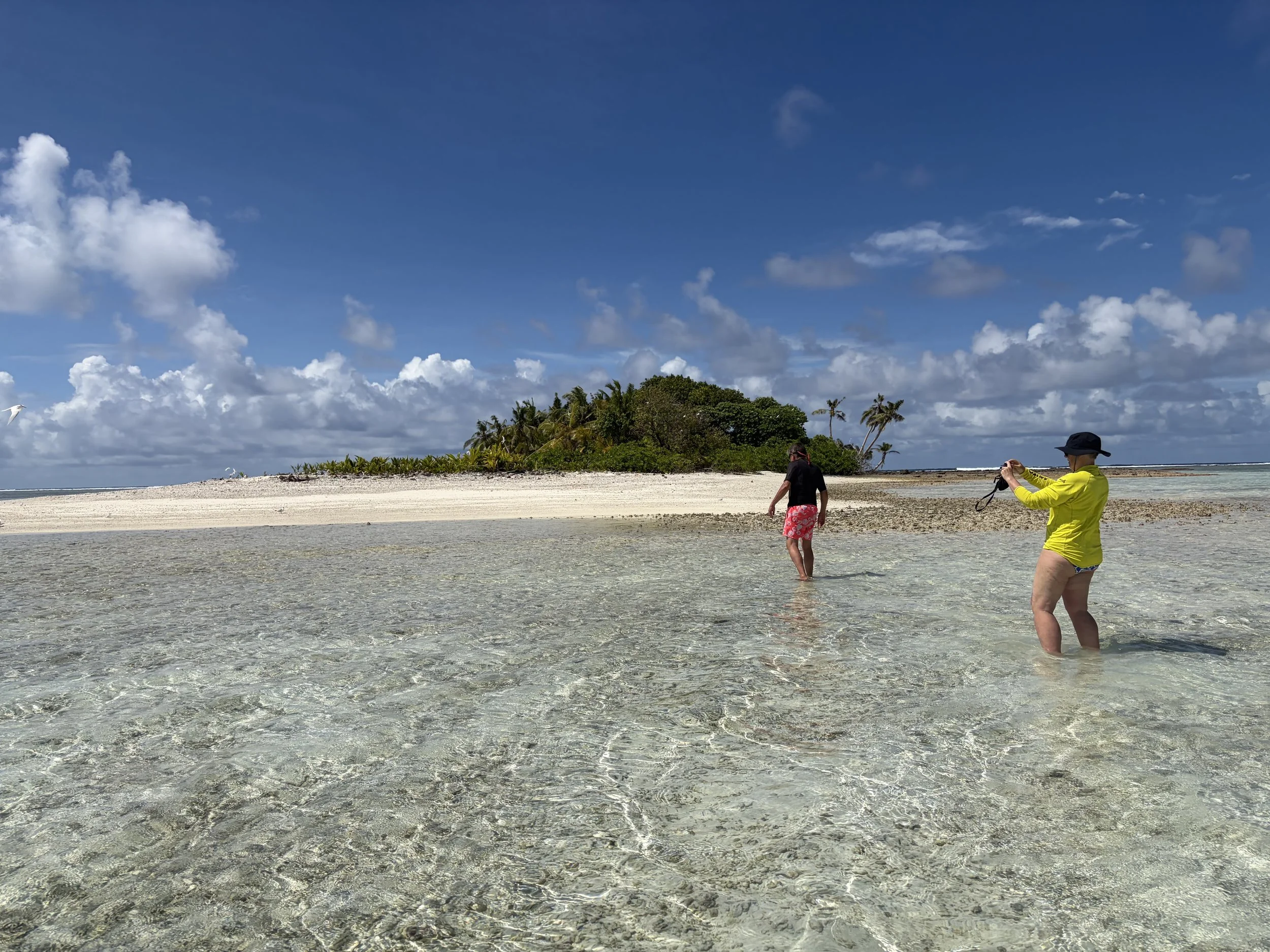
It was a much nicer day when we woke and it was sunny and cloudy. Keith made a cooked breakfast which we all enjoyed and after sorting ourselves out we decided to go toward a small island which has no name on the outside of the reef and which should have some good snorkelling around it.
We got into the dinghy and motored slowly toward the island and as we got closer we could see parts of the reef which we could meander through. This led us to the shelf on which the island sat and we anchored in about a foot of water on sand/old coral. We walked on to the island which had a sand bank on the North end and a large old coral flat stone ledge on the South side. The island was about 50m long and about 30m across and covered in trees and foliage. We were greeted by dozens of terns or those sort of birds squawking at us and they used the sand as a sort of runway parking spot. There were a number of red footed boobies and shearwaters in the trees just sitting perhaps nesting.
The red-footed booby (Sula sula – a number of which hitched a lift on Stormbird on the way over) is a large seabird of the booby family, Sulidae. Adults always have red feet, but the colour of the plumage varies. They are powerful and agile fliers, harnessing the wind to fly efficiently, but they are clumsy in take-offs and landings. They forage by catching flying fish from above the ocean's surface and by performing shallow dives. They are found widely in the tropics, and breed colonially in coastal regions, especially isolated islands such as St. Brandon, Mauritius (Cargados Carajos shoals), and the Chagos Archipelago. Although its population is declining, it is considered to be a least-concern species by the International Union for Conservation of Nature (IUCN). It faces threats from climate change, competition with fisheries, human disturbance, and invasive species. The red-footed booby is the smallest member of the booby and gannet family at about 70 cm (28 in) in length and with a wingspan of up to 152 cm (60 in). The average weight of 490 adults from Christmas Island was 837 g (1.845 lb). It has red legs, and its bill and throat pouch are coloured pink and blue. This species has several morphs. In the white morph the plumage is mostly white (the head often tinged yellowish) and the flight feathers are black. The black-tailed white morph is similar, but with a black tail, and can easily be confused with the Nazca and masked boobies. The brown morph is overall brown. The white-tailed brown morph is similar, but has a white belly, rump, and tail. The white-headed and white-tailed brown morph has a mostly white body, tail and head, and brown wings and back. The morphs commonly breed together, but in most regions one or two morphs predominates; for example, at the Galápagos Islands, most belong to the brown morph, though the white morph also occurs. The sexes are similar, and juveniles are brownish with darker wings, and pale pinkish legs, while chicks are covered in dense white down.
The red-footed booby is widespread throughout the tropics of the Atlantic, Pacific, and Indian Oceans. In the Atlantic, they mainly live in the Caribbean islands. In the Pacific, populations can be found in the Galapagos Islands, mostly on Genovesa and San Cristobal and in Hawaii, on Kauai. In the Indian Ocean, it is found on Aldabra, the Seychelles, Rodrigues, the Maldives, the Chagos Archipelago, the Cocos (Keeling) Islands, and Christmas Island.
This species breeds on islands in most tropical oceans. When not breeding it spends most of the time at sea. In the Chagos Archipelago, it remains close to its breeding colony throughout the year, rather than migrating. It nests in large colonies, laying one chalky blue egg in a stick nest, which is incubated by both adults for 44–46 days. The nest is usually placed in a tree or bush, but rarely it may nest on the ground. It may be three months before the young first fly, and five months before they make extensive flights.
Red-footed booby pairs may remain together over several seasons. They perform elaborate greeting rituals, including harsh squawks and the male's display of his blue throat, also including short dances.
The diet of red-footed boobies consists mostly of fish (such as Exocoetidae flying fish and Gempylidae escolars) and squid. Studies of the red-footed booby on Christmas Island have found that most fish eaten are 6–15 cm (2.4–5.9 in) long, with a maximum length of 20 cm (7.9 in), and most squid are 6–10 cm (2.4–3.9 in), with a maximum length of 15 cm (5.9 in). On Aldabra, the proportion of fish and squid in the diet varies between seasons; squid make up 21% of the diet by mass in the wet season and 1% in the dry season. They generally catch prey by diving into the ocean vertically from heights of 4 to 8 m (13 to 26 ft), although flying fish may be caught while in the air, as evidenced via bird-borne video footage. Red-footed boobies travel hundreds of kilometers from land when they are foraging for prey, and sometimes engage in multi-day trips.
Adult red-footed boobies are known to be hunted by coconut crabs; the crabs use their powerful claws to break the wings of boobies or catch them by their legs. One booby attacked while asleep on a low branch was killed by six coconut crabs over a period of several hours, while another caught after landing near the entrance to a crab burrow was dragged inside. Red-footed booby nestlings and eggs are also attacked by a variety of predators, including rats, cats, pigs, raptors, and Micronesian starlings, although introduced mammalian predators have a limited impact as the booby nests in trees However, the booby's habit of breeding on remote islands may be an adaptation to avoid predation; on the Galápagos Islands, the red-footed booby does not nest on any islands inhabited by the Galapagos hawk, even when they have suitable conditions, and has been observed colonizing islands soon after the hawk is extirpated on them. Humans eat both red-footed booby adults and nestlings; boobies will bite humans trying to catch them near their nest.
There was shallow water as we waded round and we saw lots of colourful crabs – just like the Sally Lightfoot crabs I has seen in the Galapagos scuttling away from us. Carolyn saw a small black tip shark and I saw a sort of sea snake or snake eel which scuttled under a rock.
Grapsus grapsus is one of the most common crabs along the western coast of the Americas. It is known as the red rock crab, or, along with other crabs such as Percnon gibbesi, as the Sally Lightfoot crab. Grapsus grapsus is found along the Pacific coast of Mexico, Central America, and South America (as far south as northern Peru), and on nearby islands, including the Galápagos Islands. It is also found along the Atlantic coast of South America.
Grapsus grapsus is a typically shaped crab, with five pairs of legs, the front two bearing small, blocky, symmetrical chelae (claws). The other legs are broad and flat, with only the tips touching the substrate. The crab's round, flat carapace is slightly longer than 8 centimetres (3.1 in). Young G. grapsus are black or dark brown in color and are camouflaged well on the black lava coasts of volcanic islands. Adults are quite variable in colour; some are muted brownish red, some mottled or spotted brown, pink, or yellow. This crab lives among the rocks at the often turbulent, windy shore, just above the limit of the sea spray. It feeds on algae primarily, sometimes sampling other plant matter, sponges, molluscs (such as clams), crustaceans (including other crabs), fish, young sea turtles, bird eggs and droppings, bat guano and dead animals (mainly seals and birds). As larvae, they feed on phytoplankton. They have been known to resort to cannibalism when populations densities are high or food is scarce. It is an agile crab, capable of leaping, and consequently hard to catch. Not considered very edible by humans, it is used as bait by fishermen. It is preyed upon by the chain moray eel, Echidna catenata, as well as by octopuses.
We continued our walk and saw some small fish and the boobies and shearwaters were quite inquisitive and came to see us. We walked all the way round and then we decided to snorkel off the shelf as there were some bommies and patches of coral nearby. I went toward the large bommie which was like its own ecosystem and had large and a wide variety of fan shaped corals as I swam round. The colours were lovely and the sun shone through the water to enhance their colours -yellows, green, creams and browns. There were other colourful corals as well with all sorts of fish swimming around the coral and under them and through them. There was a wide variety of fish and some quite large shoals here and it seemed as if it was in its own world.
The other had gone right and I had gone left so I went back to the dinghy and then right. This area was a coral bank as it swept down the reef and the shelf the dinghy and island was on. There was lots of healthy coral of a similar variety and many fish – some a lovely purple/blue colour and shoals of thousands of little fish -so thick you could not see through them. It was a remarkable snorkel. Joyce said she saw a load of sea snakes and Erika and Keith rays that bury themselves in the sand. It was a lovely morning spent in a remote and beautiful environment.
We returned to Stormbird for some lunch and then a rest. I had heard from another crew member who was supposed to be doing the Mauritius to Cape Town leg that he was going to have to have an operation. I am therefore potentially 3 short now so I am making urgent attempts to find more crew. If you can help please contact me.
After lunch we rested and I had to do some more forms for Mauritius. We then decided to go to another larger island in the atoll called Isle D’Anglaise. We had been told they had larger fish there. We headed off in the dinghy dodging bommies as we went. We eventually came to a shallow area where we could anchor with coral patches around us and it would be quite difficult to go all the way to the island.
We got out and snorkelled around us and there were a lot of large fish around skirting and going in between various coral patches. The coral was different and low level here but still healthy and vibrant and supporting all of the reef fish.
I was snorkelling along when suddenly a moray eel came out from the coral and I thought he was going to go for me. I am not sure who was more surprised – the eel or me but I swam off quickly and he came out of another part of the coral to look at me. A close escape I think.
Moray eels, or Muraenidae, are a family of eels whose members are found worldwide. There are approximately 200 species in 16 genera which are almost exclusively marine, but several species are regularly seen in brackish water, and a few are found in fresh water.
The English name, moray, dates back to the early 17th century, and is believed to be a derivative from Portuguese moreia, which itself derives from Latin mūrēna, in turn from Greek μύραινα, muraina; these are the Latin and Greek names of the Mediterranean moray.
The dorsal fin extends from just behind the head along the back and joins seamlessly with the caudal and anal fins. Most species lack pectoral and pelvic fins, contributing to their elongated appearance. Their eyes are relatively small; morays rely mostly on their highly developed sense of smell, while remaining concealed to ambush prey.
The body is generally patterned. In some species, the interior of the mouth is patterned as well. Their jaws are wide, framing a protruding snout. Most possess large teeth suited for tearing flesh or grasping slippery prey. A smaller number of species, for example the snowflake moray and zebra moray, primarily feed on crustaceans and other hard-shelled animals, and they have blunt, molar-like teeth suitable for crushing.
Morays secrete a protective mucus over their smooth, scaleless skin, which in some species contains a toxin. They have much thicker skin and high densities of goblet cells in the epidermis that allows mucus to be produced at a higher rate than in other eel species. This allows sand granules to adhere to the sides of their burrows in sand-dwelling morays, thus making the walls of the burrow more permanent due to the glycosylation of mucins in mucus. Placement of their small, circular gills on their flanks, far behind the mouth, requires the moray to maintain a gape / gulping motion to facilitate respiration
The pharyngeal jaws of morays are located farther back in the head and closely resemble the oral jaws (complete with tiny "teeth"). When feeding, morays launch these jaws into the mouth cavity, where they grasp prey and transport it into the throat. Moray eels are the only known animals that use pharyngeal jaws to actively capture and restrain prey in this way.
In addition to the presence of pharyngeal jaws, morays' mouth openings extend far back into the head, compared to fish which feed using suction. In the action of lunging at prey and biting down, water flows out the posterior side of the mouth opening, reducing waves in front of the eel which would otherwise displace prey. Thus, aggressive predation is still possible even with reduced bite times. In at least one species, the California moray, teeth in the roof of the mouth are able to fold down as prey slides backwards, thus preventing the teeth from breaking and maintaining a hold on prey as it is transported to the throat.
Differing shapes of the jaw and teeth reflect the respective diets of different species of moray eel. Evolving separately multiple times within the Muraenidae family, short, rounded jaws and molar-like teeth allow durophagous eels (e.g. zebra moray and genus Echidna) to consume crustaceans, while other piscivorous genera of Muraenidae have pointed jaws and longer teeth. These morphological patterns carry over to teeth positioned on the pharyngeal jaw.
Morays are opportunistic, carnivorous predators, and feed primarily on smaller fish, crabs and octopuses. A spotted moray eel has been observed eating a red lionfish without harm. Groupers, barracudas and sea snakes are among their few known predators, making many morays (especially the larger species) apex predators in their ecosystems.
Reef-associated roving coral groupers (Plectropomus pessuliferus) have been observed recruiting giant morays to help them hunt. The invitation to hunt is initiated by headshaking. This style of hunting may allow morays to flush prey from niches not accessible to groupers.
The moray eel can be found in both fresh and saltwater habitats. The vast majority of species are strictly marine, never entering freshwater.
Due to their nocturnal activity and the often-inaccessible environments in which reproduction occurs, direct observations of moray eel courtship and spawning behaviour are rare. Consequently, their reproductive mechanisms remain one of the least documented aspects of their biology.
We continued snorkelling until the light began to fade and we could see rain clouds approaching. We went back to Stormbird and dried off. I needed to change the oil and the filter for the generator. I was able to pump the oil out easily and I needed a filter remover to unscrew it. This came off easily and I then put the new filter in and all looked fine. I refilled with oil and started it. It did not seem to want to stay on. I returned to the engine room and found that the seal on the filter was half out and the new oil had splurted under the generator. Ahhh. I removed the filter and the seal was faulty so I put in another and topped up with oil and it ran fine with no leaks. I then had to clear up all the oil which had come out which was a messy and hot job. Once done I ran the generator for an hour and all was fine. I will check in the morning and put all the casings back. I need to change the oil and filter every 100 hours.
By this time it was almost dark and we had a drink and then Keith made chicken with the aloo gobbi curry which had been prepared the night before. It had been a good day in Chagos.
The picture of the day is the island we went to explore.
Need/Opportunity Year Three
I will be going shortly from India to the Maldives and then on to Mauritius, Reunion, Cape Town, St Helena, Azores and back to the UK.
I am currently in need of potentially 2 crew from Mauritius to Cape Town from about 10 June 2026 and we should arrive in Cape Town on about 25-30 July 2026. If at all interested contact me on my email below or WhatsApp +44 7931360372.
The blog will continue as we continue the journey. If you have any comments or suggestions about the blog then do email me on hine.nick9@gmail.com