Year 3 -7 May 2026 –Solomon Atoll -Chagos – part of BIOT (British Independent Overseas Territory).
The rain seemed to stop in the night and we woke to a dry morning so all the washing went out to dry. We had a fruit breakfast as our pineapples were on their last legs!
I had to get in the dinghy and bail it out again and I then got the pump out and all tubes needed a bit of air. As we were thinking of going ashore we got ready. Then a rainstorm came in and we had to wait for this to clear. Once it had cleared we got in the dinghy and headed ashore.
There were a number of bommies on the way which we dodged and then we came up to an old stone pier which was crumbling and covered in bush and had a stone pole at the end. We clambered ashore and walked along the pier and picked our way through foliage. We also saw a number of hermit crabs who were carrying their shells with them. As we came through the end of the pier we saw an old stone building on the left covered with trees and then on the right was a stone cross and a book of remembrance in stone for those who lived here.
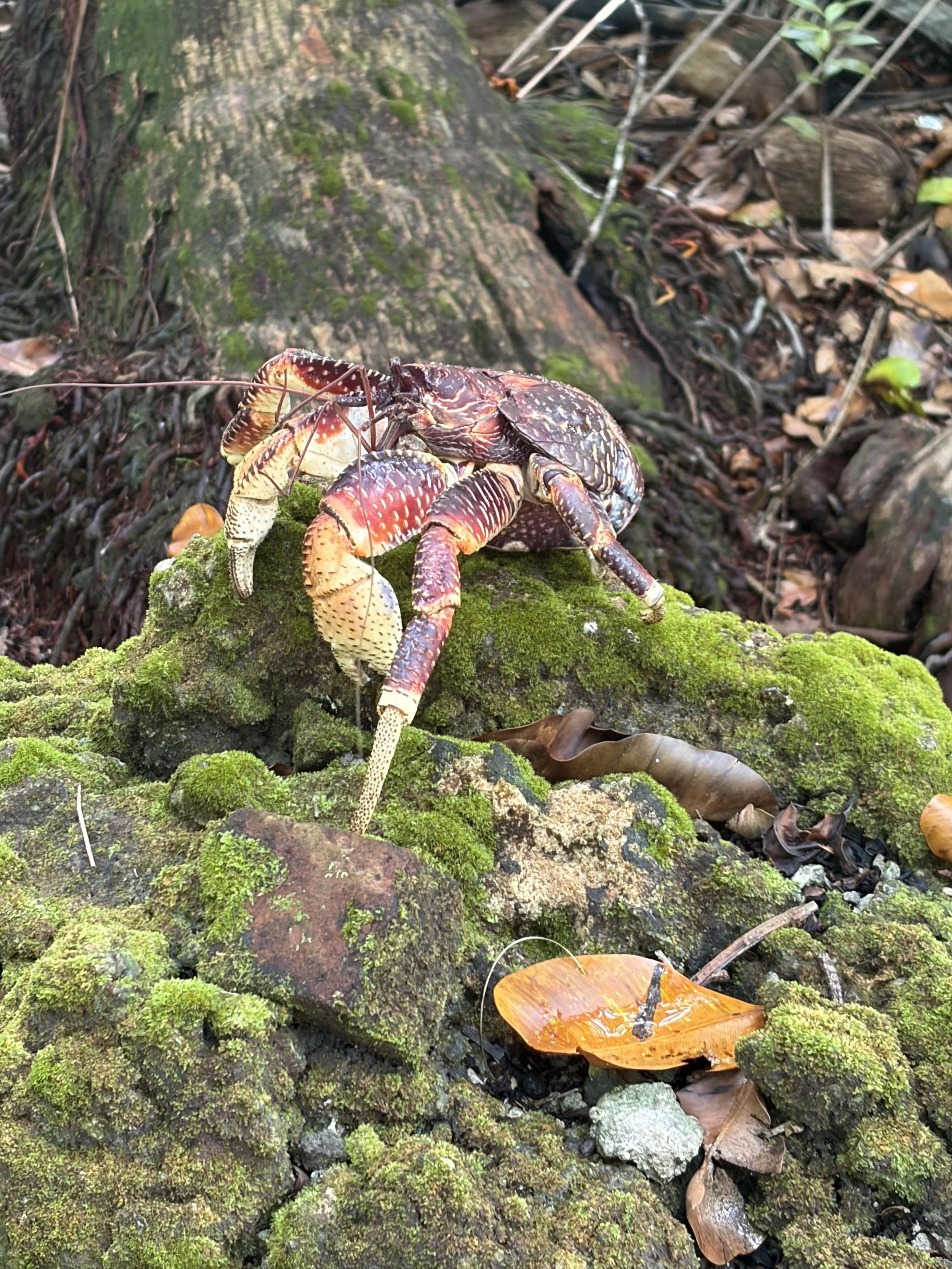
We knew there was a track to follow and someone had put ribbons round trees to guide the way. We therefore walked on and suddenly I saw a coconut crab. It had large claws and was red and yellow. In fact we saw several as we were walking through the jungle. There were also small crabs of a normal size which stuck their claws up threaten you.
The coconut crab is a terrestrial species of giant hermit crab, and is also known as the robber crab or palm thief. It is the largest living terrestrial arthropod, with a weight up to 4.1 kg (9 lb). The distance from the tip of one leg to the tip of another can be as wide as 1 m (3 ft 3 in). It is found on islands across the Indian and Pacific Oceans, as far east as the Gambier Islands, Pitcairn Islands, and Caroline Island, and as far west as Zanzibar. While its range broadly shadows the distribution of the coconut palm, the coconut crab has been extirpated from most areas with a significant human population such as mainland Australia and Madagascar.
The coconut crab shows a number of adaptations to life on land. Juvenile coconut crabs use empty gastropod shells for protection like other hermit crabs, but the adults develop a tough exoskeleton on their abdomens and stop carrying a shell. Coconut crabs have organs known as branchiostegal lungs, which they use for breathing instead of their vestigial gills. After the juvenile stage, they will drown if immersed in water for too long. They have an acute sense of smell, which they use to find potential food sources, and which has developed convergently with that of insects.
Adult coconut crabs feed primarily on fleshy fruits, nuts, seeds, and the pith of fallen trees, but they eat carrion and other organic matter opportunistically. Anything left unattended on the ground is a potential source of food, which they will investigate and may carry away – thereby getting the alternative name of "robber crab". Despite its name, coconuts are not a significant part of the crab's diet. Although it lives in a burrow, the crab has been filmed climbing coconut and pandanus trees. The crab has never been filmed selectively picking coconut fruit, though they might dislodge ripe fruit that otherwise would fall naturally. When a crab is not near its burrow, climbing is an immediate escape route from predators. Sea birds eat young crabs, and both humans and larger, older crabs eat crabs of all ages.
Mating occurs on dry land, but the females return to the edge of the sea to release their fertilized eggs, and then retreat up the beach. The larvae that hatch are planktonic for 3–4 weeks, before settling to the sea floor, entering a gastropod shell and returning to dry land. Sexual maturity is reached after about 5 years, and the total lifespan may be over 60 years. In the 3–4 weeks that the larvae remain at sea, their chances of reaching another suitable location are enhanced if a floating life-support system avails itself to them. Examples of the systems that provide such opportunities include floating logs and rafts of marine or terrestrial vegetation. Similarly, floating coconuts can be a very significant part of the crab's dispersal options. Fossils of this crab date back to the Miocene.
The coconut crab has been known to western scientists since the voyages of Francis Drake around 1580 and William Dampier around 1688.
The body of the coconut crab, like those of all decapods, is divided into a front section (cephalothorax) with 10 legs, and an abdomen. The front-most pair of legs has large chelae (claws), with the left being larger than the right. The next two pairs of legs, as with other hermit crabs, are large, powerful, walking legs with pointed tips that allow coconut crabs to climb vertical or even overhanging surfaces. The fourth pair of legs is smaller, with tweezer-like chelae at the end allowing young coconut crabs to grip the inside of the shell or coconut husks that juveniles habitually carry for protection. Adults use this pair for walking and climbing. The last pair of legs is very small and is used by females to tend their eggs and by the males in mating. This last pair of legs is usually held in the cavity containing the breathing organs, inside the carapace. Some difference in colour occurs between individuals found on different islands, ranging from orange-red to purplish blue. In most regions, blue is the predominant colour, but in some places such as the Seychelles, most individuals are red. In Chagos they are red and yellow.
The hardened abdomen protects the coconut crab and reduces water loss on land, but must be periodically moulted. Adults moult annually, digging a burrow up to 1 m (3 ft 3 in) long in which to hide while their soft shell hardens. Depending on the size of the individual, 1–3 weeks are needed for the exoskeleton to harden. The animals remain in this burrow for 3–16 weeks, again depending on size.
The female lays her eggs shortly after mating, and glues them to the underside of her abdomen, carrying the fertilised eggs underneath her body for a few months. At the time of hatching, the female coconut crab migrates to the seashore and releases the larvae into the ocean. The coconut crab takes a large risk while laying the eggs, because it cannot swim. If a coconut crab falls into the water or is swept away, its weight makes swimming back to dry land difficult or impossible. The egg-laying usually takes place on rocky shores at dusk, especially when this coincides with high tide. The empty egg cases remain on the female's body after the larvae have been released, and the female eats them within a few days.
Upon reaching the glaucothoe stage of development, they settle to the bottom, find and wear a suitably sized gastropod shell, and migrate to the shoreline with other terrestrial hermit crabs. At that time, they sometimes visit dry land. Afterwards, they leave the ocean permanently and lose the ability to breathe in water. As with all hermit crabs, they change their shells as they grow. Young coconut crabs that cannot find a seashell of the right size often use broken coconut pieces. When they outgrow their shells, they develop a hardened abdomen. The coconut crab reaches sexual maturity around 5 years after hatching. They reach their maximum size only after 40–60 years. They grow remarkably slowly, and may take up to 120 years to reach full size.
Coconut crabs live in the Indian and the central Pacific Ocean, with a distribution that closely matches that of the coconut palm. The western limit of the range of B. latro is Zanzibar, off the coast of Tanzania, while the tropics of Cancer and Capricorn mark the northern and southern limits, respectively, with very few populations in the subtropics, such as the Ryukyu Islands.
Christmas Island in the Indian Ocean has the largest and densest population of coconut crabs in the world, although it is outnumbered there by more than 50 times by the Christmas Island red crab (Gecarcoidea natalis). Other Indian Ocean populations exist on the Seychelles, including Aldabra and Cosmoledo, but the coconut crab is extinct on the central islands. They occur on several of the Andaman and Nicobar Islands in the Bay of Bengal. They occur on most of the islands, and the northern atolls, of the Chagos Archipelago
The coconut crab can take a coconut from the ground and cut it to a husk nut, take it with its claw, climb up a tree 10 m (33 ft) high and drop the husk nut, to access the coconut flesh inside. They often descend from the trees by falling, and can survive a fall of at least 4.5 m (15 ft) unhurt. Coconut crabs cut holes into coconuts with their strong claws and eat the contents, although several days may be needed before the coconut is opened.
Adult coconut crabs have no known predators apart from other coconut crabs and humans. Their large size and the quality of their meat means that they are extensively hunted and are very rare on islands with a human population. The coconut crab is eaten as a delicacy – and regarded as an aphrodisiac – on various islands, and intensive hunting has threatened the species' survival in some areas.
The track meandered through the jungle and after about 10 minutes we came to a walled cemetery which was full of graves. A number of them had collapsed but they were clearly evident and on one grave I found a date of 1882. There was quite a community here at one point until the British removed them between 1967-1976. It was quite sobering to see this.
We retraced our steps back to the pier and went the other side where there was a large building with no roof on it and this became a type of yacht club for visiting yachtsman.
Once we had finished looking around we retraced our steps back to the beach and pier and then got back in the dinghy and returned to Stormbird. I suggested we got out to the reef for a snorkel on the coral. We therefore changed and got in the dinghy and went South to the reef in front of us. We skirted round the coral and found a sandy patch to anchor in.
We got out and there was a lot of coral mostly of the large cauliflower shaped fans with colours of green, yellow, browns and then we came across some blue coral and purple coloured. There was an abundance of fish -some quite large swimming around in shoals and angel fish with their yellow and blue distinctive markings. It was a great snorkel and the coral was healthy and clear. It was a lovely thing to do and what a treat to do this in such a remote place which has been left to itself for years.
We returned to Stormbird for some tea and then this went into lunch.
I had heard from the Mauritius agent and that I had to complete about 15 documents for entry into Mauritius. This was an onerous task and each document had to be stamped and signed electronically and then converted into PDF. Some were very difficult to edit and the whole process took me about 3 hours and I hope I have done as much as I could. The others rested and swam and read.
Keith wanted to go for another snorkel and we took the dinghy North this time past the other boats and to the reef this side. The coral was of a different type and more spiky and broccoli shaped. There were lots of fish as well of all sorts of sizes and colours. It was great to see such healthy reefs.
We returned to Stormbird and dried off and then we had a sundowner. The sun was not out but it was dry and rather grey but beautiful in its rawness.
Carolyn converted the remains of a spag bol into a sort of chilli with cauliflower and made the base of a potato curry for the following evening.
We therefore had a nice meal in the cockpit tent with our solar lights like candles.
It had been a good and interesting day and we hope to explore further tomorrow.
The picture of the day is a coconut crab we came across on Boddam Island.
Need/Opportunity Year Three
I will be going shortly from India to the Maldives and then on to Mauritius, Reunion, Cape Town, St Helena, Azores and back to the UK.
I am currently in need of potentially 2 crew from Mauritius to Cape Town from about 10 June 2026 and we should arrive in Cape Town on about 25-30 July 2026. If at all interested contact me on my email below or WhatsApp +44 7931360372.
The blog will continue as we continue the journey. If you have any comments or suggestions about the blog then do email me on hine.nick9@gmail.com