Year 3 -31 August 2026 -St Helena
It was a grey rainy day when we woke – just typical of a Bank Holiday Monday which it was here as well as in the UK. We had a cooked breakfast and then headed ashore about 9.30am as we were meeting Derek Richards- a Saint (that’s what they call themselves here) – who runs his own business of Island Images which provides tours, accommodation and catering on the Island. He was introduced to us by Chris Boock, the rigger in Cape Town.
We wandered along the wharf and they were taking down the marquees from the Scout event from yesterday. We met Derek and said hello and he said nothing is open today but he will drive us round the Island and he had invited us for some lunch/supper later.
The island has around 73 to 80 miles of roads but generally a drive around takes about 45-60 minutes. We set off from Jamestown going up the aptly named Main Street and out of the town going North. The roads are steep and windy and go up and down a lot over various passes. He drove us round to Ruperts Bay where the Port Authority and Customs are based and explained that when they built the airport in 2017 that they had to build a new road to take all the materials to where the airport is now. There is also a fuel dock for the whole island and for jet fuel should planes need it. There is a weekly flight from Johannesburg which refuels in Namibia and goes on to Ascension Island as well as St Helena. The flights are often not able to land due to fog and cloud and wind sheer issues. In fact the plane had not been able to land for the last 2 days.
The road passed through unusual rock formations and undulating ridges of different hues of brown. The island has its own type of Fynbos (like South Africa). Derek explained that a lot of the trees and plants were brought here over the years from ships which used St Helena as a stopover on the trade routes. It seemed to me things grow quite well here although the conditions can be quite harsh. The shrubs are green and yellow and in places there were clusters of trees and woodland -some like ancient woodland with lichens on the trunks, found in the Canaries. The airport appeared out of the mist and had a stone terminal with two cannons outside and looked modern. The runway which we saw sticks out over the sea and is 1.5km long, meaning reasonable size jets stop there.
Saint Helena Airport is an international airport on Saint Helena, a remote island in the south Atlantic Ocean, in the British Overseas Territory of Saint Helena, Ascension, and Tristan da Cunha.
The construction of the runway was finished in 2015 and the airport opened in 2016. The inaugural scheduled flight was delayed, but general aviation, charter, and medical evacuation flights were able to serve the airport from May 2016.
The airport began scheduled commercial services on 14 October 2017, when the South African carrier Airlink inaugurated a weekly service from O. R. Tambo International Airport in Johannesburg, South Africa, via Walvis Bay Airport, Namibia, using an Embraer E190-100IGW, about one and a half years after the originally expected inauguration date. The service was flown with a smaller-sized aircraft because of wind shear problems affecting the airport. Additionally, monthly charter flights operate between Ascension Island and Saint Helena.
Prior to the opening of the airport, the island was only reachable by sea, making it one of the most remote populated places on earth, measured as travel time from major cities. Sea journeys used to take five days from Cape Town, with departures once every three weeks.
The first consideration of an airport on Saint Helena was made in 1943 by the South African Air Force, which undertook a survey on Prosperous Bay Plain from October 1943 until January 1944. They concluded that, while technically feasible, an airport was not a practical proposition.
It was suggested that an airport would extend the United Kingdom's capabilities to carry out airborne missions in the South Atlantic region, such as maritime patrols in accordance with international fishing agreements (e.g., International Commission for the Conservation of Atlantic Tunas), counter-piracy missions along important trade routes, and also airlift operations notably into Southern Africa.
According to analysts, the UK government's decision to finally go ahead with the airport, after long delays, seemed to be driven in part by concerns over a continuing tense standoff with Argentina over the Falkland Islands sovereignty dispute. The island is about 3,812 miles (6,135 km) from the Falklands – seven hours and 40 minutes' flight time. But analysts say that was nevertheless an improvement over the previous state of isolation from the UK for both St Helena and the Falklands. The airport was officially opened by Prince Edward, Duke of Edinburgh on 26 January 2024.
After the airport we drove to Longwood House -which was closed and where Napoleon was imprisoned.
Longwood House is a mansion on the British overseas territory island of St. Helena. It was the final residence of Napoleon Bonaparte, the former Emperor of the French, during his exile on the island of Saint Helena, from 10 December 1815 until his death on 5 May 1821. Originally an East India Company farm, it was later acquired by the Government of France and now operates as a museum. Longwood "was originally a farm belonging to the East India Company and was afterwards given as a country residence to the Deputy-Governor. It was converted for the use of Napoleon in 1815. The British government eventually recognized its inadequacy as a home for the former emperor and his entourage and, by the time of his death, had built a new house for him nearby, which he never occupied. In February 1818, Governor Sir Hudson Lowe proposed to Lord Bathurst to move Napoleon to Rosemary Hall, a house that became available and was located in a more hospitable part of the island, sheltered from the winds and shaded, as Napoleon had preferred. But the revelations of General Gourgaud in London brought Lord Bathurst to the opinion that it was safer to keep Napoleon at Longwood, where an escape was harder to undertake. The building of the new house only began in October 1818, three years after Napoleon's arrival on the island. The will written by Napoleon in 1821 at Longwood House is preserved in French National Archives.
We shall have to go back to Longwood House when it is open.
We travelled on round the island and there were lots of houses scattered about. There was some sheep, goats and cattle but very little agriculture. We passed through a number of valleys and passes. The whole island looked clean- there was no litter anywhere and people seemed to respect its beauty and want to maintain it. A lesson we need to learn in the UK. The roads were well maintained and the road signs clean and up to date.
The Wire bird is St Helena’s symbol and it is endemic.
The Saint Helena plover, locally known as the wire bird due to its thin legs, is a small wader endemic to the island of Saint Helena in the mid-Atlantic. The bird is similar in appearance to Kittlitz's plover and the Madagascar plover, but a little larger and an absence of chamois colouring. It is the national bird of St Helena and has been depicted on the country's coins. Populations in general have been declining. Threats include predation by cats, the introduction of the common myna, deforestation, off-road vehicle use, the Saint Helena Airport and a projected windfarm. As of 2021, the population had recovered to about 545 mature individuals, from a previous minimum of less than 200 in 2006; consequently, the species was downlisted to Vulnerable from its previous assessment of Critically Endangered.
The bird was first mentioned in 1638, and is the national bird of Saint Helena, featured on the island's coat of arms and flag. Some older local 5 pence coins (those issued prior to 1998) have the wire bird on the reverse.
This plover is resident all year on the open areas of Saint Helena, and it is thought that the widespread deforestation on the island, while generally harmful for the island's ecosystem, has in fact benefitted this particular species, since it lives in open clearings in the forest.
As we drove on our tour we saw a number of these birds. After the drive we went to Derek’s House which overlooked a large valley with a spectacular view of the sea behind. He had an amazing garden full of different plants and some water features including a pond with carp. There was also some interesting topiary with a bush which looked like a ballerina with tutu, various hearts and blow me the Arsenal word made out of a bush! This gave a clue really as to what team he supports!
We had a drink and marvelled at the view. We met his wife Linda who had kindly been helping with our provisioning. Mark liaised with her about this.
After chatting and exploring the garden we agreed to go back to Jamestown and to take what provisions we had to Stormbird and to collect our mountain of washing which Linda kindly agreed to do.
We set off in the car and came down the road which is at the top of Jacobs ladder and it overlooked Jamestown nettled in the gulley between two mountains. We got the ferry service which they provide to take you to and from your boat as there is no place safely to leave your dinghy. We took the provisions back grabbed our washing and returned up the steep road to Derek’s house.
Linda had prepared a late lunch of Chicken and vegetable casserole and a tuna bake which was delicious. This was followed by chocolate brownies and what she called sparklies which was a coconut desert and was purple.
Derek got out his whisky collection which he was partial to and so some of us had to try them as he could not drink alone!
We had a great time and it was fun to learn more about the island and island life. For example there were 66 deaths last year and only 6 births. The population is declining.
We returned to Stormbird having seen and learnt a lot about the island. We later had cheese and biscuits and then watched one of my favourite Clint Eastwood films Thunderbolt and Lightfoot.
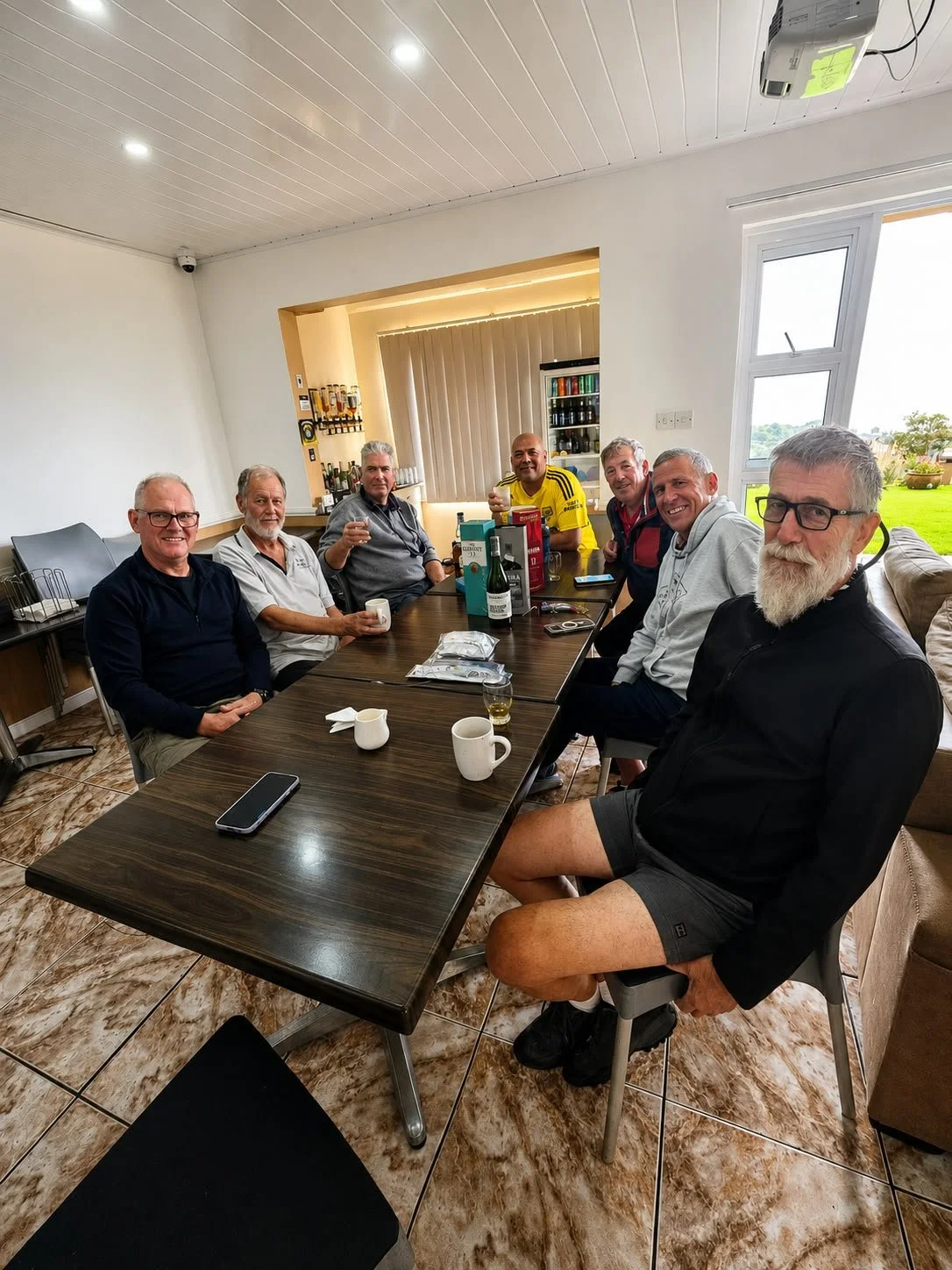
The picture of the day is of all of us at Derek’s house with Derek.
Need/Opportunity Year Three
I am now on the way to St Helena, Cape Verde, Azores and back to the UK.
The blog will continue as we continue the journey. If you have any comments or suggestions about the blog then do email me on hine.nick9@gmail.com