Year 3 -30 August 2026 -Day 11 Cape Town-St Helena
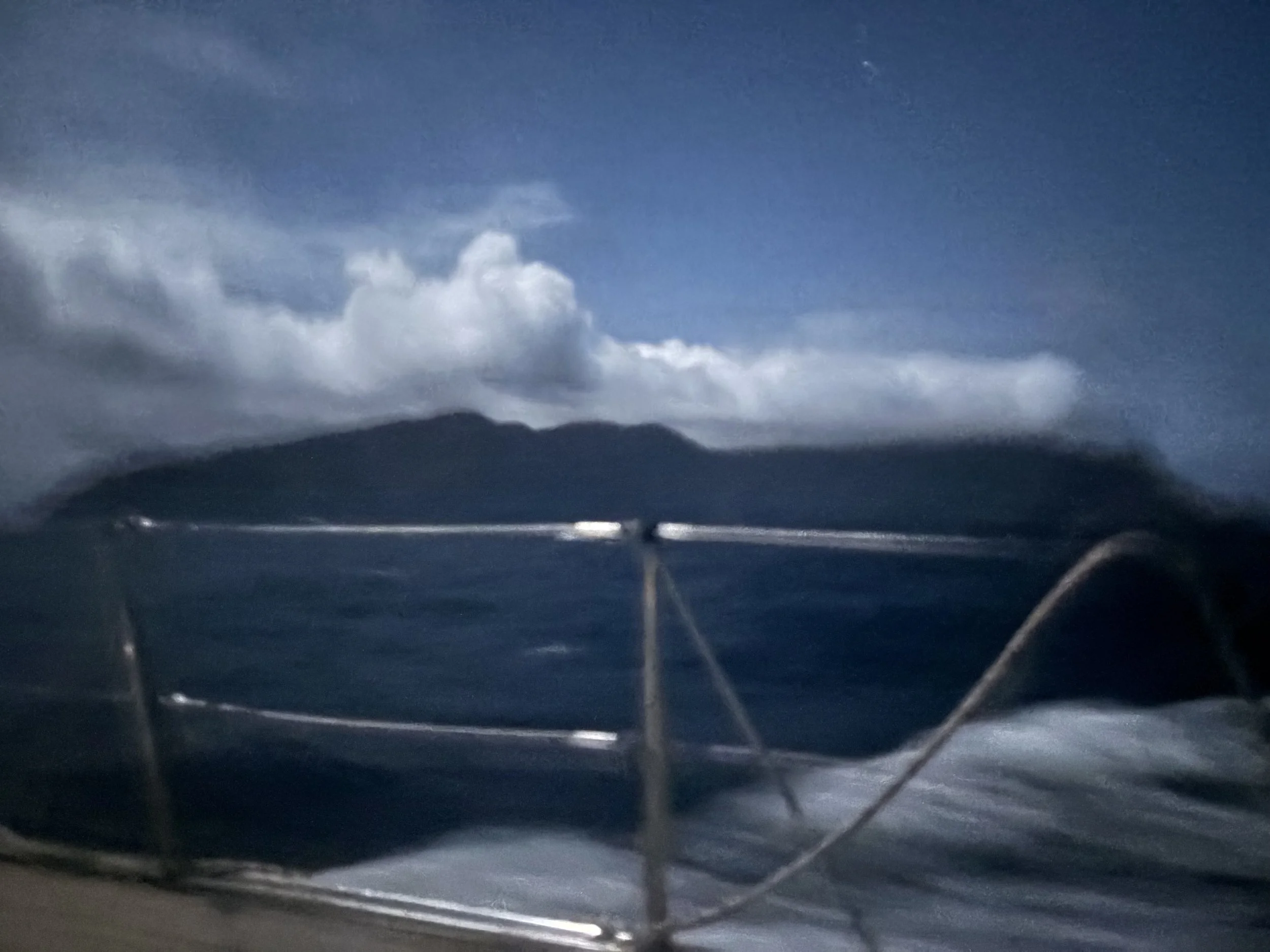
During the night I heard the guys gybing and due to the wind angle it was better to gybe back to the Southwest of the island again rather then the North. Julian and I were on again at 2.00am and found us sailing toward a waypoint Southwest of the island. We were only about 3 miles from the waypoint. I could clearly see St Helena with its high cliffs looking austere and dark. It was covered in cloud and looked like land you see in a ghost or horror film.
We continued and sailed past the waypoint for a mile and then we brought in the main and put it away and then gybed with just the genoa so we could sail round the Southwest corner and then up the West side of the island. The wind was howling 24-29 kts and you could hear it whistling in the rigging. The waves were 3-4 m and also growling as the top of the wave curled on itself with a roar and trying to target Stormbird’s stern. These waves seemed to tower up behind us as if trying to get into the cockpit. However, Stormbird was too clever and experienced for this and would slide away from their grasp.
John stayed up with us as he was too excited to go to bed. We curved around the Southwest corner and then up the West side doing 7-8 kts and we could see the high cliffs on our right. There were a few growlers which hit our side and sprayed me in the cockpit – refreshing really.
I called St Helena radio and to my surprise they answered and I explained our arrival and our intention to go to the anchorage given to us. I also explained about the crew member who needed medical attention to remove the staples from his head. They authorised us to proceed to our anchorage and said they would let Port Control know. They tried to say something which I could not understand. I suggested I call them back when 1nm from the anchorage.
As we came round the West side the wind began to decrease as the cliffs began to shelter us from the Southeast wind. The swell also gradually began to decline. When the wind reduced enough we brought in the genoa and motored forward some 8nm toward our anchorage. I could see ahead a couple of small boats ahead just floating around. I presumed they were fishing boats. I could see a load of lights ashore and a flashing green light on a breakwater.
I called up St Helena radio again and they agreed we could go to the anchorage and to call the ferry which started at 4.00am so our casualty could be taken to the medical centre. This seemed a bit early.
We approached the old mooring field and this was a possibility to anchor but it looked dark and unwelcome. We carried on to the second anchorage point and I saw two other yachts at anchor with their anchor lights on. Talk about good timing but it started to rain and so we manoeuvred round and found a good spot in 17 m of water and I asked for the anchor to be dropped. Mark was up front with John and Dave. We dropped some 70m and the wind was howling as it went down and the rain was christening us as we did so. We floated down wind and waited for the anchor to hold and then we began to stop and swung round to the wind and the anchor had bitten. We went into slow tick over astern to bed the anchor in, then 1,000 revs and then 1,500 revs and we held well. That means we will hold in a Force 8. The snubber was put on and the anchor ball. We had arrived and anchored at 4.16 am in St Helana.
We had travelled 1,846nm since Cape Town. It had taken us 10 days, 16 hours and 16 minutes which makes an average of about 7.2 kts for the whole trio which is not bad bearing in mind the conditions.
We were tired, wet and happy to be here. It was not a time to have to celebratory beer so we all went to bed and will see what tomorrow holds. We could see the lights of Jamestown and in particular we could see Jacob’s ladder lit up. (more about this later) like a lit staircase going up the hill. We did not want to have to take John ashore now and so we decided to sleep first.
I slept well and deeply but was woken by the light and it was about 7.30am. I peered out of the cockpit and saw the island in front of me with two large cliffs and Jamestown nestled in between with the spire of the church. We were here- you have to pinch yourself- yes we had done it.
The little ferry man came and said Port Control asked to pick us up at 8.00am. I explained that we need some breakfast and to come back at 8.30am. I asked Paul to get on with the breakfast and he cooked bacon and eggs and Dave made toast. We had a great, cooked breakfast (bacon and egg) which was the best start to the day.
We caught the ferry at 8.30am when it returned. It was a small boat driven by Fry and he took us round to Ruperts Bay. We walked along a large concrete wharf with the cliffs staring down at us. There was some cranes hanging around and a lot of commercial equipment. We walked to a new building called Seafront House where Port Control was located. They were very welcoming and said they got my emails but could not download the attachments. I therefore had to fill in the forms again!. We then went to Customs and Immigration and did the necessary. We had worried about checking in but they were all open on a Sunday which was great and the formalities were done.
We walked back to the wharf to get the ferry back and noticed angel fish swimming around the harbour. We got the ferry back to Jamestown via Stormbird so I could dump off the passports and documents.
Jamestown was interesting. It was like going back decades with an old fort with a moat and archway. The cars all had just numbers for registration numbers and the town had an oldy world feel. You could see on the right Jacobs ladder going up the rock which was a staircase up the cliff.
Jacob's Ladder is a Grade I listed staircase leading from Jamestown, Saint Helena, up the side of Ladder Hill to Ladder Hill Fort. The name is a reference to the biblical Jacob's Ladder, a ladder extending to heaven.
The ladder is all that remains of a cable railway that was built there in the early 1800s. Its tracks and cars were later removed, although the stairs have remained in place and have become a tourist attraction connecting Jamestown and the suburb of Half Tree Hollow at the top of the hill. Designed by the local engineer J. W. Hoar, the Saint Helena Railway Company built a two-car inclined plane, 924 feet (281.6 m)-long, in 1829 to carry cargo between Jamestown and the fort. The cars rode on a pair of iron-plated fir rails, laid on wooden sleepers anchored into the rock of the valley wall, that were separated by a staircase of 700 steps for pedestrians. The angle of ascent varied between 39 and 41 degrees. Motive power was provided by a team of three donkeys at the top that rotated a capstan connected to the cars by an iron chain and pulleys.
Termite damage to the sleepers caused the Royal Engineers to remove the cars, rails and associated machinery in 1871, and it is now known as Jacob's Ladder. Subsequent roadwork covered one step so that only 699 remain. Lights were installed along the sides of the stairs in 2000 and the steps were refurbished in 2006. The staircase has been declared a Grade I listed structure. During the island's annual "Festival of Running", a timed run takes place up Jacob's Ladder, with people coming from around the world to take part. As of 2024, the record time to ascend the stairs is 4 minutes, 40.75 seconds.
We walked past the castle. The Castle is the main government building of the British Overseas Territory of Saint Helena, Ascension and Tristan da Cunha, located in Jamestown on the island of Saint Helena. A Grade I-listed building, the oldest parts of the complex date to 1708, but it was largely reconstructed in the 1860s because of termite damage. It does not have the appearance of a typical castle, though historically the site was part of the East India Company fortifications of Jamestown.
Governor John Roberts ordered the construction of the Castle in 1708 on the site of the previous triangular James Fort, close to James Bay. The fort was rebuilt over the next several years to extend across the entire seaward mouth of James Valley and the Castle was immediately behind it to the east. It replaced the decrepit Fort House as the official residence of the governor of Saint Helena and also housed the island's administrative offices. It was a modest one-storey building with a low basement; an upper storey was added in 1776. The Castle was rebuilt in 1867 to repair termite damage and has remained essentially the same ever since.
Plantation House, in the District of Saint Paul's, became the governor's official residence in 1792, although the Governor's office remains in the Castle. Most of the main administrative offices of the colony, including the Chief Secretary’s, are in the Castle and the Legislative Council meets in the Council Chamber on the second floor. Also part of the complex are the Printing Office, Savings Bank and the colony's archives. Only the foyer is open to the public.
We walked on and saw Annies – a famous café but it was closed. We came to the Mantis Hotel which did lunches and we decided to go back to a café near the front which sold St Helena coffee. This is a rare and expensive single-origin Green Tipped Bourbon Arabica bean grown on the volcanic island of Saint Helena in the South Atlantic. Brought to the island from Yemen in 1733 by the East India Company. Known for bright acidity, floral notes, citrus, berry, and a smooth body. It was favoured by Napoleon Bonaparte during his exile on the island, who famously remarked that the coffee was the only good thing about St. Helena. It is cultivated on just a few small plantations using traditional methods in rich volcanic soil. The coffee was nice but not so special that I need to have it again but very drinkable.
We walked up Main Street and Mark and I came across a few shops which was open. We had a look around. The Market was closed but there were two pubs within 30 yards. We went into the Standard and were welcomed by the landlady Sally Ann who was very pleasant. Mark and I had our first beer for 11 days which was very enjoyable. She was very pleasant and explained quite a bit about the island. She allowed us to put our drinks on the tab and lent us £200 St Helena pounds as you can only pay by cash here and there are no cashpoints. A charming lady.
John and Paul had gone to the medical centre and the staples were removed which was a relief. We saw them walking down the street so we called them in and Dave came past as well. Julian stayed in the hotel watching the football. The 5 of us enjoyed the hospitality of The Standard.
We then walked down to the Mantis again and had a very pleasant lunch. Paul and John set about walking up Jacobs Ladder which they both achieved.
We then walked down to the front where there was a fair going on to raise money for the scouts. They had all sorts of stalls and a bar and a band. We had a drink and listened to the music. We watched and observed the Saints. They are all friendly and clearly know each other. We spent an enjoyable few hours at the fair. It was clear that the youngsters are very keen on what they wear to impress their peers.
When we had enough we returned to Stormbird and had some tea and enjoyed the sun. We were here for the night, put on some music and had some of Dave’s cake and cheese and biscuits for supper. It felt good to be alive and we had had a good day. We will explore tomorrow.
The picture of the day is of St Helena as we approached in the dark.
Need/Opportunity Year Three
I am now on the way to St Helena, Cape Verde, Azores and back to the UK.
The blog will continue as we continue the journey. If you have any comments or suggestions about the blog then do email me on hine.nick9@gmail.com