Year 3 -3 August 2026 -Cape Town-South Africa
The foghorn continued most of the night so it must have remained foggy but it was gone when I woke. I just had some toast and went off early to meet the riggers.
The mast was at East Quay and it takes 3 bridges and about a 10–12-minute walk to get there even though it is about 200 yards away as the crow flies as you have to go right round to get there.
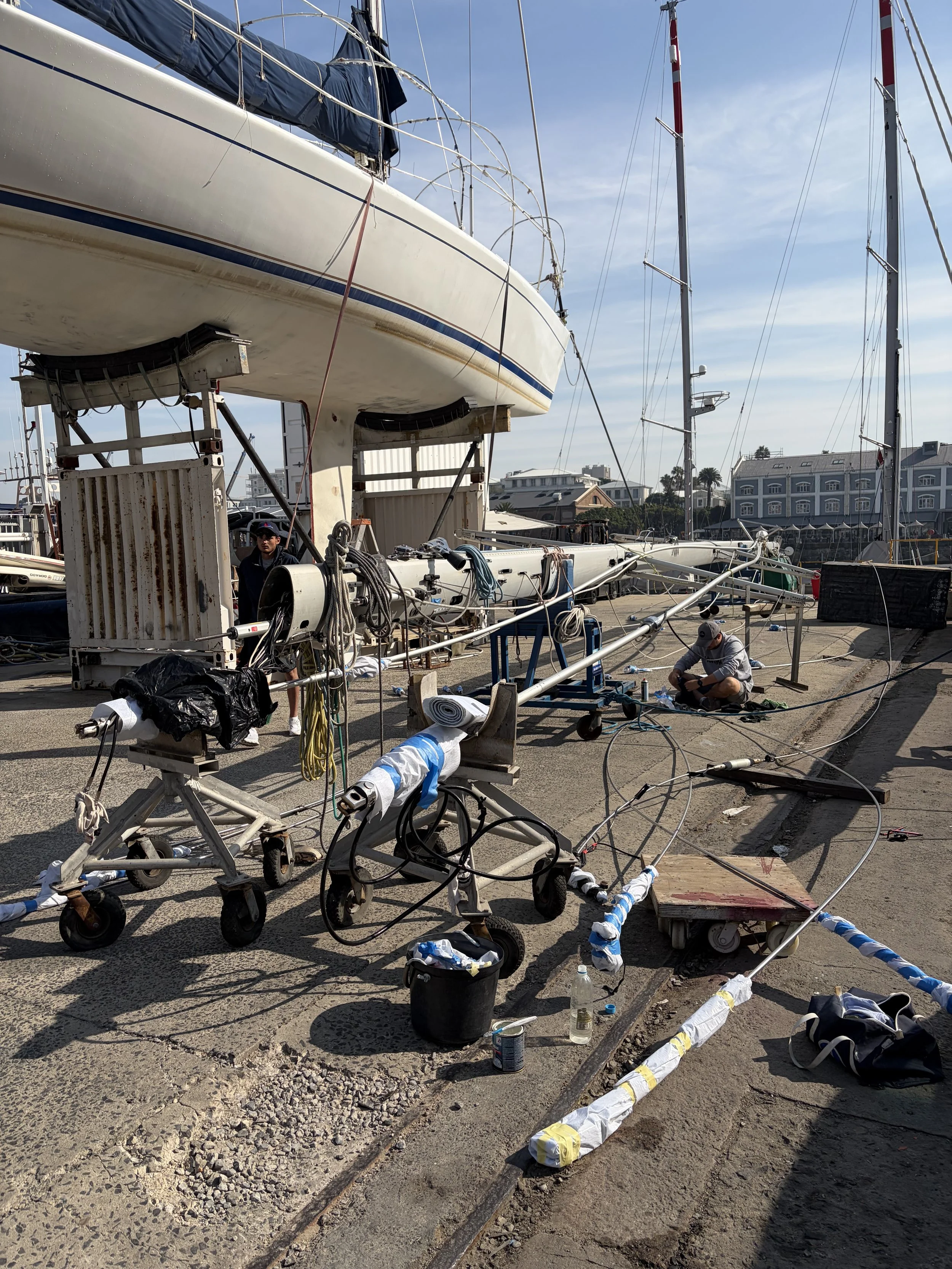
I met Chris Bock (who came to India) and Warren Fraser of Associated Rigging who I have had a number of dealings with but had never met. They started at the top of the mast and the D rings with shackles needed replacing as did the sheeves (the wheels that the halyards run over) and they had that in hand. They explained that the rod rigging at the top from the top spreader to the top of the mast called V3’s were old (10 years +) and had not been replaced. I had paid for this to be done in the UK in 2022 and it had not been -you can imagine how annoyed I was. They then showed me the rod head of another section and it had not been done well at all. These will both need to be replaced and so shoddy workmanship in some areas. They showed me what a proper rod head should look like and some were good but others were not good. They will replace and sort out.
They also showed me a number of things which they were resolving and I wondered why had these things not been done when the mast was down in 2022. It was interesting and taught me a number of things. They also showed me the spreaders which were showing a little corrosion and will need replacing in due course. We tried to contact Selden but they are closed for August so the riggers came up with a plan to strengthen them with special plates in case we cannot get any. I contacted Transworld Yachts and they will try and use their contacts to contact Selden to see if we can get them. The outhaul, vang and backstay cylinder are all being serviced and will be like new.
There is a lot to do but it is very important to have a good rig and one that is safe and this exercise will mean that I will have effectively serviced the whole rig. Let’s hope it can be completed by the end of this week or the beginning of next. We also talked of changing the metal halyards for the genoa and main to dynema and I had some from when Chris brought some out to India. He also needed a new section for the foil which the mainsail wraps around and I had that on board. I therefore went to get them and gave them to him.
I returned to Stormbird and found the hot water tank outside with the two new gas cylinders I had ordered with a new regulator. They could not fill my old cylinder here so I had to get some new ones. I managed to fit the new regulator and get that tank ready and stored the spare one. I should now have enough to get home.
The water tank man came and the frame was not what was discussed and the rear connection would not work with the broken wood support which had failed before. It was a different man and he understood what I was saying and will have to go away to get some new wood and he will epoxy it in place and leave it for 24 hours before he can fit the tank. This was annoying and meant I would not have water for a few more days. He fixed this by connecting the water feeds together. I therefore had water but will not have hot water.
I got on and cleaned the forward heads and had actually changed the water pump which pumps sea water from outside as the old one seemed to be dying. Luckily I had a spare and it is now working.
I then cleaned the heads in the double cabin but could not prepare the cabin as the electrics for the mast will need to be reconnected first and everything put back in the wardrobe.
I cleaned my own heads and then got the hose out and cleaned the deck which was grubby after a number of days of dust from the air. I filled the port tank but when I went to take the water top off the starboard tank it was hard to remove and someone must have cross threaded it and not put it back properly so something else to resolve!
I went for a shower and enjoyed the last of the sun before it went down. It had been another jobs day and I am conscious time is running out to get everything resolved before the crew arrive.
I went for a quick supper in Den Anker and had some tuna which was nice.
Tomorrow is another jobs day and I hope the water maker membranes will be fitted and that potentially the engine and generator will be serviced.
On the way back from the rig I saw a statue and went to look at it. It was of a man called Stanley John Reed and it had been unveiled by Robin Knox Johnston.
Stanley John Reed (19 January 1943 – 18 December 2006), known as Bertie Reed, was a South African yachtsman. He was the first South African to complete three singlehanded circumnavigations. Reed was born in Port Elizabeth in 1943. He joined the South African Navy in 1961 and served for 21 years. He started sailing whilst in the Navy.
In the 1982–1983, BOC Challenge race he placed second in the Knysna built yacht, Voortrekker.[2]At the time Voortrekker was 14 years old and considered obsolete. In the 1986–1987, race he was placed 7th, sailing Stabilo Boss, a yacht subsequently raced as Maiden. He was awarded South Africa's highest civilian award for bravery, the Wolraad Woltemade Decoration for his rescue of sailor John Martin whose yacht sank after hitting a submerged iceberg in the Southern Ocean during the 1990–1991 BOC Challenge. In 2006, he was inducted into the Single-Handed Sailors' Hall of Fame. He received Springbok colours 5 times for sailing.
Circumnavigation is the complete navigation of a person around an entire island, continent, or astronomical body (e.g. a planet or moon). This article focuses on the circumnavigation of Earth.
The first circumnavigation of the Earth was the Magellan Expedition, which sailed from Sanlucar de Barrameda, Spain in 1519 and returned in 1522, after crossing the Atlantic, Pacific, and Indian oceans.
Maritime
· The Castilian ('Spanish') Magellan-Elcano expedition of August 1519 to 8 September 1522, started by Portuguese navigator Fernão de Magalhães (Ferdinand Magellan) and completed by Spanish Basque navigator Juan Sebastián Elcano after Magellan's death, was the first global circumnavigation.
· The survivors of García Jofre de Loaísa's Spanish expedition 1525–1536, including Andrés de Urdaneta and Hans von Aachen, who was also one of the 18 survivors of Magellan's expedition, making him the first to circumnavigate the world twice.
· Francis Drake carried out the second circumnavigation of the world in a single expedition (and on a single independent voyage), from 1577 to 1580.
· Jeanne Baret is the first woman to complete a voyage of circumnavigation, in 1766–1769.
· John Hunter commanded the first ship to circumnavigate the World starting from Australia, between 2 September 1788 and 8 May 1789, with one stop in Cape Town to load supplies for the colony of New South Wales.
· HMS Driver completed the first circumnavigation by a steam ship in 1845–1847.
· The Spanish frigate Numancia, commanded by Juan Bautista Antequera y Bobadilla, completed the first circumnavigation by an ironclad in 1865–1867.
· Joshua Slocum completed the first single-handed circumnavigation in 1895–1898.
· In 1942, Vito Dumas became the first person to single-handedly circumnavigate the globe along the Roaring Forties.
· In 1960, the U.S. Navy nuclear-powered submarine USS Triton (SSRN-586) completed the submerged circumnavigation.
· In 1969, Robin Knox-Johnston became the first person to complete a single-handed non-stop circumnavigation.
· In 1999, Jesse Martin became the youngest recognized person to complete an unassisted, non-stop, circumnavigation, at the age of 18.
· In 2001, the U.S. Coast Guard USCGC Sherman (WHEC-720) became the first Coast Guard vessel to circumnavigate the globe.
· In 2012, PlanetSolar became the first ever solar electric vehicle to circumnavigate the globe.
· In 2012, Laura Dekker became the youngest person to circumnavigate the globe single-handed, with stops, at the age of 16.
· In 2017, trimaran IDEC 3 with sailors: Francis Joyon, Alex Pella, Clément Surtel, Gwénolé Gahinet, Sébastien Audigane and Bernard Stamm completed the fastest circumnavigation of the globe ever; in 40 days, 23 hours, 30 minutes and 30 seconds. The voyage followed the North Atlantic Ocean, Equator, South Atlantic Ocean, Southern Ocean, South Atlantic Ocean, Equator, North Atlantic Ocean route in an easterly direction.
The picture of the day is of the mast laid out and being worked on.
Need/Opportunity Year Three
I am now on the way to Durban and will then head for Cape Town and then on to St Helena, Azores and back to the UK.
The blog will continue as we continue the journey. If you have any comments or suggestions about the blog then do email me on hine.nick9@gmail.com