Year 3 -2nd September 2026 -St Helena
It was another grey drizzly day. We had a few jobs to do before we went ashore. The Blue Baron needed to be tied down so John got on with that. Paul and Dave took the twist out of the main sheet as the rope can become twisted over time. I changed the empty gas cylinder for a full one so when the next one goes we can switch over easily at sea in about 2 minutes.
We prepared to go ashore at 8.30am and the ferry picked us up. We went ashore in the drizzle and went to the café near the fort for breakfast. We all fancied a bacon buttie or something like that. In the end 2 had the full monty breakfast and 3 of us had a bacon and egg roll. It was a fine breakfast with the St Helena coffee. Julian had gone ashore earlier to do some more spreadsheets!! A spreadsheet a day makes Julian a happy day.
We wandered around after breakfast and Mark bought up the last of the cheese and ginger cheese and some more biscuits. We wanted to go to the museum and it opened at 10.00am. It was an interesting museum which gave some history about St Helena. Residents used to live in tents or stone huts here for a long time. As time went on and people got more wealthy homes developed but things moved slowly here. In 1976 more than half the homes had no water piped to their houses. In 1987 one in 5 properties had no electricity and 40% still cooked using wood only. There were also a number of forts here and quite a large military presence which used to almost double the population. We also saw the diagram of Jacobs Ladder when it was a tramway. The island was discovered on 21 May 1502 by the Portuguese explorer Joao da Nova and they hold a Saints festival each year to mark this occasion.
Derek kindly picked us up at about 10.30am to take us on another tour of the island. The weather was being a bit unkind and it continued to drizzle. We drove out of Jamestown and round the island where the sun came out every now and then and showed us how beautiful this island is with its spectacular scenery and foliage. The cloud and mist would then descend and block the view and then it became like Weathering Heights again.
We drove up and down dale and then came to a spot right over the airfield spread out below us. We had a clear view of the runway and then within a few minutes the view had gone as the mist descended.
We drove on through hamlets and woodland and foliage including Flax which they grow here. New Zealand flax had been grown here for over 150 years and between 1907 and 1966 flax island production was one of the most successful industries. At its peak 3,000
acres produced flax. The fibre was shipped to England or South Africa.
Flax, also known as common flax or line, is a flowering plant. It is cultivated as a food and fiber crop in regions of the world with temperate climates. Textiles made from flax are known in English as linen and are traditionally used for bed sheets, underclothes, and table linen. Its seeds are known as flaxseed or linseed and its oil is known as linseed oil. In addition to referring to the plant, the word "flax" may refer to the unspun fibres of the flax plant. Flax rope is a 100% natural, biodegradable cordage made from the bast fibres of the flax plant. They used to grow a lot of Flax here but now ropes are made from manmade material so the industry died.
We drove on and came to Longwood House where Napoleon lived when he was imprisoned here. The house was on top of a hill with lovely gardens around and it had a sea view. He had some Generals and other assistants with him and it was in St Helena that he wrote his memoirs and of course his will I which he left most of his wealth to his generals and assistants. We learnt that he died on the 5th May 1821 of Stomach Cancer officially although the rumours are that he was poisoned with Arsenic although there is no evidence of this. The French were allowed to exhume his coffin in 1840 and to take Napoleon back to France.
We drove on seeing more of the island but eventually came to Plantation House. Plantation House is the official residence of the governor of Saint Helena. It is located 3.6 km (2.2 mi) to the south of the capital, Jamestown, on the island of Saint Helena.
The house was built 1791-2 by the East India Company, as a "country" or summer residence for the governor. The company governed the island until 1834, when it became a crown colony, although governors of the island have continued to use the property since. Administration of the island is generally carried out from Jamestown, notably at The Castle (historically the governor's residence which then became the "town" residence). An explanation for the location of the governor's official residence is the less arid climate and terrain found further inland, compared to in James Valley. The (summer) residence of the lieutenant governor was Longwood House, also inland from Jamestown.
The house was extended most dramatically in 1816 and considerable alterations, mostly external, were made in 1960. The roof was originally slate but, like with most buildings on the island, this has been replaced with metal sheeting. It is designated as a Grade I listed building. Tours of the state rooms are available by appointment.
Possibly the world's oldest living tortoise, named Jonathan (alleged to be 194 years old), resides in the grounds and belongs to the government of Saint Helena. He potentially could also be the last living example of his species. The grounds are home to at least five giant tortoises. We saw Jonathan and one other tortoise whilst we were there but we were not able to get that close.
We drove on round the island and then ended up at Derek’s house where we relaxed. We were taught to prepare Chicken Plo and Tuna Plo- 2 St Helena dishes which we then ate for a late lunch. Linda had also been doing our washing and some more provisioning. They have been so kind.
If my blog has inspired any of you to visit then I suggest you contact Derek on office@islandimages.co.sh www.islandimages.co.sh. They will guide you through what you can do and when and where you can stay.
We returned to Stormbird and other than a few items of washing and final provisions we are ready to go. I shall get on with the checkout procedures tomorrow and Mark will deal with the final items and we then hope to head off on our way to Cape Verde, some 2,300nm away.
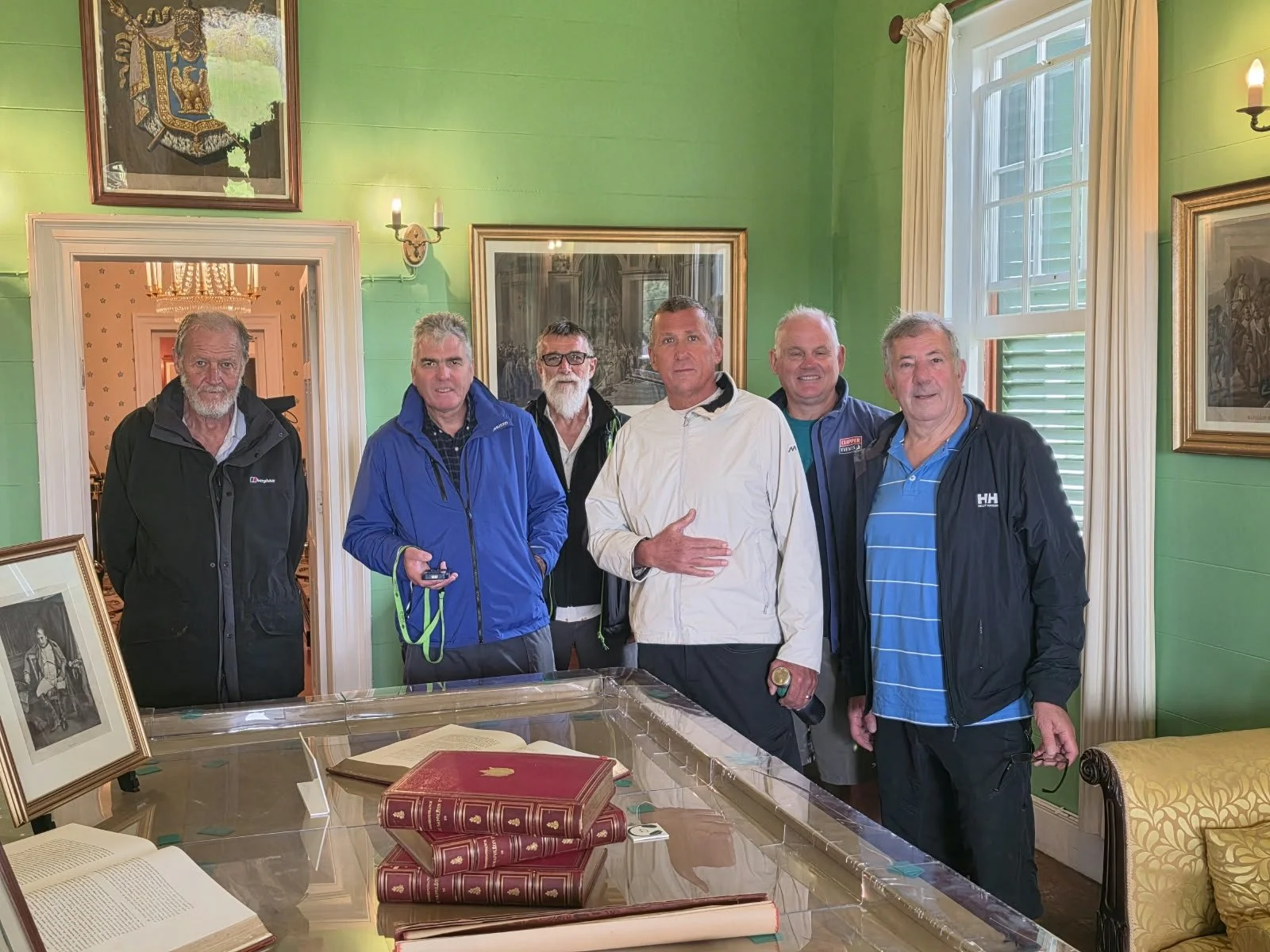
The picture of the day is of us all inside Longwood House – Napoleon’s House.
Need/Opportunity Year Three
I am now on the way to St Helena, Cape Verde, Azores and back to the UK.
The blog will continue as we continue the journey. If you have any comments or suggestions about the blog then do email me on hine.nick9@gmail.com