Year 3 -28 January 2026 -Nuwara Eliya -Kandy -Sri Lanka
We had agreed with Chinta that he would pick us up from the Araliya Hills Hotel at 11.00am. This gave us a little time to explore Nuwara Eliya. We had breakfast about 8.15am and then I finished off the blog and when done went to explore.
As previously stated it is described as Little England due to its cooler weather and because of old colonial architecture. The English fell for it after the heat of Colombo and the breathtaking landscape. Samuel Baker introduced English style agriculture to this town and so the variety of beets, leaks, cabbages, potatoes and strawberries are still going strong some 160 + years later.
There are a number of colonial style buildings – the Hill Club, The Grand – which looks like it has jumped straight out of a golf course in Surrey. There is Victoria Park which is like their botanical gardens and there is actually a golf course. There is a Turf Club where horse racing takes place and many of the hotels have been built in a colonial style. There is Gregory Lake which is now used for boating purposes and of course the highest peak in Sri Lanka -Mount Pidurutalagala (2524m and only about 500 m up from the town) overlooks the town. It now hosts the radar for Air Traffic Control for Sri Lanka.
We did drive up Single Tree Mountain which was opposite and on it now stands a Buddhist Temple and a huge head which they are building. We walked around and enjoyed the views. It had been interesting to see the town and it was recognisably cooler here.
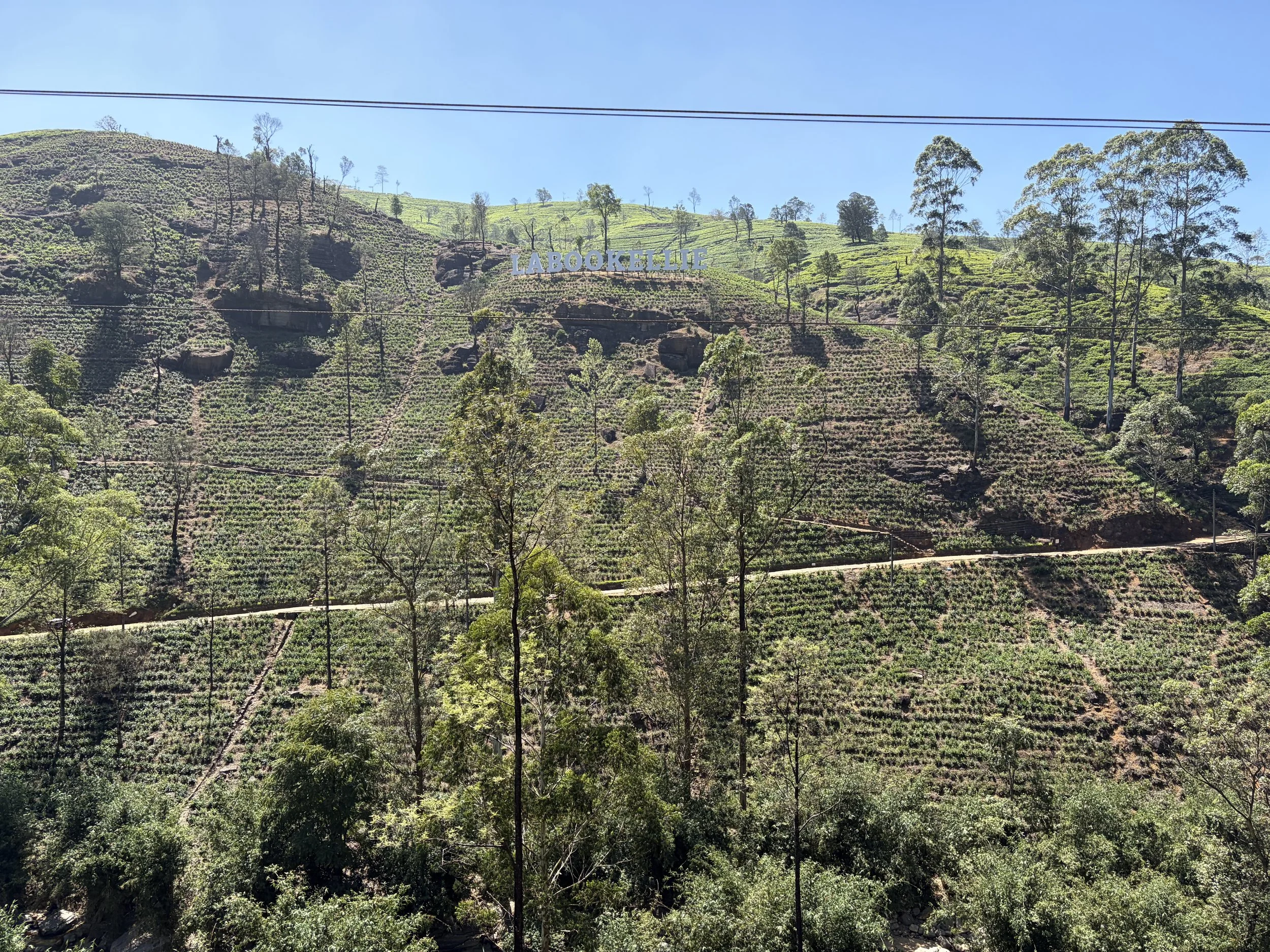
We then set off for Kandy some 2 hours plus drive away. However, we were going to Labookellie Tea Factory for a tour. This was some 45 minutes from Nuwara Eliya and we drove through many mountain villages and towns to get there. There were clearly many damaged parts to the hillsides from the recent Cyclone they had in November 2025. The previous Cyclone was about 45 years ago. They had repaired the road mainly but without support there will be more landslides.
Labookellie has about 1200 hectares of tea plantation and employs about 1,000 employees, 600 of which are women and the rest men. The women do the picking and the men do the other jobs. We had a guide who explained a number of things. Their tree plants last about 50-60 years and every 5 years are pruned back to waist height. If they were not pruned they could grow to 9 metres. Only the top new leaves are picked for the tea and the same plants can be picked again in 7 days when new shoots will have formed.
They make 3 types of tea -white tea which is just the smallest shoot of certain plants and you need to pluck 7 kilos to make 1 kg of white tea. Green tea is the top 2-3 leaves as is black tea and you need 5 kilos of leaves to make 1 kg of green tea and 3 kilos of black tea to make 1 kg of black tea.
White tea – the leaves have to be picked before the sun gets too hot ideally before sunrise and they are literally dried in the sun until mid-morning. There is no other process. It is the most expensive tea and the best for you health wise. It has no caffeine in it and you should make the tea with hot water 70-80 degrees (not boiling) to allow to infuse and you can re-use the leaves 3-4 times. You should never add milk or sugar to this tea and it is of a light colour.
Green tea has some caffeine in it and again you should only use hot water 70-80 degrees to allow to infuse and you can re-use the leaves 2 times. You should again not put in milk or sugar and it was a slightly darker colour than white tea. It was made in another factory but it is essentially dried.
Black tea is what we mainly drink and there is a process for this. The leaves are picked and then put 2 feet deep in a drying rack overnight and there is a fan blowing under the rack. 2 feet becomes 1 foot when dried. The tea is then spun in a round container to break it up and to make it into bits. For the tea that is going into tea bags it is ground and then put as mush 3 inches high on a table and allowed to ferment for some 3 hours. For tea which is going to be loose tea it is shaken on a moving table (called rolling) which breaks up the bits into smaller pieces and it is then fermented.
The tea then goes through a machine which separates the stalks from the leaves. The tea is then dried in a wood burning machines (for 12-21 minutes) and then the tea is graded and put into bags. The process can mean that they can turn the leaves when picked into tea in 24 hours. This was all very interesting.
We were then led upstairs to taste and we tasted 3 teas – a medium strength white tea (this was light and we had the tiny shoot leaf in the tea and it tasted quite bitter but not strong), a green tea (which was darker in colour and the taste was stronger) and then a black tea which had an orange colour and was even stronger in flavour. Some of us bought some of their different teas.
Once we had finished our tour we continued on to Kandy which is Sri Lanka’s second largest city.
Kandy is a major city located in the Central Province of Sri Lanka. It was the last capital of the Sinhalese monarchy from 1469 to 1818, under the Kingdom of Kandy. The city is situated in the midst of hills in the Kandy plateau. Kandy is the administrative capital of the Central Province, and considered as the cultural capital of Sri Lanka, due to its architectural heritage. Kandy is the home of the Temple of the Tooth Relic, one of the most important places of the Buddhist world. It was declared a World Heritage Site by UNESCO in 1988. Historically the local Buddhist rulers resisted Portuguese, Dutch, and British colonial expansion and occupation.
The city and the region have been known by many different names and versions of those names. Some The Kingdom of Kandy has also been known by various names. The English name Kandy, which originated during the colonial era, is derived from an anglicised version of the Sinhala Kanda Uda Rata (meaning the land on the mountain) or Kanda Uda Pas Rata (the five counties/countries on the mountain). The Portuguese shortened this to "Candea", using the name for both the kingdom and its capital. In Sinhala, Kandy is called Maha Nuwara, meaning "Great City" or "The Capital", although this is most often shortened to Nuwara in daily use.
As the capital, Kandy had become home to the relic of the tooth of the Buddha which symbolises a 4th-century tradition that used to be linked to the Sinhalese monarchy, since the protector of the relic was the ruler of the land. Thus the Royal Palace and the Temple of the Tooth were placed in close proximity to each other.
It is the second-largest city of the island and the capital of the Central Province of modern Sri Lanka. Its geographic location has made it a major transportation hub in the island: while Kandy being the gateway to the Central Highlands of Sri Lanka, the city can be reached by major motorways in every direction of the island. The railway line from Colombo, the seaport on the western coast runs via Kandy to the farthest point of Badulla in the Central Highlands. The main roads Colombo-Kandy and Kandy-Nuwara Eliya are two of the most scenic roads of Sri Lanka; Colombo-Kandy road passes through the rubber, tea plantations and rice paddies, Kandy-Nuwara Eliya road cuts through paddy fields and seamless tea plantations. Both roads claw their way up winding, rounding over the rings of hills.
Kandy's climate is still tropical as mean temperatures year-round are above 18 °C on average. The city does experience a drier period from January to April. From May through to July and October to December the region experiences its monsoon season, during this time the weather is rough and unstable. From March through the middle of May is the intermonsoonal period, during this time there is light rain and strong humidity. The humidity is generally between 70% and 79%.
When driving to Kandy we went through picturesque scenes. We also passed through the University of Peradeniya which has about 11,000 students and it looked very colonial.
Kandy was very busy and we got stuck in a traffic jam for a while but eventually came to the Thailanka Hotel which was very nice and the pool overlooked the city and the lake. We all had a swim and then a buffet supper which was good.
We have a number of places to explore in this city which we will try and do tomorrow.
The picture of the day is Labookellie Tea Plantation.
Need/Opportunity Year Three
In year three I will be going from Thailand to Sri Lanka, India, Maldives and then on to Mauritius, Reunion, Cape Town, St Helena, Azores and back to the UK.
I am looking for crew from Mauritius/ Reunion Island to Cape Town (mid June to end of July) and from Cape Town to the Azores and then to the UK (mid August onwards). If of any interest do email me.
The blog will continue as we continue the journey. If you have any comments or suggestions about the blog then do email me on hine.nick9@gmail.com