Year 3 -26 January 2026 – Central Highlands -Ella -Sri Lanka
We woke quite early and saw the sun come up over Little Adams Peak. We had a buffet type breakfast (not as good as Cinnamon Wild) and then met Chinta down the hill by the main road.
We set off for Lipton’s Seat – a venue about an hour and a half away deep in the tea area. However, you need to understand the history of tea to put it in perspective.
The story of tea in Sri Lanka began over two hundred years ago. British rule was very much under way and in the year 1824, the first tea plant was brought to Ceylon. It came from China and was planted in the Royal Botanical Gardens in Peradeniya for non-commercial purposes. James Taylor is widely regarded as the ‘father’ of Ceylon Tea. He hailed from Scotland and arrived on the island in the year 1852. He was sent to the Loolecondera Estate, a coffee plantation in the Kandy District, and was made its manager within five years as Ceylon went on to become the world’s largest coffee producer by 1860. Despite the successes of coffee, the owners of Loolecondera suggested to Taylor that he experiment with tea. It was fortuitous timing as the coffee rust disease first made an appearance two years later, and within the following two decades, coffee was all but wiped out.
In 1866, on the orders of G.D.B. Harrison, proprietor of Loolecondera Estate, Hewaheta (along with W.M. Leake), Taylor collected tea seeds from Peradeniya Botanical Gardens and planted them along the roadsides of Loolecondera. This was in an attempt to make up for the losses borne from the dying coffee plantations. Successfully, within the next 12 months, the first tea estate was born – Field No. 7 – expanding to 19 acres on the Loolecondera Estate, marking the birth of the industry.
This led to Taylor eventually beginning the operation of a fully fledged tea factory at the Loolecondera Estate, and the first sale of Loolecondera tea made in Kandy in 1872. It consisted of two small packs of 23 pounds of tea. The Maskeliya Planter’s Association was established the same year in July as the plantation purposes grew into a fruitful commercial aspect. he first shipment of Ceylon tea, a consignment of 23 pounds – 10 kg, arrived in London for trade in the year 1873. The value was set at Rs. 58; a worthy sum for its value at the time.
Taylor also built the first Tea House or factory in the same year. It was of wattle and daub and had hessian lofts in which to wither the leaf. He was said to have invented a tea leaf roller, which was powered by a 20ft. water wheel. Botanist Henry Trimen succeeded the legendary George Thwaites as Director (previously entitled Superintendent) of the Royal Botanical Gardens, Peradeniya in 1880. Trimen presided over the critical transformation period from coffee to tea and his contribution is therefore considered second to none. The first successful tea-rolling machine was also invented in the same year by the Walker brothers and manufactured by their firm, John Walker & Co.
As Ceylon tea gained popularity throughout the world, the first public auction was held on 30 July 1883 at the premises of Somerville and Co. along Queen Street now renamed Janadhipathi Mawatha. The Auction itself was only modestly successful with one lot of Kabaragala un-assorted tea selling for Rs. 45 cents a pound, whereas the other four lots remained unsold due to either lack of bids or due to bids received not meeting the Broker’s expectations at the time. The Colombo Tea Auction is considered the oldest and largest tea auction centre in the world. Despite debacles, Somerville & Co. and the other brokers persisted and were able to conduct auctions on a regular basis, promoting the common interest of both buyers and sellers of tea, within the island as well as overseas.
John Walker helped build the first central tea factory in the Fairyland Estate (Mount Pedro) in 1884. The factory belonged to J. A. Rossiter.
Sir Thomas Lipton was said to have visited Ceylon in 1890 and met with James Taylor. Taylor was presented with a tea and coffee service by the Planters Association in 1891, the inscription reading, “to James Taylor, Loolecondera, in grateful appreciation of his successful efforts which laid the foundation of the Tea and Cinchona Industries in Ceylon.” Sadly, he passed away the following year on 2 May.
The growth and production of tea however remained at large and in the year 1894, the Ceylon Tea Traders Association was formed. All tea produced in the island is virtually conducted through this association and the Ceylon Chamber of Commerce at present. Wharran Megginson of the Carolina Plantation, in the Watawala area, commissioned John Walker to build what was to become the prototype factory of the time in the same year, at a cost of Rs 35,000. The design stood the test of time and was little changed over the next half century.
By 1927, tea production on the island exceeded 100,000 metric tons, almost entirely for export. By then tea was not only produced in the highlands, but also in low-elevation areas as a means of expanding cultivation and the growing foreign demand. The humidity, cool temperatures, and rainfall of the country’s central highlands provide a climate that favours the production of high-quality tea. On the other hand, tea produced in low-elevation areas such as Matara, Galle and Ratnapura districts with high rainfall and warm temperature has a high level of astringent properties. The tea biomass production itself is higher in low-elevation areas.
The Ceylon Tea Propaganda Board was established in 1932. In the years that followed the Tea Research Institute commenced work on vegetative propagation at the St. Coombe’s Estate in Talawakele in 1938. The first Ceylonese tea broking house, M/S Pieris and Abeywardena was established in 1941.
In 1944, as the estate based trade union became a significant player in the tea plantation sector, the estate owners created a collective movement under the Ceylon Estate Employers’ Federation to balance the bargaining power of this growing trade. The success of the industry had numerous benefactors, across multiple fields over the many initial decades of growth. From the road to the railways, the bridges and tunnels to the botanists and engineers, the surveyors and even politicians, it was a cohesive and collective contribution that enabled the industry to prosper as it did.
Sri Lanka gained independence in 1948 and continues to be within the British Commonwealth.
By 1960, over 200,000 hectares of tea estates produced over 200,000 metric tons of tea, making Sri Lanka one of the leading tea exporters in the world. Accounts of the existing estates and plantations were attempted to be kept; however due to the fact that several had their beginning in coffee before switching to tea, some information throughout the years have been missed.
By 1963, the production and exports of Instant Teas was introduced and in 1965, Sri Lanka had grown to become the world’s largest tea exporter for the first time. The successful milestones are owed to the countless stakeholders, from the plantation workers and tea pickers to the auctions and exporters.
We were bound for Lipton’s Seat. One of Sri Lanka's most impressive viewpoints is just outside a small village in the country's central highlands. It's a place that barely registers a blip on the tourist radar; most tourist buses trundling by are headed straight for the well-worn streets of Ella or Kandy.
The trail begins unofficially at the Dambatenne Tea Factory, and winds its way through eight kilometres of lush, green tea plantations studded with Tamil tea pickers busying themselves among the leaves. At the top, after a steady climb to 2000 metres above sea level, the triumphant hiker is rewarded with views out over the undulating hills of central Sri Lanka, across a patchwork of tea estates, out to Udawalawe National Park in the south.
It's from this spot that over a century ago Scottish tea baron Sir Thomas Lipton viewed his burgeoning empire after he too made the slog through the countryside. It was a favourite place for Lipton: a scene almost reminiscent of The Lion King, in which just about everything that the light touched was his.
Now all that remains of Lipton is a garish statue of him reclining on a bench, arm outstretched at an awkward right angle. The tea cup he once held in his extended arm seems to have gone missing. Until that's rectified, he simply seems to be stuck lighting an imaginary lighter, or mid-thumbs up.
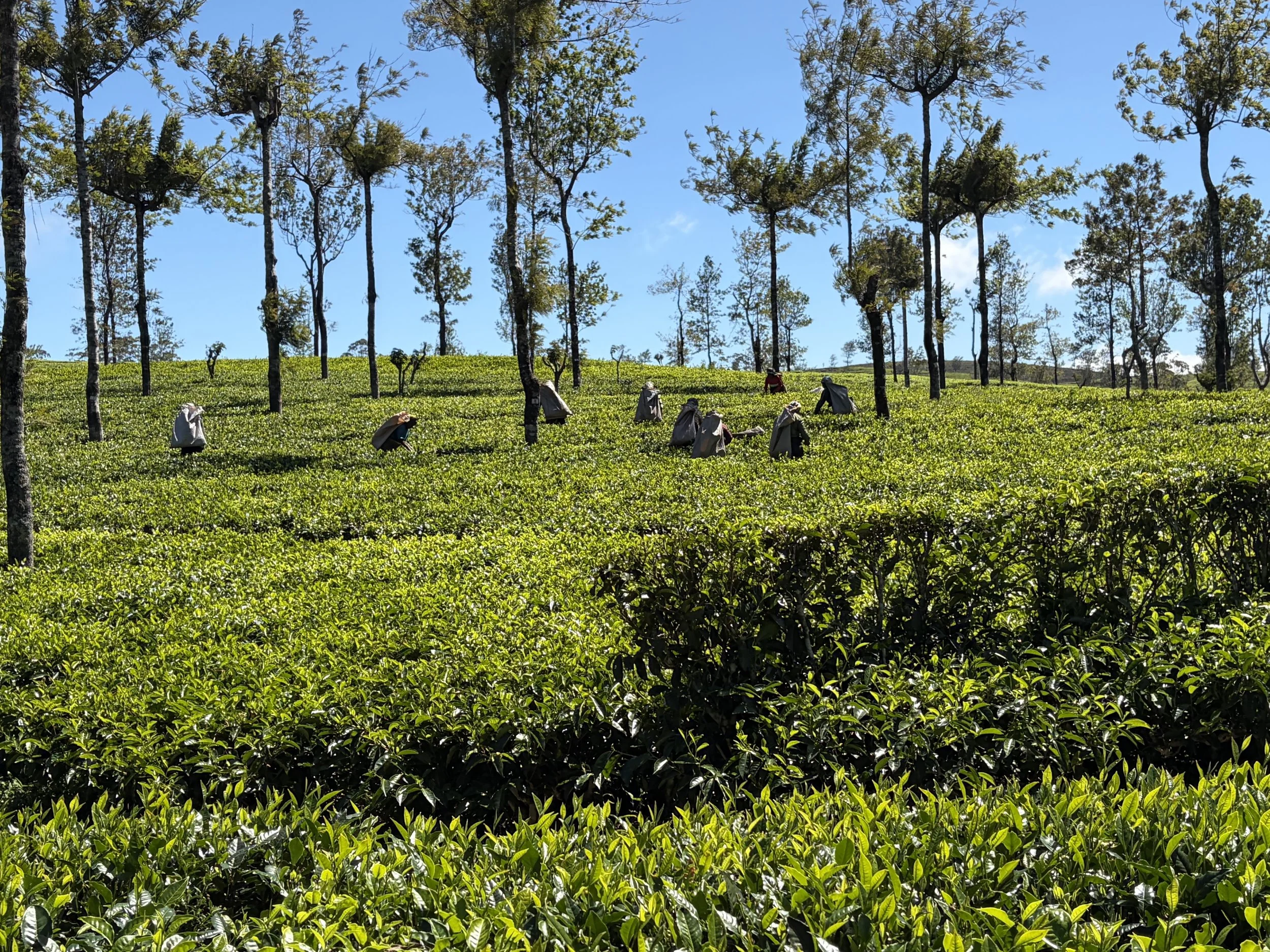
We drove through these 8km of tea territory and it is stunning. There are sheer valleys and hillsides lined with tree plantations and buildings either to support the workers or to be involved in tea production. We saw some pickers and they only pick to top 3 leaves unless it is white tea and they then only pick the shoots. We eventually came to a village and then left the van and went up to Lipton’s Seat by tuk tuk which lies about 1900m high. The views were stunning and at the top it was like we were on the top of the world with a 360 degree view over the hillsides below. Believe it or not there was a tiny place offering tea -so when in Rome. It was a fascinating experience and we all were stunned by the beauty and the vastness of the whole area.
On the way up there were some signs on the walls -one said – which I thought might be apt for the English right now, “Wherever you go, no matter what the weather, always bring your own sunshine.” In other words – have a positive outlook in life. Another which I thought was relevant to what I am doing was “There is a fantastic world out there, right outside your window, so go and explore it.” Finally, “Slow down and enjoy the pleasantries of life.” Makes you think does’nt it!!
We came down by tuk tuk and then drove back to Ella and we went to the 9 arches bridge. The Nine Arch Bridge also called the Bridge in the Sky, is a viaduct bridge in Sri Lanka and one of the best examples of colonial-era railway construction in the country.
The bridge was designed to accommodate a challenging nine-degree curve and steep gradient. Built entirely by local labour under British supervision, the construction faced significant logistical challenges, including difficult terrain and material transport. Completed in 1919, the bridge used concrete cornice blocks for arch support and locally produced sand-cement blocks for facing. It is located in Demodara, between Ella and Demodara railway stations.
The work had been carried by Harold Cuthbert Marwood as Engineer in charge of that section of the railway, under the approval of the Chief Construction Engineer, Railway Extensions, M. Cole Bowen.
At the time of construction, which coincided with the commencement of World War I, rumours were that the steel assigned for the bridge were reallocated to British war related projects, and as a result, work came to a standstill, leading the locals to build the bridge with stone bricks and cement, but without steel, except of course for the rails and pins securing them.
We could not get that close so we parked some way off and tuk tuks’ again took us right to the edge of the bridge. This scene was used in the Bridge over the River Kwai film. We walked over the bridge and admired its construction and arches. We then returned by tuk tuk and then drove to Demodara railway station. We then caught the train from there to Bandarawela a journey of about 45 minutes and we crossed the 9 arches bridge in the process. The journey was through magnificent hillsides and jungle. We noticed that practically every inch of ground is being cultivated in some way.
We arrived at Bandarawela and Chinta picked us up. We then drove back to Ella and our hotel. We had a quick hour turn around and went for supper in a local restaurant called AK Ristoro. We had a great meal to finish a great day.
The picture of the day has to be the tea pickers at work in the tea plantation.
Need/Opportunity Year Three
In year three I will be going from Thailand to Sri Lanka, India, Maldives and then on to Mauritius, Reunion, Cape Town, St Helena, Azores and back to the UK.
I am looking for crew from Mauritius/ Reunion Island to Cape Town (mid June to end of July) and from Cape Town to the Azores and then to the UK (mid August onwards). If of any interest do email me.
The blog will continue as we continue the journey. If you have any comments or suggestions about the blog then do email me on hine.nick9@gmail.com