Year 3 -20 May 2026 –Port Louis - Mauritius
We were up at a reasonable time and I had admin to get on with the crew coming to Mauritius and Reunion. It looks like Keith Winstanley will come back to Mauritius and then go on to Cape Town which is great news and a relief for me. In addition I have recruited 2 South African sailors John Oliver and Peter Wright who will join In Mauritius and Reunion in that order. That means we will have 6 to Mauritius and 6 from Mauritius to Durban which is what I wanted and needed. John and Peter cannot commit at this stage to go on to Cape Town but Mark Spittle hopefully will join then so we will be 5 for the 800nm to Cape Town which we will probably do in a few hops depending on the weather. I also have a potential recruit who could join there for the leg down to Cape Town. I am therefore thankful for those who have helped me be able to organise this.
I was also lying in bed thinking about whether I could get another Mastervolt charger out. As soon as I got up I photographed the model and specifications and emailed them to Transworld Yachts who I bought Stormbird through and who are the Hallberg Rassy agents in the UK. I also contacted the agent here and checked how easy it is to bring in parts- which luckily is reasonably straight forward for a fee of course! In short I rang Jeremy Mason who runs Transworld and he made contact with Mastervolt who had my model in stock and by the end of the day I have a new one being couriered to Mauritius and I should hopefully have it in about 3 days. This is the advantage of modern technology and logistics.
After breakfast I waited for Jerome who came about 30 minutes late. He first looked at the heads and discovered one of the pipes had a kink in it which was probably causing the blocking so he recommended replacing the pipe. This may have been the cause of previous problems and I hope that is the cause. He then went up the mast to fix the Windex (wind arrow broken by an eagle in India) but the fitting has deteriorated and he will have to come back and drill a new fitting. I had looked in my spares and found a fixed switch for the cockpit light which he fitted so that is working. He said hopefully the ladder will be ready on Saturday. Due to our tours I arranged that he came on Saturday morning.
The ladies went off for another massage whilst I remained. I then set about changing the oil and filters in the main engine. This is relatively straight forward but always takes longer than you think and always creates a mess. However, I managed it in about 2 hours and by then the ladies had returned for lunch and they had had a great time.
After lunch we decided to go off to the museum about Indentured Labourers. This was housed in a famous building called Aapravasi Ghaty. Following the abolition of the slavery trade the British experimented with Indentured Labourers (as an alternative) and brought nearly half a million Indentured Labourers to Mauritius to work the sugar plantations between 1833 and 1920. Once the labourers arrived they were processed for 2 days before being allocated for various duties and they were offered a contract to work for wages which was sworn in front of a Magistrate. The labourer could not resign and had to finish the contract and if they did not work they were not paid. The vast majority were from India but also from China, the Comoros, Madagascar, Mozambique, South Africa and Southeast Asia and Yemen. 70 % of the current population of Mauritius descend from these people.
Indentured servitude is a form of labour in which a person is contracted to work without salary for a specific number of years. The contract, called an "indenture", may be entered voluntarily for a prepaid lump sum, as payment for some good or service (e.g. travel), purported eventual compensation, or debt repayment. An indenture may also be imposed involuntarily as a judicial punishment. The practice has been compared to the similar institution of slavery, although there are differences.
Like any loan, an indenture could be sold. Most masters had to depend on middlemen or ships' masters to recruit and transport the workers, so indentureships were commonly sold by such men to planters or others upon the ships' arrival. Like slaves, their prices went up or down, depending on supply and demand. When the indenture (loan) was paid off, the worker was free but not always in good health or of sound body. Sometimes they might be given a plot of land or a small sum to buy it, but the land was usually poor. While most indentured laborers were adults, children could also be indentured, shifting the upkeep of the child to the contract holder but also giving the contract holder the benefit of the child's labour.
Through its introduction, the details regarding indentured labour varied across import and export regions and most overseas contracts were made before the voyage with the understanding that prospective migrants were competent enough to make overseas contracts on their own account and that they preferred to have a contract before the voyage.
Most labour contracts made were in increments of five years, with the opportunity to extend another five years. Many contracts also provided free passage home after the dictated labour was completed. However, there were generally no policies regulating employers once the labour hours were completed, which led to frequent ill-treatment.
The museum was interesting and clearly these people lived in quite hard conditions and it seemed to me to be a form of slavery. There was another museum next door on slavery which none of thought we could face. Joyce and Erika carried on and Carolyn and I went to walk round the town and to buy a longer igniter for the cooker which we did. We walked around what must have been the banking and financial centre and it is quite an advanced city I thought and busy too.
We found a large fruit and veg market which looked very good and the quality looked good. We therefore bought some papaya, mango, bananas, lemons and the largest avocado I have ever seen which we will have for breakfast tomorrow.
We wandered back to Stormbird but Erika and Joyce were not back yet so I went off to get a few things including some local beer called Phoenix.
Phoenix Beverages is the largest brewery in Mauritius. Their Phoenix Beer (lager) is widely distributed on the island and is exported to Europe, Australia, Reunion Island, Madagascar, etc. The company also has connections with the Guinness Brewery and is listed on the Stock Exchange of Mauritius. They have three plants in Mauritius, PhoenixBev Brewery Plant, PhoenixBev Carbonated Soft Drinks Plant and PhoenixBev Stills Plant. They also have a plant in Reunion Island known as Edena Boissons.
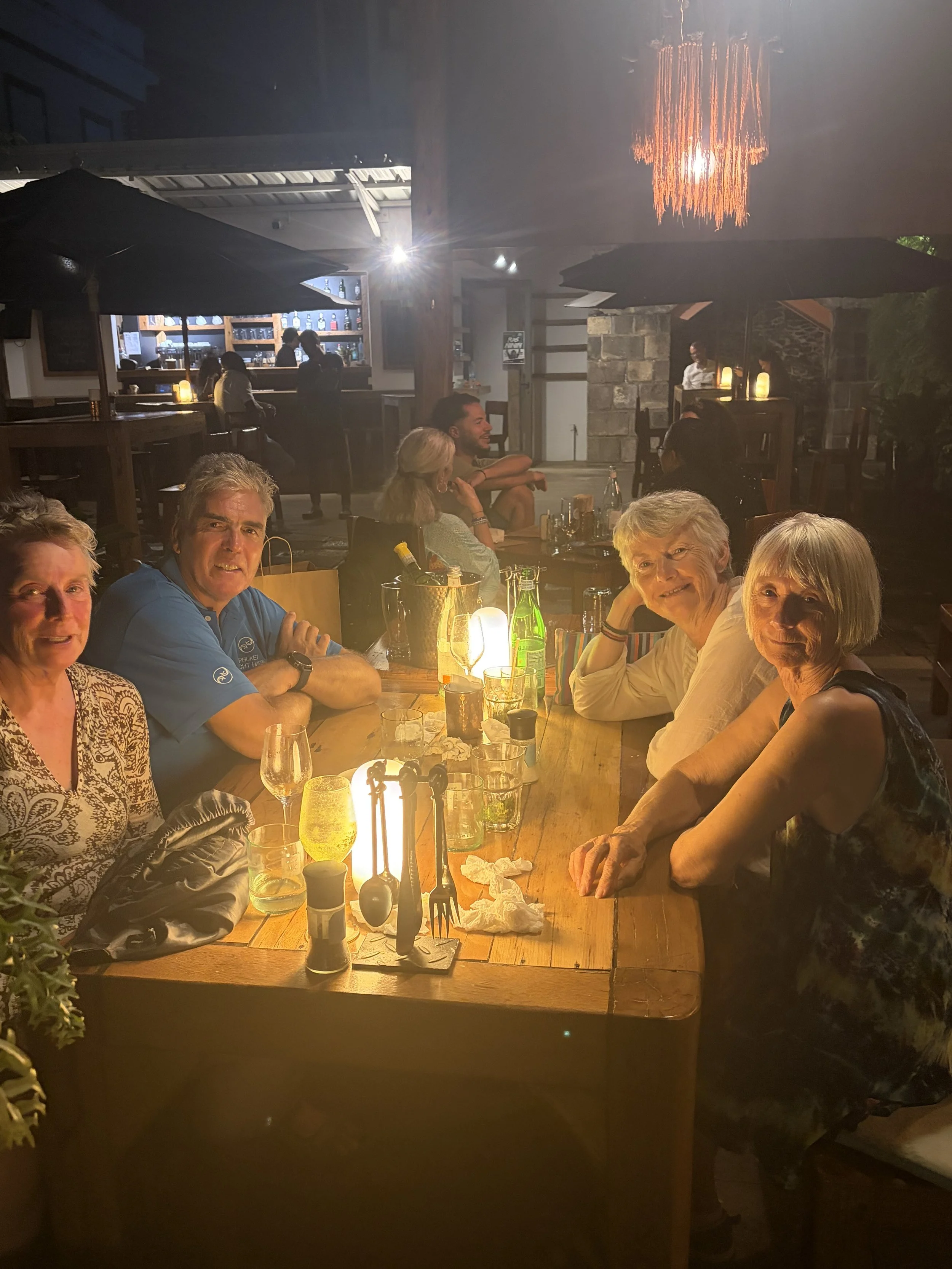
I returned and everyone was back. We then readied ourselves and went out for a great fish supper in the town. It had been good to get out and see things as well as making progress on the boat.
The picture of the day is the 4 of us at dinner.
Need/Opportunity Year Three
I will be going shortly from India to the Maldives and then on to Mauritius, Reunion, Cape Town, St Helena, Azores and back to the UK.
I am currently in need of potentially 2 crew from Mauritius to Cape Town from about 10 June 2026 and we should arrive in Cape Town on about 25-30 July 2026. If at all interested contact me on my email below or WhatsApp +44 7931360372.
The blog will continue as we continue the journey. If you have any comments or suggestions about the blog then do email me on hine.nick9@gmail.com