Year 3 -1st October 2026 – Faial -Azores – the most Western Point of Europe
We woke at a reasonable time to a rather grey day. Mark went out to get some croissant and cakes and we all had breakfast in the cockpit. Dave and John were at their Airbnb apartments.
I had arranged a tour of the island and we had to meet at the shop at 9.00am. I had arranged for my Starlink to be turned on today. We met Dave and John at the shop.
We were picked up by our guide Victor and we had two mature American ladies join us for the lady. They were sisters and travel the world together.
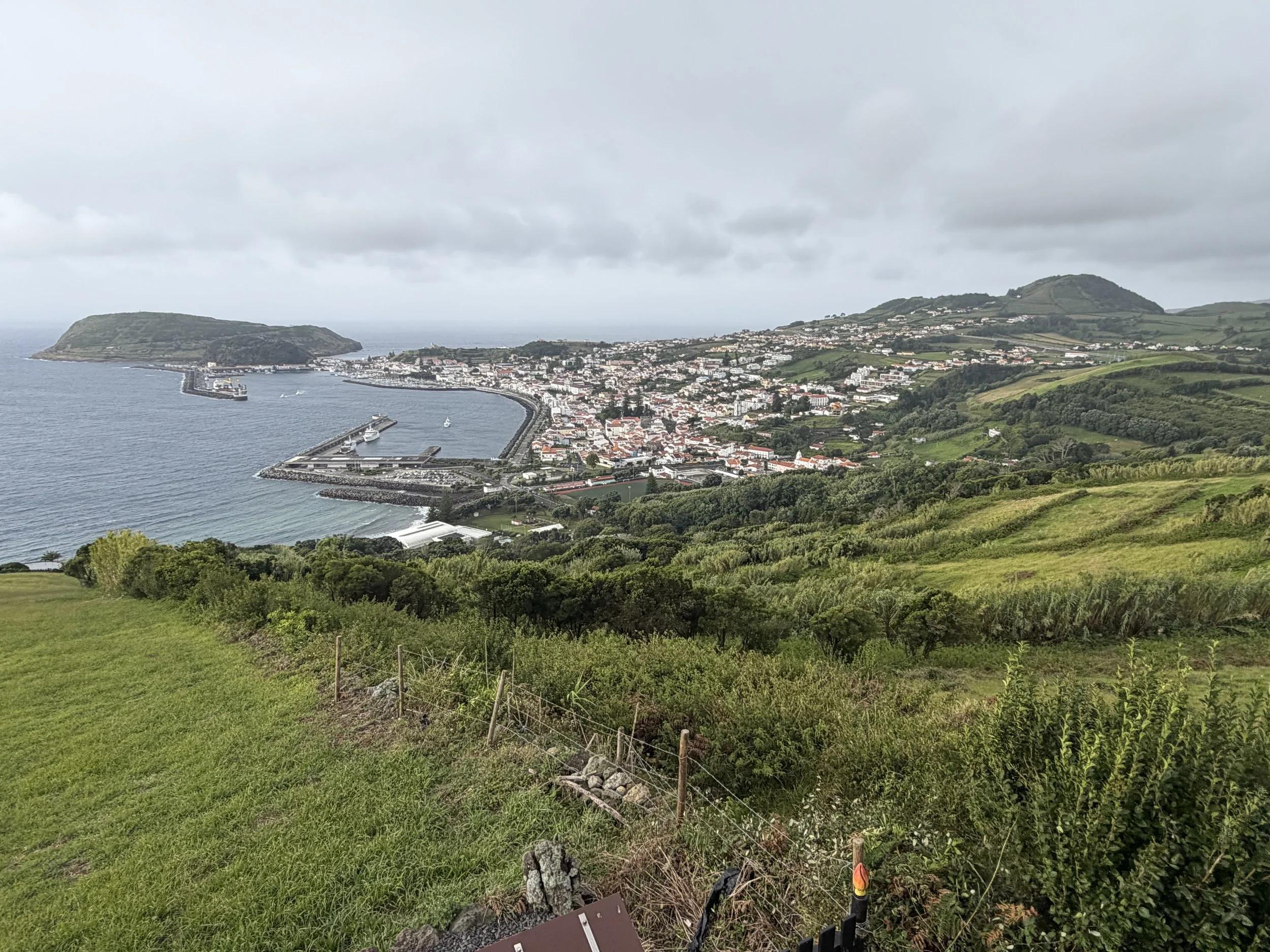
We were taken first through Horta and up to a monument we could see on the hill overlooking Horta. This was a statue of a lady and called Miradoura Sra du Conceicao. This was a great viewpoint and we could see over Horta and the land beyond it.
The island is very green and lush and it is called the Blue Island due to the many blue hydrangeas there are all over the island. Whilst the season is over there were still the odd blue bloom about and you can imagine when in full bloom how beautiful it would be. Victor explained that there were about 15,000 residents in Faial. However, there are about 60,000 cows and we saw a lot during our tour of the island.
We were taken from this monument to another look out which gave great views of different sections of the coast. In fact there are so many beautiful lookouts one the island as it has stunning scenery.
We went from here to the Faial Caldera – the Volcanic cone which collapsed. It is about 400m deep and 2km across and if you walk round it – it is 6.8km. The caldera is 900 m above sea level and the highest part is 1.043m. Unfortunately it was raining when we got there and it was covered in cloud.
We retraced our steps and went to Saloa – a village which used to have a whaling station and you could see the old, abandoned buildings.
There were two events which have had a considerable impact on the island. The first was the last volcanic eruption which was in 1957-1958 which I will discuss later. The second was an earthquake which occurred on the 9 July 1998 which damaged 70% of the island buildings. The houses used to be old black stone buildings and many were just left to rot as they were unsafe and the former residents have gone and built elsewhere. We saw many of the damaged buildings on our tour.
We drove on tarmac roads but there are over 50km of roads made with the volcanic materials on the island. These were quite good and took us through beautiful, lush green valleys with cows and lots of Japanese Cedar trees which were planted here.
We drove on to another village down by the sea which had a pleasant black volcanic sand beach where we had a walk around the volcanic cliffs and on the beach called Praia do Almoxarife.
We then were taken to a restaurant run by Victor’s wife and had a lovely meal. They make a special cheese here called Morro and it can be fresh, soft or hard. We had the fresh to start with and a local sausage which tasted like chorizo. We had tuna and beef with potatoes and salad which was delicious followed by a local mousse which was good.
After lunch we headed over to the West of the island where there was an old lighthouse, now abandoned due to the 1957 eruption which created an extra 2.5km of island from the sea. The sea began to erupt on 28 September 1957 and the volcanic activity did not stop until 24 October 1958. This dropped at least 2 metres of ash in the surrounding area and you can see the roof and walls of various abandoned houses. There is a good museum which explains about what happened and you can walk around the area. The eruption occurred just off the coast in the sea in front of the lighthouse and created its own island which was then joined by the activity to Faial. The volcano is called Capelinhos.
We then drove on to a village called Faja which was on the North of the island and another black beach. Believe it or not the sun came out.
We then drove back along the North coast back to Horta and round the promontory which sticks out by Horta.
This is a most beautiful island and very lush and green. The busiest times of the year for them is June to September. The ladies we toured with are going to 4 different island and spending about 3 nights in each.
I think the Azores like the Scillies is a hidden secret and well worth a visit.
We returned to Horta, collected our washing and then returned to Stormbird for some tea.
We decided to go out for supper and ended up in the famous Café Peter Sport.
Peter Café Sport is a café-restaurant located in the city of Horta , on the island of Faial , in the Azores . Founded in 1918 under the name "Café Sport", it has been run by the same family since its origin and is one of the reference establishments for the international yachting community that crosses the Atlantic .
Throughout the 20th century, the establishment accumulated functions that went beyond the restaurant business, having served as a post office, currency exchange, information point and support location for crews in transit through the port of Horta , which earned it the common designation of "post office of the Atlantic". On the upper floor, since 1986, there has been a museum dedicated to scrimshaw , the art of engraving and carving on sperm whale teeth and bones
Newsweek magazine included the café in lists of bars published in 1986 and 1989. In 2009, the establishment came first in an international bar competition aimed at yachting enthusiasts.
We had to wait for a table but got one quite quickly. We had a good meal in a pleasant environment. Time for bed.
The picture of the day is view overlooking Horta from the look out.
Need/Opportunity Year Three
I am now at the Azores and hope to head back to the UK on about 9 October 2026. At present I am full for the final passage back to the UK with some old veterans returning David Mark, Keith Watson (Watty) and of course Keith Winstanley -the Commodore.
The blog will continue as we continue the journey. If you have any comments or suggestions about the blog then do email me on hine.nick9@gmail.com