Year 3 -18 July 2026 – Another Day out in Cape Town -South Africa
I had sent Des some money to thank him for his help since we left Chagos. I paid him more than what he asked or as he has been very helpful and $300 seemed quite small to me.
He replied:
Dear Nick
A special BIG thank you for your EXTREMELY generous donation which has just cleared into my bank account. Allow me to put your generosity into context.
Over the past 9 years and 900+ yachts later - less than 10% have made a donation and the top donor was a solo sailor -$1500 - whom I guided from Cooktown on the east coast of Australia all the way back to the Caribbean over a 2-year period.
The average donation over the past year was < $300. The question I get most often is - why? - definitely not for the money! It is "payback" for all the kindness, friendship, camaraderie and assistance we received from fellow sailors during our 13 years cruising up to 2015. I am convinced the cruising yachties are the only sane people left in this "clown world" we live in. The prospect of communicating with these "special people" every day is the main reason why it is still worthwhile getting up in the morning - especially after my wife's passing in June 2021. It beats the hell out of spending a constructive half hour with my head in a gas oven. So to you and all those special people out there - A BIG THANK YOU! - you keep me alive!! Best wishes and fair winds always Des
He sent a second email.
Dear Nick
I have just sent my standard vanilla acknowledgment of your donation which cleared into my bank overnight. It should give you some of the background but it would be remiss of me to not put your generosity into context.
The average yachty usually makes contact in Thailand\Bali\Darwin etc in Mar\April and over the next 6 - 8 months and 6000nm later we part company in Cape Town. The pattern is similar to yours - daily emails\ updates etc. The average donation over the past 2 years was<$300 - +-SA R0.80c\nm. Our first contact was on 2\5\2026 en route to Chagos and then via Mauritius to Cape Town - 3000nm over slightly more than 2 months @ R4.20\nm! - 5 times the average - so my reference to extreme generosity is not just blowing sunshine!
Over the years I have classified yachties into many categories but the most important is - high and low maintenance. High maintenance does not imply a large volume of comms - it's when yachties expect me to make their decisions and "sail" their vessels. I have had 3 lawsuits threatened and in all three instances was able to supply their legal counsel with copies of the actual emails exchanged which collapsed their client's allegation of negligence. It seems the default position of the incompetent is to look around and see who they can blame for their own "C" ups. You have placed yourself at the top of the merit list not only with your generosity but also your competence and seamanship. Although my experience is limited to the Indian Ocean I have extended my service to selected yachties heading across the Atlantic. My input is very much limited to what is available on the weather models but am happy to chip in my 10cents worth. It has been a pleasure and privilege. Best wishes and fair winds
Des
Ps Any chance of a pic of your "lady" and crew for my 2026 Rogues Gallery?
It was nice for Des to thank me.
We had breakfast and it was another grey day but we were determined to not let that spoil the day. We decided we would go on a walking tour of the city which start at the hop on hop off bus stop in Long Street. We decided to walk there and walked from the marina along the canals as far as we could go until we reached the business area and then we meandered through it until we reached Long Street and the stop. There was a walking tour going at 1.00pm so we had an hour to kill. We walked round the corner into Green Market, which was selling all sorts of carvings, clothes etc. It was called Green Market as that was where fruit and vegetables were sold many years ago.
We walked around and there was a Methodist Church on the corner where Jenny when she was training spent a number of months. There was a café there so we went in and had a coffee.
We returned to the bus office and met our guide Jennifer and she explained that we would walk around. There was crime but mostly opportunist. Do not wear necklaces and stick together. Do not buy bread or milk if asked. If you have food left over from your meals get a doggy bag and give it to those who are hungry.
We walked round to a large car park area called Green Market Square opposite the Castle of Good Hope.
Jennifer explained that originally there were no Black People in the Cape area which had Bushman and Khoi Khoi who were of a light to medium colour but not black. Starting in about 400 AD, these groups were then joined by the Bantu ethnic groups who migrated from Western and Central Africa during what is known as the Bantu expansion. The Bantu tribes were mainly limited to the area north of the Soutpansberg and the northeastern part of South Africa until the later Middle Iron Age (1000-1300), after which they started migrating south into the interior of the country.
European exploration of the African coast began in the late 14th century when Portugal sought an alternative route to the Silk Road to China. During this time, Portuguese explorers travelled down the west African Coast, detailing and mapping the coastline and in 1488 they rounded the Cape of Good Hope. The Dutch East India Company established a trading post in Cape Town under the command of Jan van Riebeeck in April 1652, mostly Dutch workers who settled at the Cape became known as the Free Burghers and gradually established farms in the Dutch Cape Colony. Following the Invasion of the Cape Colony by the British in 1795 and 1806, mass migrations collectively known as the Great Trek occurred during which the Voortrekkers established several Boer Republics in the interior of South Africa. The discoveries of diamonds and gold in the nineteenth century had a profound effect on the fortunes of the region, propelling it onto the world stage and introducing a shift away from an exclusively agrarian-based economy towards industrialisation and the development of urban infrastructure. The discoveries also led to new conflicts, culminating in open warfare between the Boer settlers and the British Empire, the two sides fighting for control over the nascent mining industry.
Following the defeat of the Boers in the Second Anglo–Boer War or South African War (1899–1902), the Union of South Africa was created as a self-governing dominion of the British Empire on 31 May 1910 in terms of the South Africa Act 1909, which amalgamated the four previously separate British colonies: Cape Colony, Colony of Natal, Transvaal Colony, and Orange River Colony. The country became a fully sovereign nation state within the British Empire in 1934 following enactment of the Status of the Union Act. The monarchy came to an end on 31 May 1961, replaced by a republic as the consequence of a 1960 referendum.
From 1948–1994, South African politics was dominated by Afrikaner nationalism. A comprehensive system of racial segregation and white minority rule known as apartheid was introduced in 1948. Some have suggested that is actually started a lot earlier by Cecil Rhodes.
On 2 February 1990, F. W. de Klerk, then state president of South Africa and leader of the National Party (NP), unbanned the African National Congress (ANC) and freed Nelson Mandela from life imprisonment in Victor Verster Prison (now called Drakenstein Correctional Centre). The CODESA talks negotiated the creation of a new non-racial democratic South Africa, for which de Klerk and Mandela were later awarded the Nobel Peace Prize.
These negotiations led to the creation of a democratic constitution for all South Africa. On 27 April 1994, after decades of ANC-led resistance to white minority rule and international opposition to apartheid, the ANC achieved a majority in the country's first democratic election. Since then, despite a continually decreasing electoral majority, the ANC has ruled South Africa. In 2024, the ANC lost its parliamentary majority for the first time since the transition to democracy.
High rates of crime, corruption, unemployment, low economic growth, an ongoing energy crisis and poorly maintained infrastructure are some of the problems challenging contemporary South Africa.
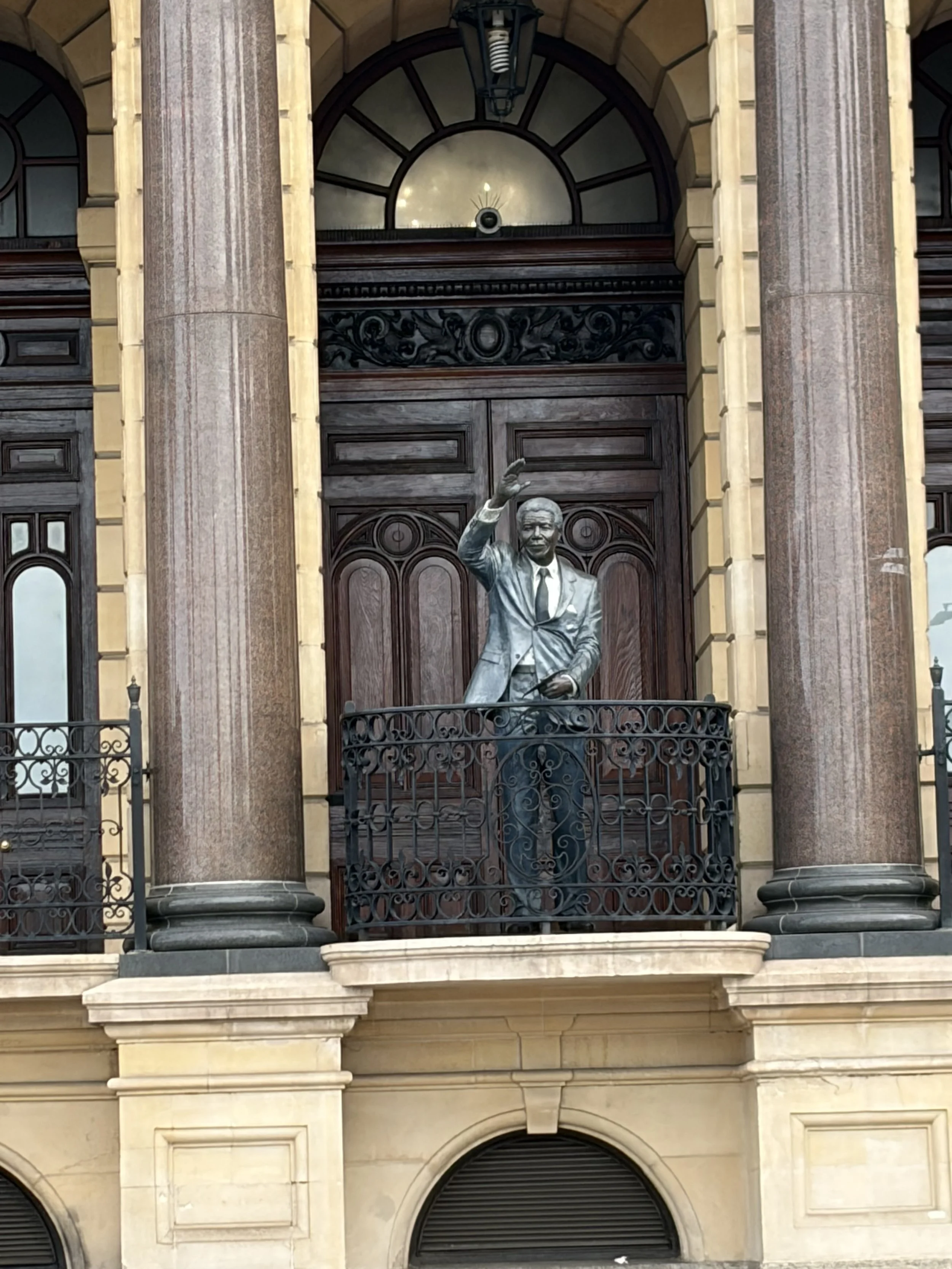
We walked on and came to the large town hall built by the British which had a statue of Nelson Mandela waving. This was in fact the location from where he made his first speech having been released from Robin Island where he spent 18 years if his 27-year incarceration.
Nelson Rolihlahla Mandela; born Rolihlahla Mandela; 18 July 1918 – 5 December 2013) was a South African anti-apartheid activist, statesman, and revolutionary who was the first president of South Africa from 1994 to 1999. He was the country's first Black head of state and the first elected in a fully representative democratic election. His administration focused on dismantling the legacy of apartheid by fostering racial reconciliation, a national peace accord and eventual multiracial democracy. Ideologically an African nationalist and socialist, he served as the president of the African National Congress (ANC) party from 1991 to 1997.
Mandela was born into the Thembu royal family in Mvezo, South Africa. He studied law at the University of Fort Hare and the University of Witwatersrand before working as a lawyer in Johannesburg. There he became involved in anti-colonial and African nationalist politics, joining the ANC in 1943 and co-founding its Youth League in 1944. After the National Party's white-only government established apartheid, a system of racial segregation that privileged whites, Mandela and the ANC committed themselves to its overthrow. Rising to prominence for his involvement in the 1952 Defiance Campaign and the 1955 Congress of the People, he was repeatedly arrested for seditious activities and was unsuccessfully prosecuted in the 1956 Treason Trial. Influenced by Marxism, he secretly joined the banned South African Communist Party (SACP). Although initially committed to non-violent protest, in association with the SACP he co-founded the militant Mkhonto we Sizwe in 1961 that led a sabotage campaign against the apartheid government. Following the Rivonia Trial, he was sentenced to life imprisonment for conspiring to overthrow the state.
Mandela served 27 years in prison. Amid growing domestic and international pressure and fears of racial civil war, President F. W. de Klerk released him in 1990. Mandela and de Klerk led efforts to negotiate an end to apartheid, which resulted in the 1994 multiracial general election in which Mandela became president. Leading a broad coalition government which promulgated a new constitution, Mandela created the Truth and Reconciliation Commission to investigate past human rights abuses. Economically, his administration retained its predecessor's liberal framework despite his own socialist beliefs, also introducing measures to encourage land reform, combat poverty and expand healthcare services. Internationally, Mandela acted as mediator in the Pan Am Flight 103 bombing trial and served as secretary-general of the Non-Aligned Movement from 1998 to 1999. He declined a second presidential term and was succeeded by Thabo Mbeki. Mandela focused on combating poverty and HIV/AIDS through the charitable Nelson Mandela Foundation.
Mandela was a controversial figure for much of his life. Although critics on the right denounced him as a communist terrorist and critics on the far left deemed him too eager to negotiate and reconcile with apartheid's supporters, he gained international acclaim for his activism. Globally regarded as an icon of moral leadership, peace, democracy and social justice, he received more than 250 honours, including the Nobel Peace Prize. He is held in deep respect within South Africa, where he is often referred to by his Thembu clan name, Madiba, and described as the "Father of the Nation". Mandela is widely considered one of the greatest and most admired figures of the 20th century. Today is called Mandela Day.
We walked on and came to an area where slaves were sold and there is a plinth where a tree once stood under which the slaves were sold. We were shown a building where they lived and which later became the first parliament of South Africa. We walked on and came to the Company Gardens which the British created out of what used to be a farm. Opposite was the legislature.
We then finished up by a South African War Memorial. It had been a most interesting tour and had given us a good sense of history and the city.
We needed some lunch and Jennifer suggested Kloof Street not far away so we went there and found a great restaurant called the Kloof House Street – which had once been a Victorian House and we had a delicious meal. We finished about 5.00pm and then walked back to the marina to ensure we were there before dark.
We were all full so we just had cheese and biscuits again and then watched a film -The Gauntlet which we all enjoyed.
It had been another good day in Cape Town.
The picture of the day is of the statue of Mandela outside the town hall on Mandela day.
Need/Opportunity Year Three
I am now on the way to Durban and will then head for Cape Town and then on to St Helena, Azores and back to the UK.
I am now in need of 1 additional crew from Cape Town to the Azores. The new crew member would need to be onboard by 10 August and it is likely we would get to the Azores by late September or early October. If at all interested in joining me please contact me on my email below or WhatsApp +44 7931360372.
The blog will continue as we continue the journey. If you have any comments or suggestions about the blog then do email me on hine.nick9@gmail.com