Year 3 -16 February 2026 – Kochi – Periya National Park India
We woke reasonable early as we were being picked up by our driver at 8.00am. We had fruit, yoghurt and granola and a good cup of coffee. We packed for our trip which was only a few days and were ready by 7.45am.
We made sure we closed all the hatches, packed everything away, took out the rubbish and went to the hotel reception. We met our driver Agil who was taking us on our trip and he suggested it would be about a 4-hour drive. We were going to Kumily, a town in the hills and this is where the Periya National Park is situated.
Periyar National Park and Wildlife Sanctuary (PNP) is a protected area located in the districts of Idukki and Pathanamthitta in Kerala, India. It is a renowned elephant and tiger reserve. The protected area encompasses 925 km2 (357 mi2), of which 350.54 km2 (135.34 mi2)[1] of the main zone was declared as the Periyar National Park in 1982. The park is a repository of rare, endemic, and endangered flora and fauna and forms the major watershed of two important rivers of Kerala: the Periyar and the Pamba.
The park is located high in the Cardamom Hills and Pandalam Hills of the south Western Ghats along the border with Tamil Nadu. It is 4 km (2.5 mi) from Kumily and 147 km (91 mi) southeast of Kochi.
The first official action towards the conservation of wildlife and biodiversity in Kerala was taken in 1934 by the Maharaja of Travancore, Chithira Thirunal Balarama Varma, by declaring the forests around Periyar lake as a private reserve to stop the encroachment of tea plantations. It was consolidated as a wildlife sanctuary in 1950 after the political integration of India. The sanctuary was included in Project Tiger, a Central Government initiative, and was renamed the Periyar Tiger Reserve in 1978.
The misty mountain ranges of the Periyar region
Periyar National Park lies in the middle of a mountainous area of the Cardamom Hills. In the north, the boundary commences from the point nearest to the Medaganam in the interstate boundary up to Vellimalai. To the east the boundary follows the inter-state boundary from Vellimalai to Kallimalai Peak (1615 m) it is bounded by mountain ridges of over 1,700 m (5,600 ft) altitude. Toward the west it expands into a 1,200 m (3,900 ft) high plateau. From this level the altitude drops steeply to the deepest point of the reserve, the 100 metre valley of the Pamba River. The highest peak in the park is the 2,019 m (6,624 ft) high Kottamala, the southernmost peak in India higher than 2,000 metres (6,562 ft). The Periyar and Pamba Rivers originate in the forests of the reserve, both in Mlappara. The topography consists of steep and rolling hills which are thickly wooded.
The temperature varies depending upon the altitude, ranging between 15 °C in December and January and 31 °C in April and May. Annual precipitation is between 2000 and 3000 mm, with about two-thirds occurring during the southwest monsoon between June and September. Much of the rest occurs during the northeast monsoon between October and December. Summers are warm with some precipitation in April and winters are cold.
We set off about 8.10am and drove for a long time through Kochi as we were heading sort of Southwest. Kochi has a population of about 3.8 million and to put this in perspective this is more than double the size of Birmingham.
We drove through busy Kochi and even through the outskirts it was urban sprawl. Eventually we got out into rural areas where there was lot of agriculture. It is a very verdant country and very beautiful except it seems the population does not care. There is rubbish hanging around everywhere and old cars and wood and rubble strewn everywhere and it is a grest shame.
We carried on and the ground began to rise and we began to go up some substantial hills. The scenery was rural bit we came through bustling villages and towns. It seems there is money around as there were lot of large houses and well-built houses. The road continued to climb and we stopped for a coffee and tea at a café beside the road. We continued on and the teas planation’s began to appear and various tea factories. In addition this is a major spice area and they grow a lot of them and sell them in their spice shops. We stopped for lunch at the Mystery Mountain tea plantation and we had a good lunch. Tea planting came to this area in 1875.
The road continued up and it was very sort of mountainous with rolling hills and sheer cliffs. We eventually came to Kumily where we stopped as they had an elephant spot here You could ride on the elephant. We decided not to but could see the elephants in a large enclosure. We decided to see the dancing show at 5.00pm for an hour.
We were then driven to our hotel the Poetree -right up in the hills. It was in a lovely position -high up with great views. They tried to put us all in one room in a King size bed. Well we were not happy and we then ended up with one twin and one double.
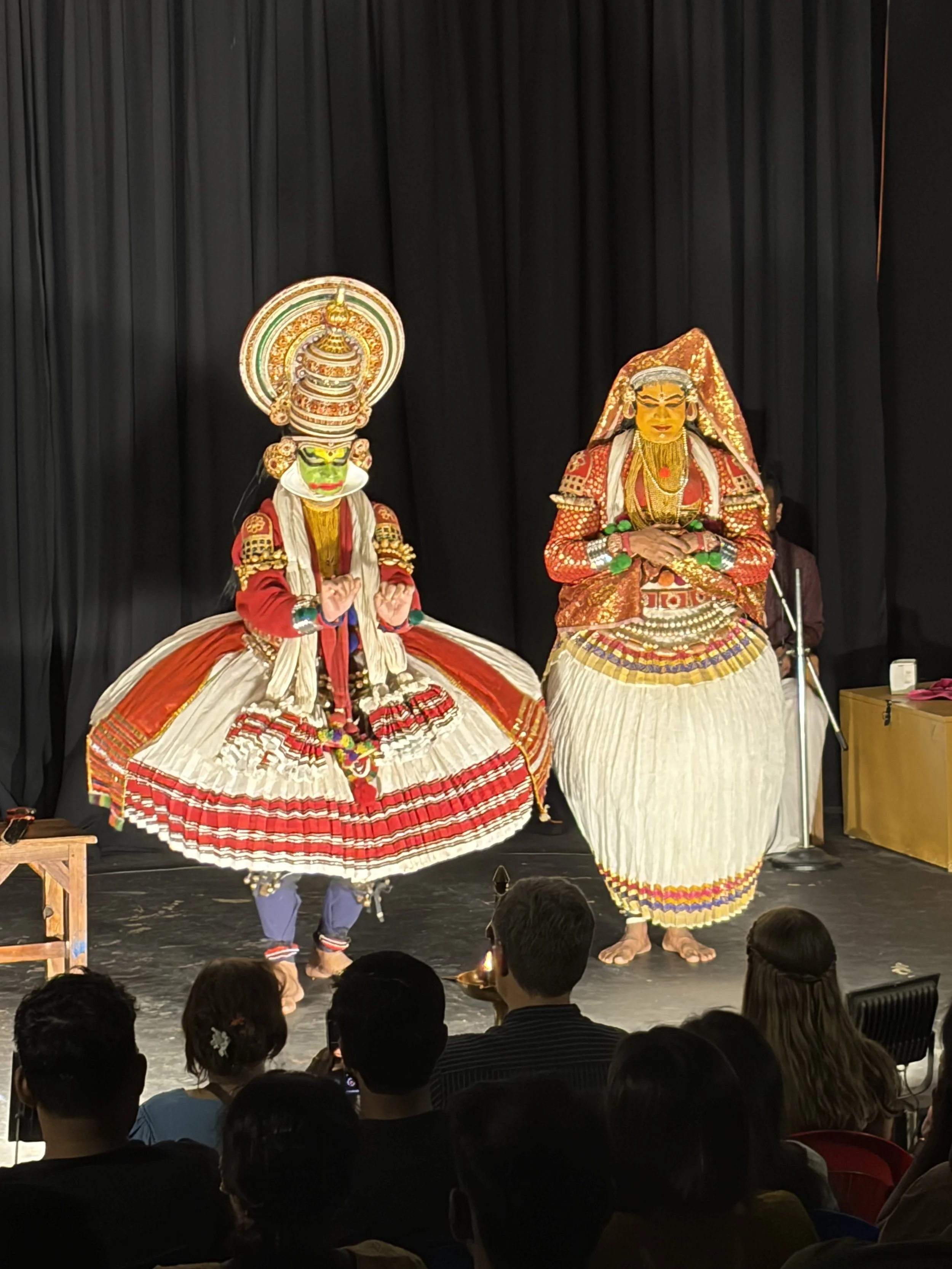
As we had taken some time to sort this out time ran on and Paul and Mark decided to stay and swim I the pool and have a beer. I decided to go and see the show. This was Kathakali dancing.
Kathakali is a traditional form of Indian Classical Dance, and one of the most complex forms of Indian theatre. It is native to the Malayalam-speaking state of Kerala and is almost entirely practiced by the Malayali people. It is a play of verses. These verses are called Kathakali literature or Attakatha. Mostly played in the courts of kings and temple festivals. Hence it is known as suvarna art forms. This performance uses the navarasas from the Natya Shastra text, authored by sage Bharata. Makeup and costumes are unique and large. It represents one of Kerala's traditional theatre artforms.
The show started with and explanation and demonstration of facial expressions and what they mean. This was then followed by a story depiction in which a lot of the facial expressions are used. It was quite interesting.
We returned to the hotel and I founds Mark and Paul. We had a drink on the terrace and the went to see some other Indian dancing that the hotel was laying on. It was beautiful but with a lot of movement.
We plan a jeep safari tomorrow and so hopefully the gods will be kind and we will see one. We are about 1100m up here and it is noticeably cooler.
The picture of the day is the dancing of the Kathakali.
Need/Opportunity Year Three
In year three I will be going from Thailand to Sri Lanka, India, Maldives and then on to Mauritius, Reunion, Cape Town, St Helena, Azores and back to the UK.
I am looking for crew from Mauritius/ Reunion Island to Cape Town (mid June to end of July) and from Cape Town to the Azores and then to the UK (mid August onwards). If of any interest do email me.
The blog will continue as we continue the journey. If you have any comments or suggestions about the blog then do email me on hine.nick9@gmail.com