Year 3 -15 February 2026 – Kochi -India
We woke at a reasonable time and it was quite cool but in India there is always a haze and you cannot see more than a few miles. Paul cooked a hash browns breakfast with eggs etc which was good.
Peter was leaving at 12.00 noon to go to the railway station and so Paul, Mark and I thought we would go to Fort Kochi as we could get the ferry on the way. We therefore had a number of hours to kill. I got on with admin and tidying the central areas and hoovering. Peter cleaned the mats with the hose. Paul looked at the port halyard which needed repairing and the outside cover had split in one position so Paul sowed it.
Mark and I then hosed the deck particularly around the mast to clear away all the metal filings etc.
We then prepared ourselves to leave and walked up to the entrance. Before we did so we closed all the hatches and put rat rings in the lines. Varghese our local man had warned us of this and said there was a boat here recently where a rat got on board and it became a major problem.
We got in the taxi with Peter and Varghese agreed to drop us off at High Court -the ferry terminal which would take us across to Fort Kochi. The driver stopped and we went across to the terminal and there was quite a queue for the Metro which was the government ferry. We were stopped by an Indian man who said he could take us across on a private boat. We agreed a fair price and the little boat took the 3 of us across. This meant going across from the ferry terminal and working our way round and we were dropped off at a sort of wharf. We had had a great views of the docks on the way!!
Once we got off we began to walk toward the fort and came across a great spice shop. It was full of all sorts of spices which were in open sacks and there were lots of pouches of curries and herbs. The smell was amazing.
As we walked on we came to a tuk tuk who offered to give us a 2-hour tour of the fort. We decided to agree and we asked to go somewhere good for lunch. The tuk tuk driver Harris suggested he take us to a good thali place for lunch to which we agreed.
The restaurant was very low key but we had a great meal. They brought us a banana leaf and then gave us several vegetarian dishes in small containers together with rice and chapati etc. We had no plate so everything was spread on the banana leaf so I think they assumed we would eat with fingers but we asked for a fork. In reality it was a great and diverse meal and we all had the same. It was delicious and it cost us £7.22 for the 3 of us including water and cokes.
So we are in Cochin or Kochi – they seem to use both names.
Kochi formerly known as Cochin is a major port city along the Malabar Coast of India bordering the Laccadive Sea. It is part of the district of Ernakulam in the state of Kerala. The city is also commonly referred to as Ernakulam. As of 2011, the Kochi Municipal Corporation had a population of 677,381 over an area of 94.88 km2, and the larger Kochi urban agglomeration had over 2.1 million inhabitants within an area of 440 km2, making it the largest and the most populous metropolitan area in Kerala. Kochi city is also part of the Greater Cochin development region and is classified as a Tier-II city by the Government of India. The civic body that governs the city is the Kochi Municipal Corporation, which was constituted in the year 1967, and the statutory bodies that oversee its development are the Greater Cochin Development Authority (GCDA) and the Goshree Islands Development Authority (GIDA).
Nicknamed the Queen of the Arabian Sea, Kochi was an important spice trading centre on the west coast of India from antiquity. The port of Muziris traded with the Romans, Persians, Arabs, and Chinese. From 1503 to 1663, the Portuguese established Fort Kochi (Fort Emmanuel), before it was taken over by the Dutch in 1663. The Dutch then ceded the area to the United Kingdom. Kochi remained under the control of the Kingdom of Cochin, which became a princely state of the British. Today, Kochi is known as the financial, commercial and industrial capital of Kerala. Kochi is the only city in the country to have a water metro system, which has been described as the world's largest electric boat metro transportation infrastructure. Kochi also successfully conducted the test flight for Kerala's first seaplane service. The Cochin International Airport is the first in the world to operate solely on solar energy. Kochi was one of the 28 Indian cities among the emerging 440 global cities that will contribute 50% of the world GDP by 2025, in a 2011 study done by the McKinsey Global Institute. In July 2018, Kochi was ranked the topmost emerging future megacity in India by global professional services firm byJLL.
Kochi's rich cultural heritage has made it a popular tourist destination among both domestic and international travellers. It has been hosting India's first art biennale, the Kochi-Muziris Biennale, since 2012, which attracts international artists and tourists. The Chinese fishing nets, introduced during the 14th century by the Chinese, are a symbol of the city and a popular tourist attraction in themselves. Other landmarks include Mattanchery Palace, Marine Drive, Venduruthy Bridge, Church of Saint Francis and Mattanchery Bridge. The city ranks first in the total number of international and domestic tourist arrivals in Kerala. The city was ranked the sixth best tourist destination in India according to a survey conducted by the Nielsen Company on behalf of the Outlook Traveller magazine. In October 2019, Kochi was ranked seventh in Lonely Planet's list of top 10 cities in the world to visit in 2020. In November 2023, the British Luxury travel magazine Condé Nast Traveller rated Kochi as one of the best places to go in Asia in 2024.
Ancient travellers and tradesmen referred to Kochi, variously alluding to it as Cocym, Cochym, Cochin, and Kochi. The Arab merchants called this place Kashi, which is seen in the books such as Tuhfat Ul Mujahideen. The origin of the name Kochi is thought to be the Malayalam word kochu azhi, meaning 'small lagoon'. Accounts by the Italian explorers Nicolo Conti (in the 15th century) and Fra Paoline (in the 17th century) say that it was called Kochchi, named after the river connecting the backwaters to the sea. After the arrival of the Portuguese, and later the British, the name Cochin stuck as the official appellation. The city reverted to a closer transcription of its original Malayalam name, Kochi, in 1996. This change in name was challenged by the city municipal corporation, but the court later dismissed the plea.
Kochi is located on the southwest coast of India at 9°58′N 76°13′E, with a corporation limit area of 94.88 km2 (36.63 sq mi). Over the years, the city has expanded considerably outside the corporation limit set in 1967, although the official city limits haven't been changed. The city straddles the backwaters, encompassing the northern end of a peninsula, several islands and a portion of the mainland. To the west lies the Laccadive Sea, and to the east is the urbanised region in the rest of the mainland area. Much of Kochi lies at sea level, with a coastline of 48 km.
The eastern part of Kochi is mainly known as Ernakulam, while the western part of it after the Venduruthy Bridge is called as Western Kochi.
Kochi's water needs are entirely dependent on ground water and the Periyar and Muvattupuzha rivers flowing through the district. The Periyar serves the entire northern part of the city and the Muvattupuzha river under the JnNurm project covers the western part.
Under the Köppen climate classification, Kochi features a tropical monsoon climate (Am). Kochi's proximity to the equator along with its coastal location results in little seasonal temperature variation, with moderate to high levels of humidity. Annual temperatures range between 23 and 31 °C (73 and 88 °F) with the record high being 36.5 °C (97.7 °F), and record low 16.3 °C (61.3 °F). From June to September, the south-west monsoon brings in heavy rains as Kochi lies on the windward side of the Western Ghats. From October to December, Kochi receives lighter (yet significant) rain from the northeast monsoon, as it lies on the leeward side. Average annual rainfall is 3,014.9 mm (118.70 in), with an annual average of 124 rainy days.
Fort Kochi- formerly also known as Fort Cochin, is a region of Kochi city in Kerala, India. Fort Kochi takes its name from the Fort Manuel of Kochi, the first European fort on Indian soil, controlled by the Portuguese East Indies. This is part of a handful of water-bound islands and islets toward the south-west of the mainland Kochi, and collectively known as Old Kochi or West Kochi. Adjacent to this is the locality of Mattancherry. In 1967, these three municipalities along with a few adjoining areas, were amalgamated to form the Kochi Municipal Corporation.
Fort Kochi is rich in heritage and culture, and is a prominent tourist destination for both domestic and international travellers- being ranked as ninth among the top 25 in National Geographic’s Top Tourist Destinations To Explore In 2020.
The port at Kozhikode held superior economic and political position in medieval Kerala coast, while Kannur, Kollam, and Kochi were commercially important secondary ports, where the traders from various parts of the world would gather. Fort Kochi was a fishing village in the Kingdom of Kochi in the pre-colonial Kerala. The Portuguese arrived at Kappad Kozhikode in 1498 during the Age of Discovery, thus opening a direct sea route from Europe to India. The territory that would be later known as Fort Kochi was granted to the Portuguese in 1503 by the Rajah of Kochi, after the forces of Afonso de Albuquerque helped him fighting the forces of Saamoothiri of Kozhikode. The Rajah also gave them permission to build Fort Emmanuel near the waterfront to protect their commercial interests. The first part of the name Fort Kochi comes from this fort, which the Dutch later destroyed. The Portuguese built their settlement behind the fort, including a wooden church, which was rebuilt in 1516 as a permanent structure, today known as the St Francis Church. Fort Kochi remained in Portuguese possession for 160 years. In 1683 the Dutch captured the territory from the Portuguese, destroyed many Portuguese institutions, particularly Catholic including convents. The Dutch held Fort Kochi in their possession for 112 years until 1795, when the British took control by defeating the Dutch. Foreign control of Fort Kochi ended in 1947 with the Indian independence.
A mix of old houses built by the Portuguese, Dutch and British in these colonial periods line the streets of Fort Kochi. St Francis Church was built in 1503 by the Portuguese as a Catholic church. Vasco da Gama was once buried in this church which now falls under the Church of South India and is one of the national monuments. Catholic Diocese of Cochin was erected under Portuguese Padroado in 1558 with its headquarters in Fort Kochi. Santa Cruz Basilica, also built by the Portuguese in the 16th century, was later destroyed by the British and rebuilt near the end of 19th century. From this period there are other residential buildings and hotels such as the Old Harbour House, some of which have been renovated in more recent times. The landmark that causes more public and visitor interest is a series of precolonial Chinese fishing nets on the waterfront, believed to have been introduced by Chinese traders in the early 14th century.
The first part of the name Fort Kochi comes from this fort, which the Dutch later destroyed. The Portuguese built their settlement behind the fort, including a wooden church, which was rebuilt in 1516 as a permanent structure, today known as the St Francis Church. Fort Kochi remained in Portuguese possession for 160 years. In 1683 the Dutch captured the territory from the Portuguese, destroyed many Portuguese institutions, particularly Catholic including convents. The Dutch held Fort Kochi in their possession for 112 years until 1795, when the British took control by defeating the Dutch. Foreign control of Fort Kochi ended in 1947 with the Indian independence.
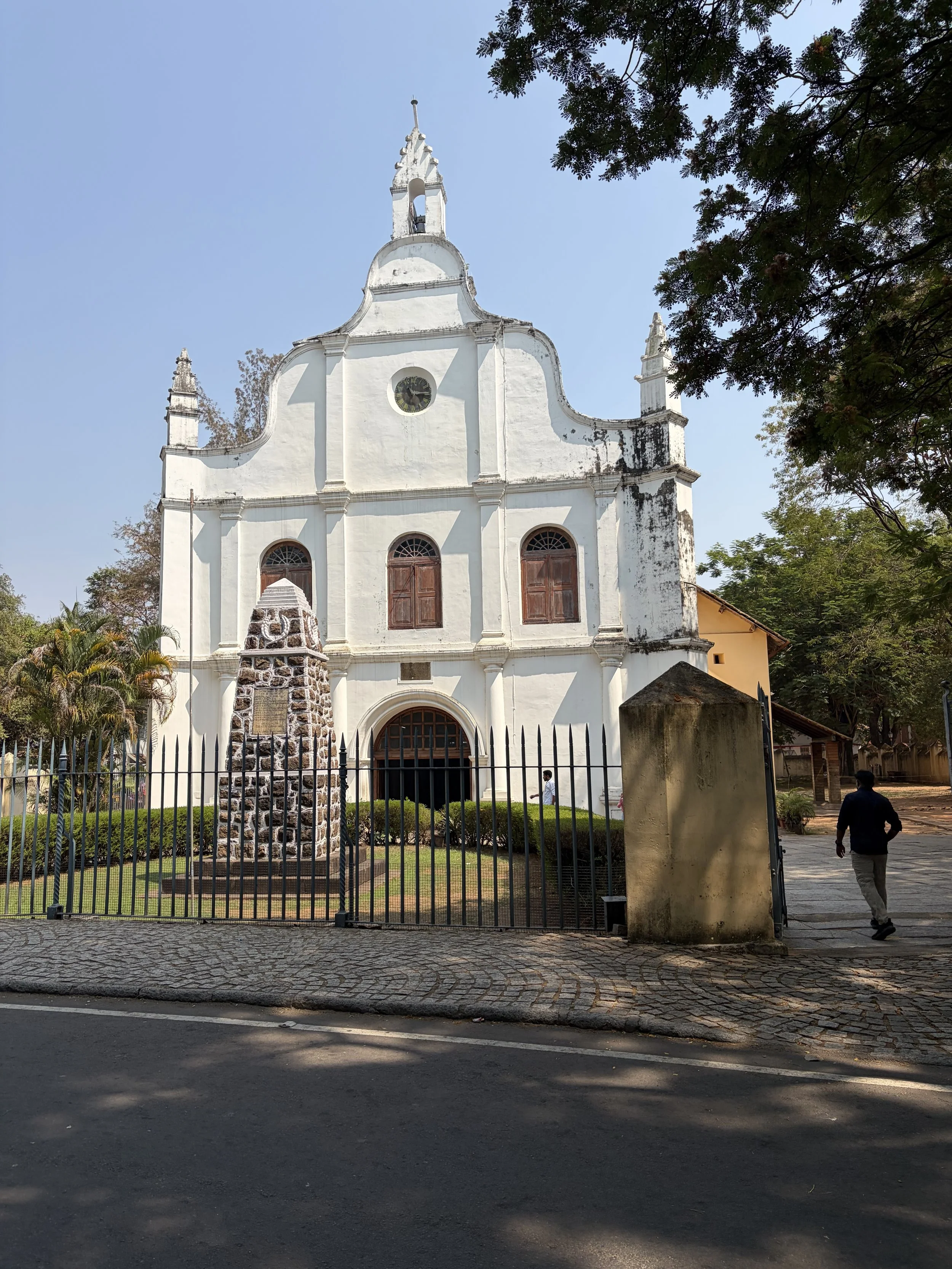
We clambered into our tuk tuk and our diver took us into the fort and showed us the main parade ground that the British used. He showed us some of the old colonial buildings which was are now mainly hotels. We then went on to St Francis Church which is one of the oldest European Churches in Kerala. It was built in the 16th century. The Portuguese explorer Vasco de Gama came her in 1498 and when he died in 1524 was initially buried in this church until his remains were taken back to Portugal. It was a lovely old Church and we could see Vasco de Gama’s old tomb.
We were then take to a large laundry -where they used to launder all the soldiers uniform. It is essentially a mass production washing and ironing area with a large acre type size drying area. We were then taken to another Church -a Syrian Church which dates back to 2500bc which is essentially built of mudbrick and sand, although the current structure dates back to 1750.
We then went to see the Mattancherry Palace which was built for Raja Varma in the 16th century. It was a lovely old palace which had a lot of manual people carriers on the streets and marvellous wooden ceilings.
We then went to Jew Town which is a great area of what was once Jewish Shops and houses and Synagogues but all the jews are now gone. It does however have a lot of shops and museums.
Kochi is well known for its perfume as it has the flowers and oils required. Perfume in Kochi is prominently associated with small-scale industries in Kalamassery, which hosts various manufacturing units including perfume production. Additionally, the historic Broadway market in Ernakulam, Kochi, is known for its diverse, bustling shops that offer various items including perfume and we saw this in the Jew Town. In fact they will allow you to create your own perfume.
We then got back in the tuk tuk and we went to the Santa Cruz Basilica which has apparently 16 th c frescoes in it but it was closed. We then went to the maritime museum and the Indian Navy is the 5th-7th largest in the world with about 140-160 ships. The UK has only about 60 I think. It was an interesting museum. We then went to the Lighthouse Bristow Hotel which we finished out tour and had a beer with the sun going down.
We then got a tuk tuk back to the boat but it was quite a death-defying drive and we nearly had several accidents. However, we got back in one piece and had a light supper of salad and cheese.
We wanted to see some tigers if we could and so contacted Justin, our agent to see if he could help. We have now planned a 2-night 3-day trip which we start early tomorrow and hope we will see tigers.
It was good to get off the boat today and to have a break.
The picture of the day is St Francis Church where Vasco de Gama was initially buried.
Need/Opportunity Year Three
In year three I will be going from Thailand to Sri Lanka, India, Maldives and then on to Mauritius, Reunion, Cape Town, St Helena, Azores and back to the UK.
I am looking for crew from Mauritius/ Reunion Island to Cape Town (mid June to end of July) and from Cape Town to the Azores and then to the UK (mid August onwards). If of any interest do email me.
The blog will continue as we continue the journey. If you have any comments or suggestions about the blog then do email me on hine.nick9@gmail.com