Year 3 -15th September 2026 -St Helena- Cape Verde -Day 13
Julian and I were on at 2.00am until 11.00pm. We were still motoring and in the Doldrums. There were plenty of rain clouds around which we could see on the radar screen and we would go off course normally to starboard to allow the rain clouds to pass in front of us so we missed the heavy rain. There was of course lightning too which lit up the sky on a regular basis. The main thing was that we were making progress and in the right direction.
We were glad to get to bed at 5.00am and left Mark & Dave to deal with a large rain cloud coming down our starboard side. The weather forecast was for the wind to fill in about 1.30pm or 5.00pm whichever was right.
I woke about 8.30am and had a welcome shower. We do not have hatches open at night and so it gets quite hot. Duvet’s were put aside long ago.
Paul and John were on watch and Paul cooked his usual egg and bacon. They then did the daily checks which was part of their watch duties.
I looked at the weather again and we should be out of the rain sector by the end of the day and once the wind picks up the end of the Doldrums. We had been lucky I think because we have had more wind than was originally thought.
I also looked at the pilot book again and worked out the light structures on the Southern Islands which we will pass through en route and if we were to arrive at night how we were going to get into the bay. I think the prudent thing to do would be to anchor outside the marina and then enter in the morning.
Mark made some tuna mayonnaise for lunch and we read, chatted and rested. Our 24 hour run until 12.00noon was 166nm.
We enjoyed lunch of wraps with houmous, tuna mayonnaise, salad (we found a lettuce which had survived from Cape Town) and of course coleslaw again!
Julian and I took over at 12.00noon and we were still motoring and waiting for the wind which came as forecast by 13.25pm and so up went the main and genoa and we were soon making 8+ kts rather than about 7kts under engine.
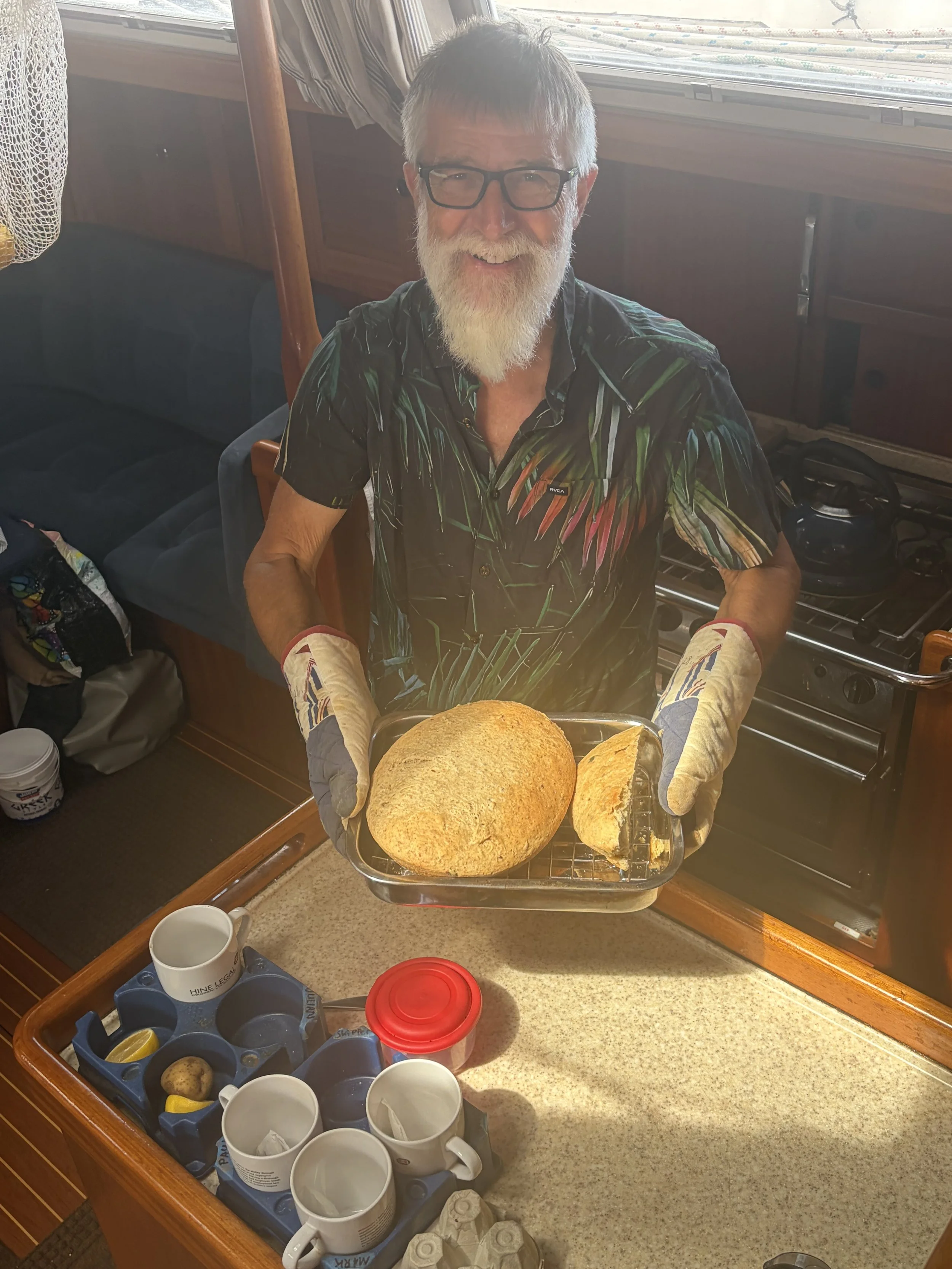
Paul and John made a loaf of bread supervised by Mark.
We are now approaching the Cape Verde islands. Cape Verde, also referred to in English by its Portuguese name Cabo Verde, and known officially as the Republic of Cabo Verde, is an archipelagic country in the eastern Atlantic Ocean, off the coast of West Africa. It consists of ten volcanic islands with a combined land area of about 4,033 square kilometres (1,557 sq mi). These islands lie between 600 and 850 kilometres (370 and 530 miles) west of Cap-Vert (i.e., Dakar), the westernmost point of continental Africa, after which they are named. Cape Verde forms part of the Macaronesia ecoregion, along with the Azores, the Canary Islands, Madeira and the Savage Islands.
The archipelago was uninhabited until the 15th century, when Portuguese explorers settled the islands, establishing one of the first European settlements in the tropics. Its strategic position gave it a significant role in the transatlantic slave trade during the 16th and 17th centuries; the islands saw rapid economic growth driven by the trade of manufactured goods, rum, cloth for African slaves, ivory, and gold. By the mid 19th century, increased foreign competition, persistent drought, and the decline of the slave trade led to economic decline and emigration; Cape Verde gradually recovered as an important commercial centre and stopping point for major shipping routes.
Cape Verde became independent in 1975. Since the early 1990s, it has been a stable representative democracy and has remained one of the most developed and democratic countries in Africa. Lacking natural resources, its developing economy is mostly service-oriented, with a growing focus on tourism and foreign investment. With a population of around 530,000 (as of 2026), Cape Verde is among the least populous countries in Africa. The Cape Verdean people trace their ancestry primarily to West African populations, with additional contributions from early Portuguese settlers and other groups who came to the islands. A sizeable diaspora exists across the world, especially in the United States and Portugal, considerably outnumbering the inhabitants on the islands. Cape Verde is a member state of the African Union.
The official language is Portuguese, while the recognized national language is Cape Verdean Creole (Crioulo), which is spoken by the vast majority of the population. As of the 2021 census, the most populous islands were Santiago (269,370) – which hosts the country's capital and largest city, Praia – São Vicente (74,016), Santo Antão (36,632), Fogo (33,519) and Sal (33,347). The largest cities are Praia (137,868), Mindelo (69,013), Espargos (24,500) and Assomada (21,297).
Cape Verde is a stable semi-presidential representative democratic republic. In 2026, it was a joint second most democratic nation in Africa (alongside Mauritius and South Africa), ranking 40th in the world, according to the electoral democracy score of the V-Dem Democracy indices.
The Cape Verde archipelago lies between latitudes 14° and 18°N, and longitudes 22° and 26°W. The country is a horseshoe-shaped cluster of ten islands (nine inhabited) and eight islets, that constitute the area of 4033 km2 (1557 sq mi).
The largest island, both in size and population, is Santiago, which hosts the nation's capital, Praia, the principal urban agglomeration in the archipelago. Sal, Boa Vista, and Maio, are fairly flat, sandy, and dry; the other islands are generally rockier with more vegetation. Cape Verde's climate is milder than that of the African mainland because the surrounding sea moderates temperatures, and cold Atlantic currents produce an arid atmosphere. Conversely, the islands do not receive the upwelling (cold streams) that affect the West African coast, so the air temperature is cooler than in Senegal, but the sea is warmer.
The afternoon wore on and the Mark and Dave took over at 4.00pm. However, by 5.00pm the wind had increased to 20kts + and the sea state rose. This meant reefing the main and the genoa and when the wind increased to 25 kts we replaced the genoa with the staysail. The sea state got to 2+m and this meant for some unpleasant conditions with some heel. The Baron came loose twice as water was coming over the bow and it had not been tied down for these conditions.
Mark cooked cassoulet with mash potatoes and artichokes for supper in these difficult conditions. This was very tasty and we eat it with quite a swell.
By 7.00pm the conditions began to ease and by 9,00pm we were back to 12-14 kts which was what was forecast. Julian and I took over at 11.00pm and the wind was down to 10-14 kts and we are only some 40 odd nm from the Southern Cape Verde islands. Some models suggest the wind will die and be less all the way to Mindelo some 160nm away in which case we will have to motor and others suggest we will have wind all the way. We will have to wait and see.
The picture of the day is John holding the first loaf he has made.
Need/Opportunity Year Three
I am now on the way to Cape Verde, Azores and back to the UK. At present I am full and there will be a change of 3 crew in the Azores for the final passage back to the UK.
The blog will continue as we continue the journey. If you have any comments or suggestions about the blog then do email me on hine.nick9@gmail.com