Year 3 -14th September 2026 -St Helena- Cape Verde -Day 12
Julian and I were on at 8.00pm until 11.00pm. We were sailing well and fast and on our course which was great and we will use the wind whilst we can. Everyone went to bed and Julian and I saw the tiny moon come out and a few stars but it was black and there were few clear patches. It seemed to me we were living on borrowed time with the wind.
At about 10.00pm the rain started and we had heavy rain. This effectively caused havoc to the wind and the direction was about 233 degrees (Southwest) when it suddenly changed in seconds to 280 and then died from about 14 kts to 5. The sails could not cope and rather than have the main flog I took it in. We sat in the rain which was teeming down and waited. In about 15 minutes we seemed to be through the worst and the wind came back to about 233 and also to about 12-14 kts so we got back to sailing again and on our course.
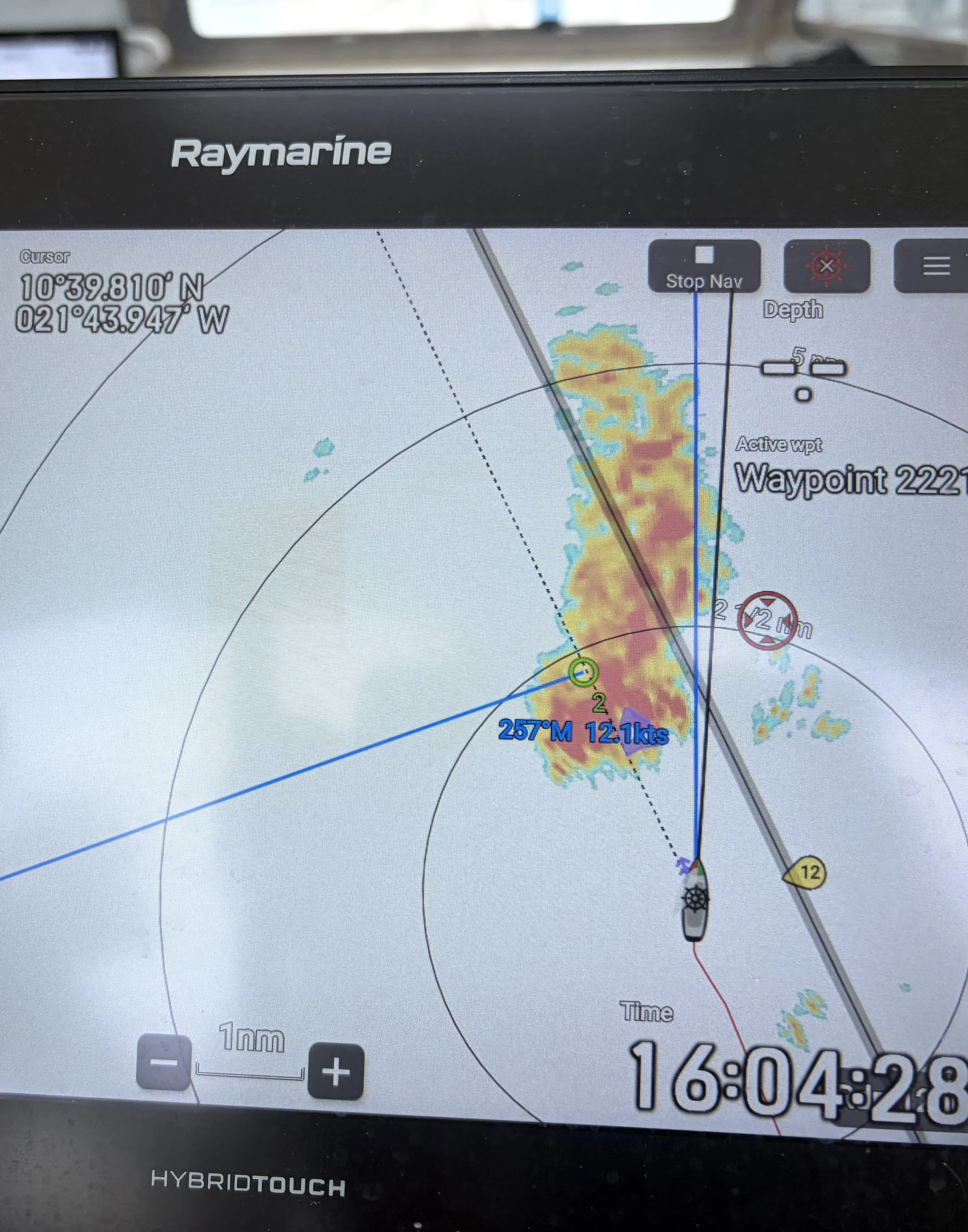
We had checked the radar and could see the rainstorms on the radar. We could see the one which we had just passed and saw another large band of rain ahead which we will arrive at about the time we hand over to Mark and Dave.
We sailed on toward it and watched things unfold. As we got closer I decided to take down both sails and motor through this one. Mark and Dave came on watch and we placed targets on various patches of rain. The decision to take down the sails was the right one as the wind went to 300 then 320 degrees and then to North – so we could never have sailed that as we would be right into the wind. I left Mark and Dave to it at 11.30pm and they said they would go back to sailing after the rain passed.
Well that was it. The rain effectively stopped the wind and it never returned and we were now in the blue light wind patch of the Doldrums.
We were still motoring when Julian and I came on at 5.00am with the wind pretty non-existent and all over the place. I checked the weather and this is now our lot until about lunchtime on the 15th (tomorrow) as we approach the Southern Islands of Cape Verde when the wind will come from the East Northeast and take us all the way hopefully to Sao Vicente, the island with the marina in Mindelo where Mark and I had been before on my last boat Luce di Mare in 2019 when we did the ARC + - crossing the Atlantic.
We came off at 8.00am and I made a bacon and egg sandwich for Dave, Paul and I. I had prepared a loaf of bread whilst on watch and this needed proving and then it went in the oven.
Mark and Dave did their daily checks and Mark made some more houmous for lunch. I read as my book is getting quite gripping. We saw on the radar various rainstorms and Julian and I had avoided one on our watch. These came and went and the wind would rise as you approached them and you could see the darkness in the cloud and the rain falling underneath it. We got some rain from time to time.
I had thought that it would be a good idea about 12.00noon to raise the Blue Baron and get it back in its bag again. We had to untangle everything and then we raised it and managed to get it back into its bag properly. As we did so we were aware of a big rain cloud coming so we decided to tie it to the deck again now snuffed properly and to raise and dry it another time. There was not enough wind to fly it at present.
The 24-hour run to 12.00noon was 166nm. This is about right bearing in mind we have been motoring about 6-6.5 kts for some time. Lunch was houmous, bread, cheese and meats with yes you guessed it coleslaw!
The afternoon wore on and we continued to dodge if we could the rain clouds and to make the miles. Paul mended some of the Blue Baron’s suffer bag and Mark set about doing a full provisioning list for when we reach Cape Verde. We hope to arrive some time on Tuesday morning -17th September 2026. He also dealt with the loose thread on the side ladder.
I have been monitoring the National Hurricane Centre for what I have referred to before as African Easterly Waves. African easterly waves (AEWs) are westward-moving atmospheric disturbances that form over sub-Saharan Africa during the summer monsoon season and act as the primary seed for about 80% of major Atlantic hurricanes. Most major Atlantic hurricanes and tropical storms trace their origins back to these waves coming off the African coast.
This is relevant as they form West of Cape Verde and could affect Cape Verde. Until now the National Hurricane Centre had been saying there is no activity expected in the next 7 days. However, when I looked yesterday I saw this.
For the North Atlantic...Caribbean Sea and the Gulf of America:
1. Central Subtropical Atlantic:
A trough of low pressure located a little more than 1000 miles
east-southeast of Bermuda continues to produce disorganized showers
and thunderstorms. Environmental conditions over the system are
currently unfavourable for development due to strong upper-level
winds. However, as the system moves west-northwestward across the
central part of the Subtropical Atlantic, it is forecast to enter a
more conducive environment for gradual development by the middle to
latter portion of this week.
* Formation chance through 48 hours...low...near 0 percent.
* Formation chance through 7 days...low...30 percent.
This is some way West of Cape Verde and something we need to keep an eye on.
Julian and I took over at 4.00pm having had 8 hours off. Where they went I do not know. It was sunny yet cloudy and immediately we had to bear right to avoid a large rainstorm which we managed. We then went back on course. We then saw a ship on AIS – excitement – we have only seen 3 on AIS since we left St Helena and we have had no visual sightings.
We motored on and Mark had been trying to fish. Suddenly the line went taught and the ratchet went and we thought we had a fish. I slowed the boat down and mark was struggling to bring it in. I then stopped the boat and went into reverse slowly and he was able to bring it in. Alas it was not a fish but Sargasso weed which we have been seeing the last few days.
Sargassum is essentially seaweed and spread predominantly in tropical and subtropical areas. It comes from the Sargasso Sea, which was named because it hosts large amounts of this seaweed. It can extend for kilometres across the ocean surface, forming golden brown drifting mats that move with the currents and wind; in recent years, Sargassum has been known for arriving in large quantities throughout the Caribbean region. More recently, scientists have found using satellite data that a new hotspot has been forming from western Africa and extends into the Caribbean Sea, called the Great Atlantic Sargassum Belt (GASB).
Sargassum plays an important ecological role in the open ocean because it provides a vital habitat for a variety of marine species, including fish, crabs, sea turtles, migratory birds and other organisms. However, when large amounts of Sargassum accumulate in the shore and start to decompose it forms what is known as Sargassum brown tides (SBT). SBT alters the water column by changing the appearance of the water and in addition alters the water quality by reducing light penetration, decreasing dissolved oxygen and changing the pH of the coastal waters. As a result, it affects seagrass meadows, corals, mangroves and coastal communities that depend on tourism. Sargassum was named after sargaço, the Portuguese word for grape, after Portuguese sailors who found the floating macroalgae in the Sargasso Sea noticed the small air-filled bladders that keep the seaweed afloat. It has become a major problem in Cape Verde washing up on its shores.
We also noticed some black fins in the water and saw a group of pilot whales which swam like dolphins but were much larger.
The sun went down but we were denied a good sunset due to cloud. Dave cooked burgers with mashed potato and peas which was good.
We settled down for a night’s motoring dodging the rain clouds and hope the wind returns tomorrow as forecast about lunchtime.
The picture of the day is radar showing us a large rainstorm which we were avoiding.
Need/Opportunity Year Three
I am now on the way to Cape Verde, Azores and back to the UK. At present I am full and there will be a change of 3 crew in the Azores for the final passage back to the UK.
The blog will continue as we continue the journey. If you have any comments or suggestions about the blog then do email me on hine.nick9@gmail.com