Year 3 -13 August 2026 -Cape Town-South Africa
It was a beautiful lovely blue-sky day when we woke and we had an early breakfast as we were being picked up by a chauffeured van at 8.30am for a day trip. I felt a little better but still a bit coldly and I had a dry cough.
Julian had to go to work so the remaining 5 of us got into the van driven by Grant and we headed off toward Langebaan some 100 + km North of Cape Town.
Grant explained that there are 3 capitals. Cape Town was the capital of the legislature, Bloemfontein is the capital of the Judiciary and Pretoria the capital of Parliament. Cape Town is heavily dependent on tourism although outside CT there is quite a lot of agriculture going on. He said the problem with South Africa is that there is 32.2% unemployment which is very high. In addition recently there has been a movement to get rid of those here illegally as there is a perception they are taking peoples jobs etc. It is therefore a difficult and complex issue.
Once you are within a few miles of CT there is little along the coast and we passed the Kroeger Power Station, South Africa’s only Nuclear power station.
We pulled into Table Bay a small town about 20 minutes North of Cape Town to go to an ATM and to get some water etc. I got some cough tincture and took some.
Once done we continued along a very straight dual carriageway road for about 90 km. This just had large areas of land each side and a fence along each side to prevent animals getting on to the road but Grant explained that they can do particularly at night.
We carried on and turned off to go into the West Coast National Park which is a game reserve although not for the big 5.
The West Coast National Park lies 88 km (55 mi) north of Cape Town in the Western Cape province of South Africa. The park is found inside of the Cape West Coast Biosphere Reserve, part of the UNESCO Man and the Biosphere Programme. It is bordered by the Atlantic Ocean on the west and the R27 coastal road, and runs from the town of Yzerfontein in the south, up to the Langebaan Lagoon. The park is particularly well known for its bird life and for the spring flowers which occur in the months from August to September, especially in the Postberg flower reserve section of the park. The park, with the islands in Saldanha Bay, has been identified by BirdLife International as an Important Bird Area. The park was proclaimed in 1985, and is 36,259.8 hectares (140.000 mi2) in size.
The Langebaan Lagoon, a Ramsar site, was proclaimed as a marine reserve in 1973. Concerns over the condition of the Langebaan Lagoon and neighbouring Saldanha Bay led to a proposal in 1976 that the Langebaan Lagoon, the peninsula, the offshore islands and the surrounding land urgently be proclaimed as a nature reserve. The Langebaan National Park was declared in 1985, after a long process, and it was expanded in 1987 when some land which had been managed by the Department of Forestry and neighbouring farms were included in the park. In that same year an additional 1,800 hectares (4,400 acres) of land around Postberg was included as a "contractual national park". Expansion has continued since then. Its name was changed to West Coast National Park in 1987 In 2000, the park and Langebaan Lagoon was added to the UNESCO Cape West Coast Biosphere Reserve.
Wildlife in the park includes large antelope such as eland, red hartebeest, bontebok, kudu, gemsbok, steenbok, mountain zebra, duiker and ostriches in the Postberg section. Other smaller animals include the bat-eared fox, caracal, and Cape grey mongoose.
Many Palearctic migrants’ winter in the lagoon during the austral summer, particularly in September as species arrive from the northern hemisphere, and in March when they gather in large numbers to feed up prior to undertaking the return migration. At these times the birds will be transitioning out of and into their breeding plumage. The birds are pushed towards the hides as the water level rises with the tide and eventually they must fly off until the tide has receded once more. Red knot, sanderling, Little stint, Ruff, marsh sandpiper, Terek sandpiper and Curlew sandpipers, Ruddy turnstone, Ringed and Grey plover, Greenshank, Eurasian whimbrel, Eurasian curlew and Bar-tailed godwit are the most regular species. Little egret and South African shelduck are residents and can often be seen with the waders, while Greater flamingos and Great white pelican occur in deeper water. An isolated hide west of the Geelbek educational centre overlooks a salt pan where it is possible to observe the rare Chestnut-banded plover. The lagoon's importance for migratory birds means that it is a site which is subject to the Ramsar Convention for the conservation and sustainable use of wetlands.
On the land, the fynbos surrounding the lagoon is home to Southern black korhaan, Cape spurfowl, Grey-winged francolin, Cape penduline and Grey tit, Ant-eating chat, White-throated and Yellow canary, Karoo lark, Chestnut-vented warbler, Bokmakierie and Cape bunting, which are all easily seen. African marsh harrier and Black Harrier hunt by quartering the ground. The coastal islands at the mouth of the lagoon are important breeding colonies for Kelp and Hartlaub's gull, Cape gannet and African penguin, as well as cormorants and terns.
Although the thousands of migrating birds are an important part of the conservation, the flowers are also a major attraction. The park is composed of various kinds of habitats — as well as the Langebaan fynbos and lagoon — which account for the variety of flora and fauna all around the park. The months of August and September bring about the proliferation of annual Spring flowers in the West Coast National Park. During the spring flower season large fields of blooming White rain daisies, Gousblo, Magriet, Livingstone daisies, and Wild sorrel can be seen along with other species of flowering plants.
The area of Postberg, where the carpets of Spring flowers can be seen, is only open during the months of August and September.
The Langebaan Lagoon was formed by the rising and drop of sea levels during pre-historic times. This is unlike most lagoons which form where freshwater rivers enter the sea. As a result, Langebaan Lagoon is purely a saltwater lagoon.
As far back as 500 000 years ago, early Homo sapiens were probably present in the area, living in groups and hunting small game, displacing carnivores, such as lions, from their kills and gathering plant foods. They made fire as protection and for cooking and probably made simple shelters from branches. They used animal skins for warmth and clothing, and also made wooden and stone tools, as evidence of these found here proves. Eve's footprint is the oldest known footprints of an anatomically modern human.
The area is rich in historical events from the first inhabitants, the Khoikhoi and San, to the arrival of the Europeans. The first European to set foot on land was Vasco da Gama at St Helena Bay on the West Coast Peninsula in 1497.
The town Langebaan was founded in 1922 and used as a whaling station until the 1960s. To protect its culture as a fishing, holiday and retirement village, the town allows no industries.
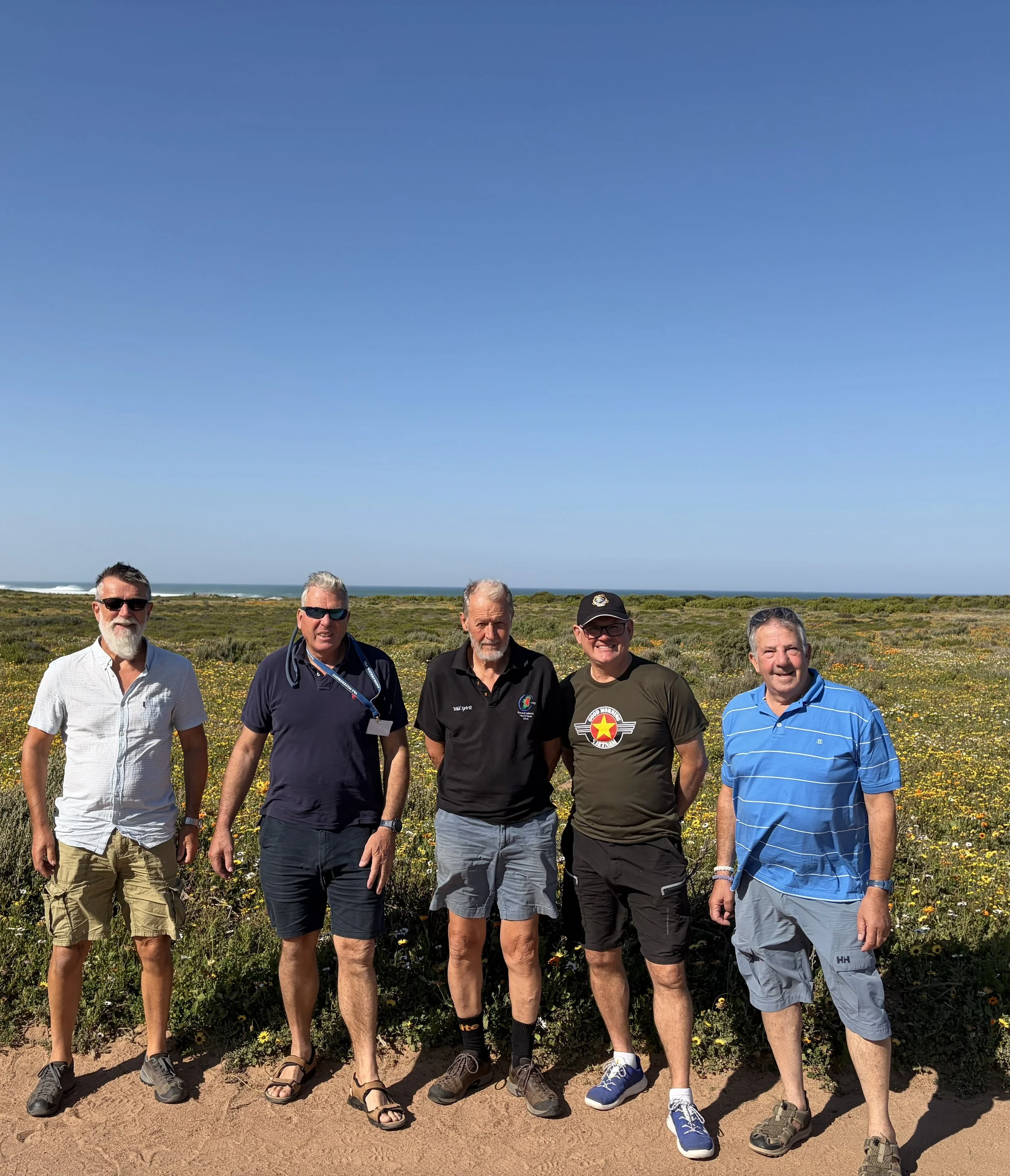
We entered the park and went up the west side of the coast and the lagoon which was on our right. We went as far as Postberg and saw the famous daisies which were in swathes of yellows, whites and orange and it was beautiful. We also saw some Bontebok, Elands, Mountain Zebras, Ostriches, a Cape grey Mongoose, Black Harriers and other Hawk like birds. There are quite a lot of snakes here- Black Mambas, Puff Adders, Cobras etc which we did not see but we did see a Cape Molesnake going across the road in front of us. The scenery was beautiful and we stopped a few times to take some pictures.
We retraced our steps and went back round the lagoon to its East side and then drove on to Langebaan where we found a restaurant overlooking the bay which was beautiful. This is a kite surfing area and there were two surfers going up and down and doing various aerial aerobatics on their boards which was interesting to watch.
We had a good lunch and then got back in the van to drive back and to go back via the Durbanville Hills to do some wine tasting. I had not been feeling great and had taken some cough mixture in the morning to help my cough. I took some more after lunch and as soon as I had done so I felt peculiar. After a while I began to feel nauseous and we had to stop the van twice and I was rather unwell. My stomach clearly did not want the contents to be there and it must have been a reaction to the cough medicine I think. I did not feel great thereafter as you can imagine and I did not participate in the wine tasting.
We drove back to the boat and I went straight to bed. Dave went off to his apartment and then Paul, Mark and John went out for supper although John was not feeling great. Julian was working poor chap.
Apparently John was ill when he came back and went to bed too so something must be going around.
It had been a good day on the whole.
I had an update from the mast guys that things were going well and we are now planning the mast going on first thing Monday morning and the sails will then go on with a test sail Monday or Tuesday. This was good news and we are making good progress.
The picture of the day is of the 5 of us at Postberg with the daisies behind us.
Need/Opportunity Year Three
I am now on the way to Durban and will then head for Cape Town and then on to St Helena, Azores and back to the UK.
The blog will continue as we continue the journey. If you have any comments or suggestions about the blog then do email me on hine.nick9@gmail.com