Year 3 -12 August 2026 -Cape Town-South Africa
It was another lovely blue-sky day when we woke and we had breakfast. I felt a bit better but still a bit coldy.
As it was such a good day some went off to go up Table Mountain and others including myself went off to Kirstenbosch Gardens. We caught the hop on hop off bus as it will take us to the gardens and on to Camps Bay where we all agreed to meet for lunch.
We therefore listened to the commentary again as we went along and got to the gardens about 10.50am. Luckily there was a tour starting at 11.00am so we joined that tour.
Kirstenbosch is a botanical garden nestled at the eastern foot of Table Mountain in Cape Town. The garden is one of 10 National Botanical Gardens covering five of South Africa's six different biomes and administered by the South African National Biodiversity Institute (SANBI). Prior to 1 September 2004, the institute was known as the National Botanical Institute.
Kirstenbosch places a strong emphasis on the cultivation of indigenous plants. When Kirstenbosch was founded in 1913 ( by Professor Harold Pearson whose vision led to the gardens and whose tomb is in the gardens) to preserve the flora native to the South Africa’s territory, it was the first botanical garden in the world with this ethos, at a time when invasive species were not considered an ecological and environmental problem.
The garden include a large conservatory (The Botanical Society Conservatory) exhibiting plants from a number of different regions, including savanna, fynbos, karoo, and others. Outdoors, the focus is on plants native to the Cape region, highlighted by the spectacular collections of proteas. It is a level IV accredited Arboreta by the ArbNet Arboretum Accreditation Program and The Morton Arboretum..
The handover of ownership of the colony to Britain in 1811 brought changes in the use of the Kirstenbosch area. Two large land grants were made, with a Colonel Bird building a house, planting chestnut trees, and establishing a bath (still extant) fed by a natural spring. The Ecksteen family acquired the land in 1823, and it later came into the possession of the Cloete family (a well-known Cape lineage). Under their stewardship, the area was farmed more formally, being planted with oaks, fruit trees, and vineyards.
The land was thereafter purchased by Cecil Rhodes in 1895. After this point, the area became run-down, with large groups of pigs feeding on the acorns and wallowing in the pools. The famous Camphor Avenue was planted in 1898. The land now occupied by the Kirstenbosch Gardens was bequeathed to the nation by Rhodes, who died in 1902.
The history of the area as a botanical garden has its origin in Henry Harold Pearson, a botanist from Cambridge University who came to the Cape Colony in 1903 to take up a position as professor in the newly created chair of botany at the South African College (the predecessor of today's University of Cape Town.) In February 1911, Pearson visited the area of Kirstenbosch by cart with Neville Stuart Pillans to assess its suitability as a site for a botanical garden.
On 1 July 1913, the area was set aside for this purpose by the government of the colony, with an annual budget of £1,000 (equivalent to R415,000 in 2018). No money was set aside for a salaried director's position, but Pearson accepted the position without pay. He lived in the gardens in difficult and reduced circumstances.
The task confronting Pearson was formidable. The area was overgrown, populated by wild pigs, overrun with weeds, and planted with orchards. Money was tight, and the budget was supplemented by the sale of firewood and acorns. Pearson commenced work in the area of Kirstenbosch known as "The Dell", planting cycads which are still visible there today.
Pearson died in 1916 from pneumonia. He was buried in his beloved garden, and his epitaph is still there today: "If ye seek his monument, look around". Since 1913, the garden has been successively administered by the Botanical Society of South Africa, the National Botanic Gardens of South Africa, the National Botanical Institute, and the South African Biodiversity Institute (SANBI) from 2004. The garden celebrated its centenary in 2013, issuing the commemorative book Kirstenbosch: The Most Beautiful Garden in Africa.
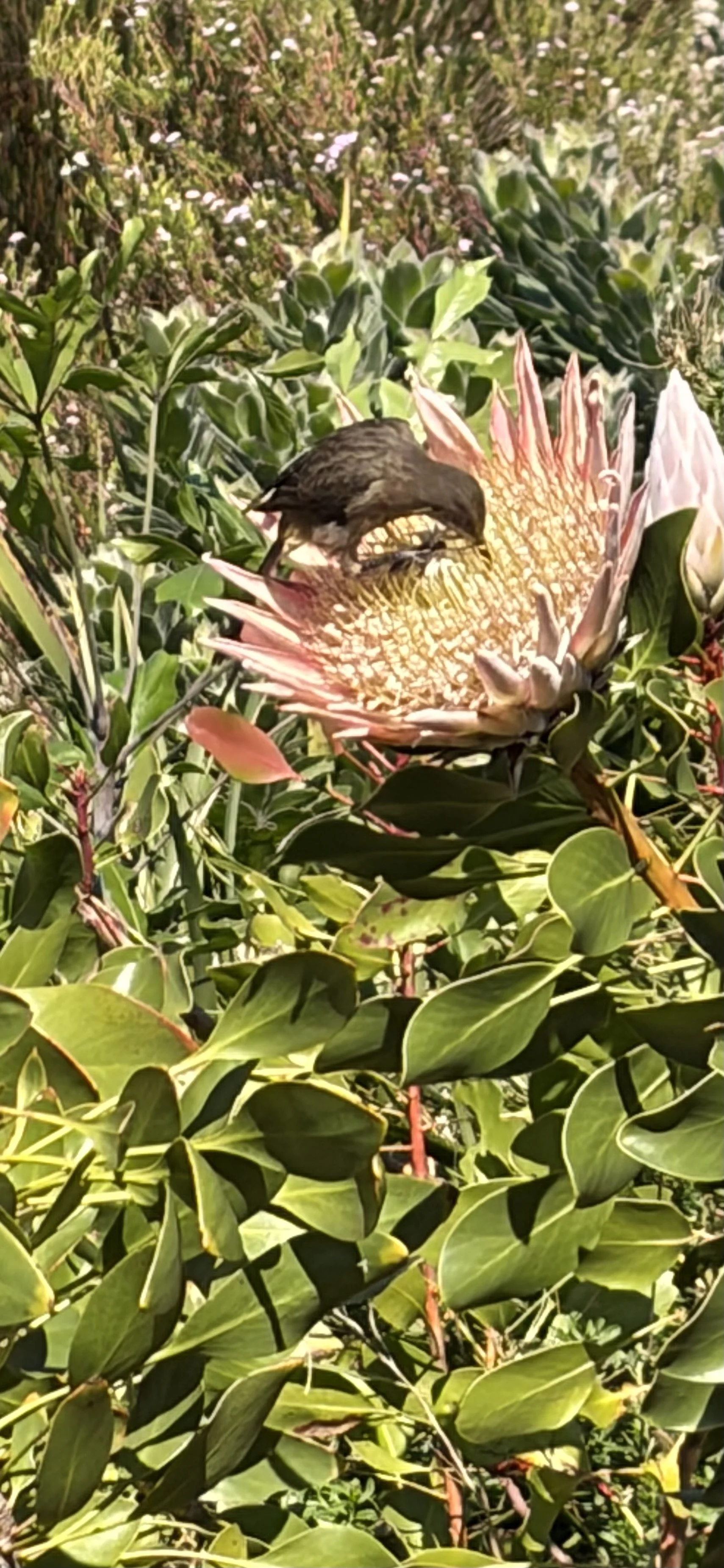
The tour took us round the gardens seeing all sorts of different plants and trees including Aloe’s, Cycads (the oldest type of tree in the world) and of course Protea’s being the National symbol for South Africa. We also saw some sunbirds which come to pollinate the flowers. They are nectar feeding birds. They have a curved beak and tongue which enables them to get into tubes to drink up the nectar.
The guys who had gone to Table Mountain had taken the VIP version so they went straight to the front of the queue otherwise they would have had a 1.5-2 hour wait. They went to Camps Bay as agreed. Once we had completed our tour we got back on the bus and went round to Haut Bay and then on to Camps Bay. This took us a while and when we arrived the others had already had lunch. It was a lovely afternoon so we sat on the terrace and overlooked the bay and watched the sea crashing on the shore and the beach activities. How lucky we are to be here and in such nice weather.
We got back on the bus and continued the journey back to the V&A enjoying the spectacular scenery on such a calm day. We got back and came back to Stormbird and enjoyed sitting in the sun.
Mark went to meet some more cousins and brought her and her sons to look at Stormbird. The sons wanted to push all the buttons – kids eh.
We decided to go to the market which is open on a Wednesday 4-9.00pm. This was the same market I had been to on my own. They were all blown away by it and so we found a table, had a drink and then individually to get different types of food from various stalls which was a change from a restaurant.
We have planned a tour tomorrow to the Langebaan Area on the West coast North of Cape Town which should be fun.
The picture of the day is of a sunbird sucking nectar out of a Protea.
Need/Opportunity Year Three
I am now on the way to Durban and will then head for Cape Town and then on to St Helena, Azores and back to the UK.
The blog will continue as we continue the journey. If you have any comments or suggestions about the blog then do email me on hine.nick9@gmail.com