Year 2- 28th October 2025 -Arrival in Port Dickson and check in to Malaysia
We woke about 5.00am and had had a calm night at anchor and managed some sleep. It was dark but we upped anchor and headed around Pulau Besar and headed North to Port Dickson which was some 40 odd miles away. We had reserved a space at Admiral’s Marina and we will check in to Indonesia there.
The navigation and steaming lights were on and we set the engine in gori (the efficient angle for the propeller) at 1200 revs. There was little wind and what there was - was on the nose. We initially had some tide with us perhaps 0.5 of a kt. We had a cup of tea and Andy and I settled down to the first watch.
It did not get light until just before 7.00am which is different even with the hour ahead change we had made the night before. I had noticed the night before that it got dark later and the correlation being it gets light later which is a bit better really although I had got used to the early starts. We had ahead a load of anchored cargo ships and tankers which we skirted round and quite a few tugs and dredgers. One was operational and we did not think he was dredging the bottom in 30 plus metres but was collecting sand from the seabed which they must use probably for building purposes.
Our shift went relatively quickly and Mark and Ruth took over and as it was light now at 7.30am we noticed much more development and sophistication in the buildings ashore compared to Indonesia.
Mark & Ruth handed over to Keith and Steve and we continued to pass anchored ships and if we zoomed out on the plotter we could see the green of the shipping lanes busily going North and South some 5 nm or so to the West of us.
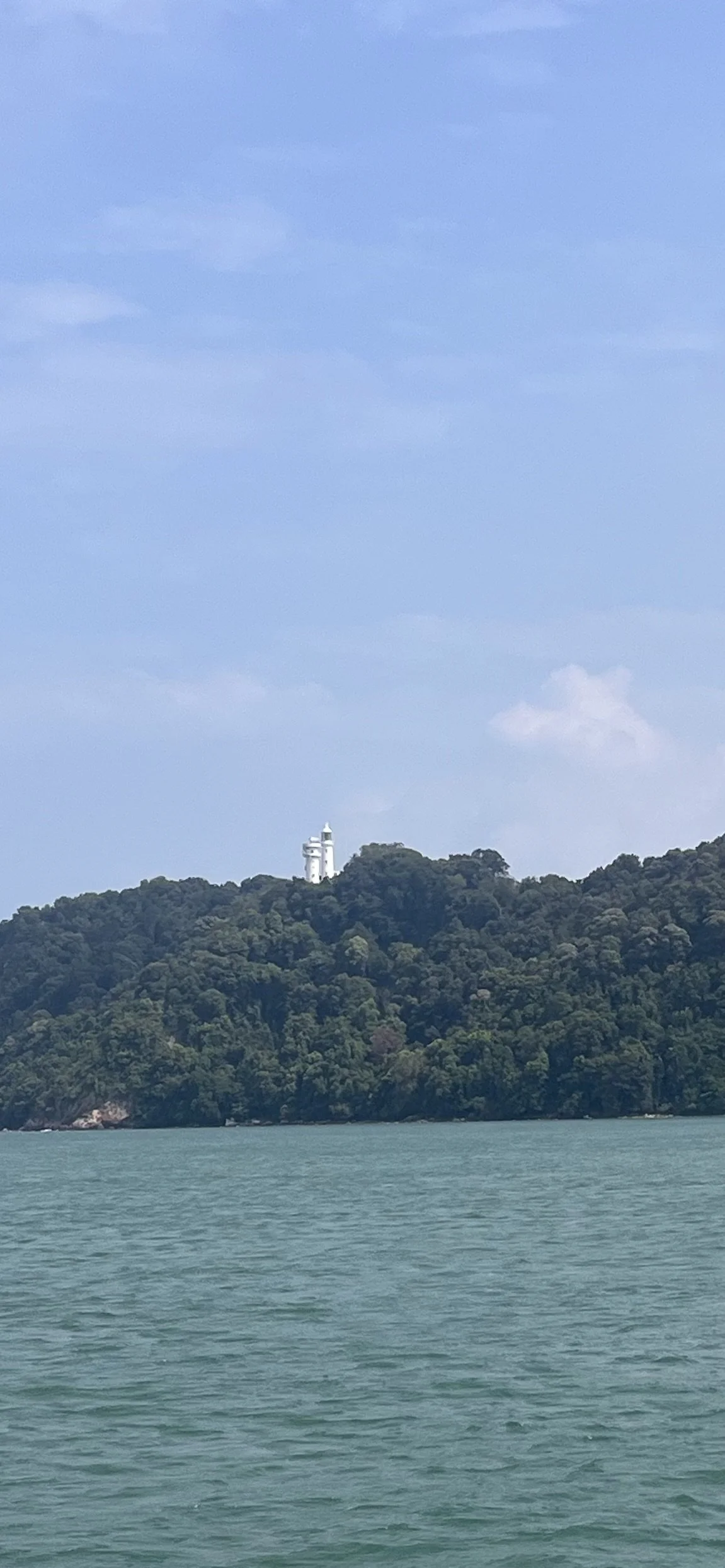
The tide slowly began to turn against us so we were going a little slower. By about 11.00am we were beginning to approach Port Dickson and the channel we needed to take to get to the marina. We passed an impressive lighthouse called the Rachado Lighthouse set high up on a cliff on the promontory before the channel which had a rock in its entrance which we had to avoid. I thought it would be good to go and see it.
We entered the channel and avoided the rock and motored along the channel until opposite the marina which means you have to cross the shallow to get to it. High Tide had only just occurred and so we were able to motor in and the lowest it got was about 4.5m. We skirted round the breakwater and then into the narrow entrance. I had called the marina on Ch 14 and I already knew which berth we had and I had been sent a map. There was some men waiting to help us at our berth. I knew by reversing in it would be starboard to and we had already prepared the lines and fenders. We therefore reversed into B3 and were soon secured on the berth. We sorted out our lines and then with the adapter they had fitted the electric cable.
As we had not checked in we were flying our Q flag and I instructed everyone to stay on board. I therefore went to the office to meet Sarah who I had been communicating with on WhatsApp. She greeted me and explained the process to check in and suggested we got taxis after lunch to go to the Harbourmaster, Customs and Immigration Offices. She said she would prepare all the paperwork for us and needed to see various documents and passports.
The buildings ashore as we approached the marina and the marina complex were noticeably more modern and sophisticated and reflected how further advance Malaysia was. The marina had a restaurant, bar, pool, gym and toilets and showers. I returned to Stormbird and explained our plan to go into town after lunch. We had a celebratory beer and then some cheese, bread and fruit for lunch.
We ordered some taxis after lunch through an app called Grab which is a bit like Uber. We first attended the Harbourmaster’s office. The route again made we realise how much more developed Malaysia is as a country and they also drive on the left here. The Harbourmaster’s office was friendly and we completed the paperwork quite quickly. We then went to customs which was next door. There is a procedure here where if you got to a port and check in, you have to check out when you leave which is a pain. We had already planned to leave in 2 days so I was just able to do the check out at the same time as you can do it 48 hours in advance. After customs we then had to go to Immigration which of course was somewhere else being the ferry terminal. The lady in charge there was not very pleasant and made you feel a bit like a naughty boy when completing the documentation. However, we eventually got our passports stamped and we legally entered into Malaysia.
We returned to Stormbird and had a relaxed afternoon either at the pool or in the bar for some. We had decided to have supper at the restaurant but the odd thing was that you are not allowed alcohol in the restaurant but can go down to the bar and eat there with alcohol although it was it as nice.
We eventually went to the bar about 7.00pm. We had met Nuria and Brice who were on the catamaran Sabre 11 who we had passed the day before and who had been on the Sail2Indonesia Rally. We had supper which was not bad except they had to bring it down in a trolley from upstairs and brought starters and main together!!. After super there was a girl band of 3 singing to just us. They were actually very good and would allow us to make requests for songs. I chose “Shine bright like a diamond” by Rhianna which they did and it was very good. We enjoyed the live music and stayed until they finished about 11.00pm.
Earlier I had been planning where to go next and had sent some messages to a marina at PangKor Island so we shall see.
Malaysia is a country in Southeast Asia. A federal constitutional monarchy, it consists of 13 states and three federal territories, separated by the South China Sea into two regions: Peninsular Malaysia on the Indochinese Peninsula and East Malaysia on the island of Borneo. Peninsular Malaysia shares land and maritime borders with Thailand, as well as maritime borders with Singapore, Vietnam, and Indonesia; East Malaysia shares land borders with Brunei and Indonesia, and maritime borders with the Philippines and Vietnam. Kuala Lumpur is the country's national capital, largest city, and the seat of the legislative branch of the federal government, while Putrajaya is the federal administrative capital, representing the seat of both the executive branch (the Cabinet, federal ministries, and federal agencies) and the judicial branch of the federal government. With a population of over 34 million, it is the world's 42nd-most populous country.
The country has its origins in the Malay kingdoms, which, from the 18th century on, became subject to the British Empire, along with the British Straits Settlements protectorate. During World War II, British Malaya, along with other nearby British and American colonies, was occupied by the Empire of Japan. Following three years of occupation, Peninsular Malaysia was briefly unified as the Malayan Union in 1946 until 1948 when it was restructured as the Federation of Malaya. The country achieved independence on 31 August 1957. On 16 September 1963, independent Malaya united with the then British crown colonies of North Borneo, Sarawak, and Singapore to become Malaysia. In August 1965, Singapore was expelled from the federation and became a separate, independent country.
Malaysia is tropical and is one of 17 megadiverse countries; it is home to numerous endemic species. The country is multiethnic and multicultural, which has a significant effect on its politics. About half the population is ethnically Malay, with minorities of Chinese, Indians, and indigenous peoples. The official language is Malaysian Malay, a standard form of the Malay language. English remains an active second language. While recognising Islam as the official religion, the constitution grants freedom of religion to non-Muslims. The government is modelled on the Westminster parliamentary system, and the legal system is based on common law. The head of state is an elected monarch, chosen from among the nine state sultans every five years. The head of government is the prime minister.
Malaysia's economy has traditionally been driven by its natural resources but is expanding into commerce, tourism, and medical tourism. The country has a newly industrialised market economy, which is relatively open and state-oriented. The country is a founding member of the Organisation of Islamic Cooperation (OIC), the East Asia Summit (EAS), and the Association of Southeast Asian Nations (ASEAN), as well as a member of the Non-Aligned Movement (NAM), the Commonwealth, and the Asia-Pacific Economic Cooperation (APEC). Malaysia ranks 10th in Global Peace Index and 11th in Henley Passport Index.
Evidence of modern human habitation in Malaysia dates back 40,000 years. In the Malay Peninsula, the first inhabitants are thought to be Negritos. Areas of Malaysia participated in the Maritime Jade Road between 2000 BC to 1000 AD. Traders and settlers from India and China arrived as early as the first century AD, establishing trading ports and coastal towns in the second and third centuries. Their presence resulted in strong Indian and Chinese influences on the local cultures, and the people of the Malay Peninsula adopted the religions of Hinduism and Buddhism. The spread of Islam increased following Parameswara's conversion to that religion. Malacca was an important commercial centre during this time, attracting trade from around the region.
The Dutch fleet battling with the Portuguese armada as part of the Dutch–Portuguese War in 1606 to gain control of Malacca. In 1511, Malacca was conquered by Portugal, after which it was taken by the Dutch in 1641. In 1786, the British Empire established a presence in Malaya, when the Sultan of Kedah leased Penang Island to the British East India Company. The British obtained the town of Singapore in 1819,[52] and in 1824 took control of Malacca following the Anglo-Dutch Treaty. By 1826, the British directly controlled Penang, Malacca, Singapore, and the island of Labuan, which they established as the crown colony of the Straits Settlements. By the 20th century, the states of Pahang, Selangor, Perak, and Negeri Sembilan, known together as the Federated Malay States, had British residents appointed to advise the Malay rulers, to whom the rulers were bound to defer by treaty. The remaining five states on the peninsula, known as the Unfederated Malay States, while not directly under British rule, also accepted British advisers around the turn of the 20th century. Development on the peninsula and Borneo were generally separate until the 19th century. Under British rule the immigration of Chinese and Indians to serve as labourers was encouraged. The area that is now Sabah came under British control as North Borneo when both the Sultan of Brunei and the Sultan of Sulu transferred their respective territorial rights of ownership, between 1877 and 1878. In 1842, Sarawak was ceded by the Sultan of Brunei to James Brooke, whose successors ruled as the White Rajahs over an independent kingdom until 1946, when it became a crown colony.
In the Second World War, the Japanese Army invaded and occupied Malaya, North Borneo, Sarawak, and Singapore for over three years. During this time, ethnic tensions were raised and nationalism grew. Popular support for independence increased after Malaya was reconquered by Allied forces. Post-war British plans to unite the administration of Malaya under a single crown colony called the Malayan Union met with strong opposition from the Malays, who opposed the weakening of the Malay rulers and the granting of citizenship to the ethnic Chinese. The Malayan Union, established in 1946, and consisting of all the British possessions in the Malay Peninsula except for Singapore, was quickly dissolved and replaced on 1 February 1948 by the Federation of Malaya, which restored the autonomy of the rulers of the Malay states under British protection.
During this time, the mostly ethnically Chinese rebels under the leadership of the Malayan Communist Party launched guerrilla operations designed to force the British out of Malaya. The Malayan Emergency (1948–1960) involved a long anti-insurgency campaign by Commonwealth troops in Malaya. On 31 August 1957, Malaya became an independent member of the Commonwealth of Nations. Subsequently, a comprehensive plan was devised to unite Malaya with the crown colonies of North Borneo (known as Sabah upon joining), Sarawak, and Singapore. The envisioned federation was originally intended to take place on 31 August 1963, to coincide with the commemoration of Malayan independence. However, due to the necessity of conducting a survey on the level of support for the federation in Sabah and Sarawak by the United Nations, as requested by opponents of the federation such as Indonesia's Sukarno and the Sarawak United Peoples' Party, the date of the federation was postponed until 16 September 1963.
The economy shifted from being agriculturally based to one based on manufacturing and industry. Numerous mega-projects were completed, such as the Petronas Towers, the North–South Expressway, the Multimedia Super Corridor, and the new federal administrative capital of Putrajaya. In the late 1990s, the Asian financial crisis impacted the country, nearly causing their currency, stock, and property markets to crash; however, they later recovered.
Malaysia is a federal constitutional elective monarchy and the only federal country in Southeast Asia. The system of government is closely modelled on the Westminster parliamentary system, a legacy of British rule. The head of state is the King, whose official title is the Yang di-Pertuan Agong. The King is elected to a five-year term by and from among the nine hereditary rulers of the Malay states. The other four states, which have titular Governors, do not participate in the selection. By informal agreement the position is rotated among the nine,] and has been held by Ibrahim Iskandar of Johor since 31 January 2024. The King's role has been largely ceremonial since changes to the constitution in 1994, picking ministers and members of the upper house.
Malaysia's foreign policy is officially based on the principle of neutrality and maintaining peaceful relations with all countries, regardless of their political system. The government attaches a high priority to the security and stability of Southeast Asia, and seeks to further develop relations with other countries in the region. Historically the government has tried to portray Malaysia as a progressive Islamic nation while strengthening relations with other Islamic states. A strong tenet of Malaysia's policy is national sovereignty and right of a country to control its domestic affairs. Malaysia signed the UN treaty on the Prohibition of Nuclear Weapons.
Homosexuality is illegal in Malaysia and authorities have imposed punishments such as caning and imprisonment. Human trafficking and sex trafficking in Malaysia are significant problems. There have also been cases of vigilante executions and beatings against LGBT individuals in Malaysia.
The death penalty is in use for serious crimes such as murder, terrorism, and drug trafficking, some of which were once mandatory. However, in July 2023, following the passing of the Abolition of Mandatory Death Penalty Act 2023, mandatory death penalty was abolished for all crimes in Malaysia, thereby allowing judges to impose the capital punishment at their own discretion and on a case-by-case basis. The new law also abolished all natural life imprisonment, replacing it with 30 to 40 years prison terms instead.
Malaysia is the 66th largest country by total land area, with a total area of 330,803 km2 (127,724 sq mi). West Malaysia shares land borders with Thailand, while East Malaysia shares land borders with Indonesia and Brunei. Singapore is separated from the West by the Straits of Johor and is linked to it by a narrow causeway and a bridge. The country also shares maritime boundaries with Indonesia, Vietnam and the Philippines. The land borders are defined in large part by geological features such as the Perlis River, the Golok River and the Pagalayan Canal, whilst some of the maritime boundaries are the subject of ongoing contention. Brunei forms what is almost an enclave in Malaysia, with the state of Sarawak dividing it into two parts. Malaysia is the only country with territory on both the Asian mainland and the Malay Archipelago. The Strait of Malacca, lying between Sumatra and Peninsular Malaysia, is one of the most important thoroughfares in global commerce, carrying 40% of the world's trade. The southernmost point of mainland Asia is located at Tanjung Piai, in the state of Johor.
Malaysia signed the Rio Convention on Biological Diversity on 12 June 1993, and became a party to the convention on 24 June 1994. It has subsequently produced a National Biodiversity Strategy and Action Plan, which was received by the convention on 16 April 1998. The country is megadiverse with a high number of species and high levels of endemism. It is estimated to contain 20% of the world's animal species. High levels of endemism are found on the diverse forests of Borneo's mountains, as species are isolated from each other by lowland forest.
Malaysia is a relatively open state-oriented and newly industrialised market economy. It has the world's 36th-largest economy by nominal GDP and the 31st-largest by PPP. In 2017, the large service sector contributed to 53.6% of total GDP, the industrial sector 37.6%, and the small agricultural sector roughly 8.8%.Malaysia has a low official unemployment rate of 3.4% as of 2024. Its foreign exchange reserves are the world's 24th-largest. It has a labour force of about 15 million, which is the world's 34th-largest. Malaysia's large automotive industry ranks as the world's 22nd-largest by production.
Malaysia is the world's 23rd-largest exporter and 25th-largest importer. However, economic inequalities exist between different ethnic groups. The Chinese make up about one-quarter of the population, but account for 70% of the country's market capitalisation. Chinese businesses in Malaysia are part of the larger bamboo network, a network of overseas Chinese businesses in the Southeast Asian market sharing common family and cultural ties.
International trade, facilitated by the shipping route in adjacent Strait of Malacca, and manufacturing are the key sectors. Malaysia is an exporter of natural and agricultural resources, and petroleum is a major export. Malaysia has once been the largest producer of tin, rubber and palm oil in the world. Manufacturing has a large influence in the country's economy, although Malaysia's economic structure has been moving away from it. Malaysia remains one of the world's largest producers of palm oil.
Tourism is the third-largest contributor to Malaysia's GDP, after the manufacturing and commodities sectors. In 2019, the sector contributed about 15.9% to the total GDP. According to the World Tourism Organization, Malaysia was the fourteenth-most visited country in the world, and the fourth-most visited country in Asia in 2019, with over 26.1 million visits. Malaysia was ranked 38th in the Travel and Tourism Competitiveness Report 2019. Its international tourism receipts in 2019 amounted to $19.8 billion.
The country has developed into a centre of Islamic banking and has the highest number of female workers in that industry. Knowledge-based services are also expanding. In 2020, Malaysia exported high-tech products worth $92.1 billion, the second-highest in ASEAN, after Singapore.[229]Malaysia was ranked 33rd in the Global Innovation Index in 2024, and 32nd in the Global Competitiveness Report in 2022.
The picture of the day is Rachado Lighthouse as we approached Port Dickson.
Need/Opportunity Year Three
In year three I will be going from Thailand to Sri Lanka, India, Maldives and then on to Chagos, Mauritius, Reunion, Cape Town, St Helena, Azores and back to the UK. I am looking for crew from Mauritius/ Reunion Island to Cape Town and from Cape Town to the UK. If of any interest do email me.
The blog will continue as we continue the journey. If you have any comments or suggestions about the blog then do email me on hine.nick9@gmail.com