Year 3 -9 March 2026-Munnar Kerala Back Waters -India
It is our wedding anniversary today and we plan to go on a houseboat and travel the Kerala Backwaters for 2 days to celebrate. It is also my eldest daughter’s birthday so happy birthday Francesca.
We had to wake early and have a quick breakfast as we had a long drive to the Kumarakom Lake Resort where we were to pick up our houseboat. Most of the boats are at Alappy and our company deliberately chose this Kumarakom location as you are away from the masses. It is on the Vembanad Lake – more about this lake later.
The drive took us down the Western Ghats and to the South of Kochi. It was a lovely drive really through villages and towns and jungle and forest. We went past the Idukki reservoir and then followed a canyon for a long way driving beside a large river and through Mavattupezah again and I think it was that river we followed. We then were on the plains and rice fields leading to our destination. These rice fields and surrounding areas were wet and the whole area was a little swampy and marshy. There were lots of birds which appeared - Egrets, Cormorants and other wetland birds.
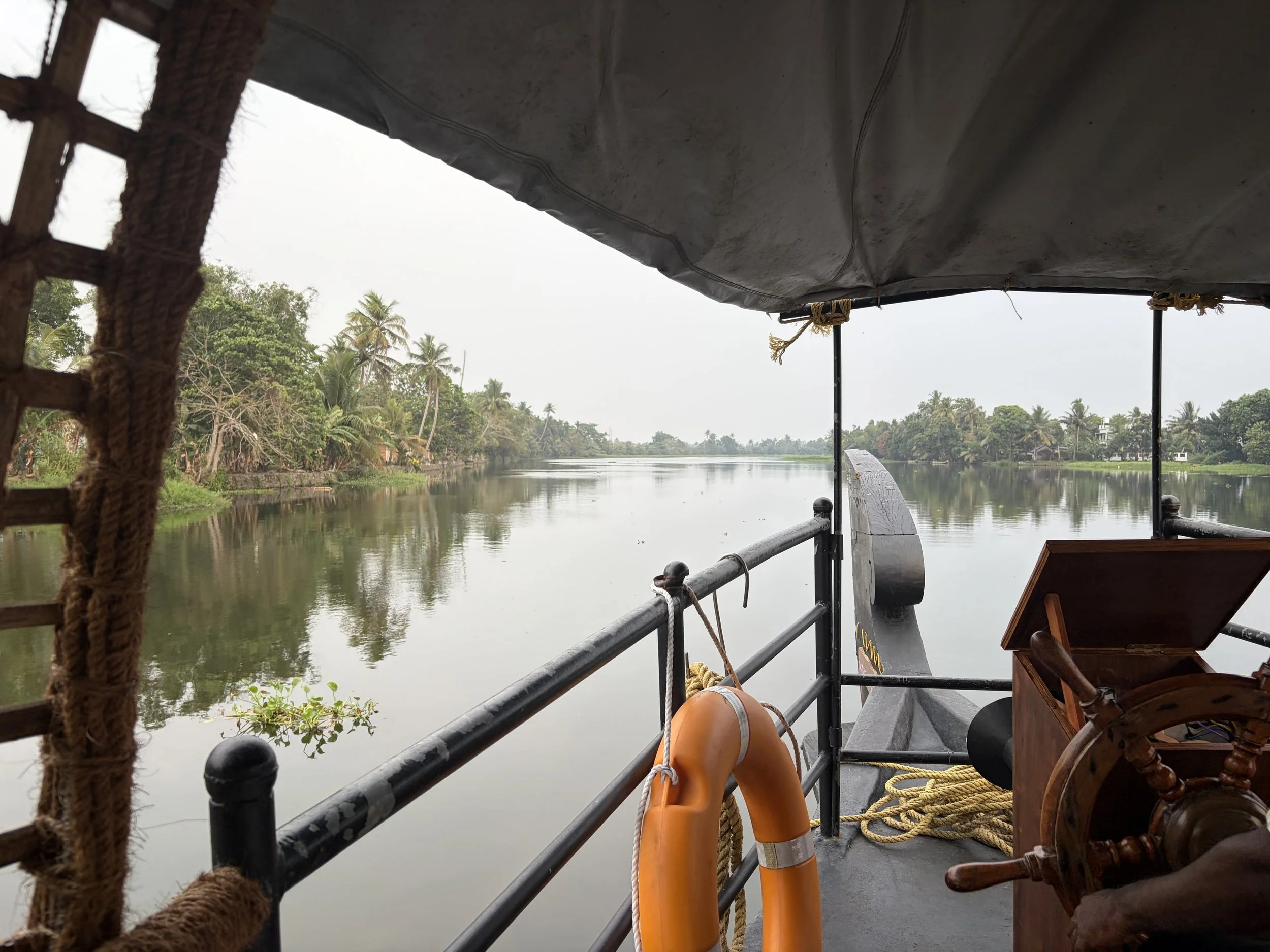
We arrived at the Kumarakom resort having had a 4–5-hour drive and we had stopped once for a pit stop and a ginger tea. We were taken into a reception area and welcomed like a hotel with wet towels and a King coconut as a welcome drink which was nice. This resort was right on the lake and it looked huge. We were told it was 97km long and 14 km wide at its widest point. We were walked round to our houseboat which was about the size of Stormbird but made from wood or the hull was with a half-moon structure covered with hessian or ratan so it looked like an old Chinese type of junk shape.
There were 3 crew, Danesh, Sandeep and Ram (chef). It was designed for 2 guest and was quite luxurious. We had a seating area at the front behind the helm so we could see as we were going along with relaxing chairs and cushions. Behind that was an air conditioned and enclosed dining room but you could see out and then a large luxurious bedroom (with air conditioning) which was like being in a good hotel with an en-suite shower room and normal loo. It was very well done.
We were going to have 2 good days to explore some of the Kerala Backwaters.
The Kerala backwaters are a network of brackish lagoons and canals running parallel to the Arabian Sea along the Malabar coast of Kerala state in south-western India. It also includes interconnected lakes, rivers, and inlets, a labyrinthine system formed by more than 900 km (560 mi) of waterways, and sometimes compared to bayous. The network includes five large lakes linked by canals, both man made and natural, fed by 38 rivers, and extending virtually half the length of the Kerala state. The backwaters were formed by the action of waves and shore currents creating low barrier islands across the mouths of the many rivers flowing down from the Western Ghats range. In the midst of this landscape there are a number of towns and cities, which serve as the start and end points of backwater cruises. There are 34 backwaters in Kerala. Out of it, 27 are located either closer to Arabian Sea or parallel to the sea. The remaining 7 are inland navigation routes and we must have passed some of these on our drive.
The backwaters have a unique ecosystem: Freshwater from the rivers meets the seawater from the Arabian Sea. A barrage has been built near Thanneermukkom, so salt water from the sea is prevented from entering the deep inside, keeping the fresh water intact. Such fresh water is extensively used for irrigation purposes. Many unique species of aquatic life including crabs, frogs and mudskippers, water birds such as terns, kingfishers, darters and cormorants, and animals such as otters and turtles live in and along the backwaters. Palm trees, pandanus shrubs, various leafy plants, and bushes grow alongside the backwaters, providing a green hue to the surrounding landscape. The National Waterway from Kollam to Kottappuram covers a distance of 205 km (127 mi) and runs almost parallel to the coastline of southern Kerala facilitating both cargo movement and backwater tourism. Vembanad (the lake we joined), covering an area of 2,033 km2 (785 sq mi), is Kerala's largest lake. The lake has a large network of canals that meander through the region of Kuttanad. There are a number of important rivers from north to south which flow idown from the Ghats into it. Most of these rivers are navigable up to the midland region, in country crafts.
Vembanad Lake is the longest backwater in Kerala, as well as the longest lake in India. The Kochi city, Kuttanad, Kumarakom, and Pathiramanal Island are located in this long backwater. The Vellayani Lake, the Pookode Lake, and the Sasthamcotta Lake are the freshwater lakes in Kerala. Sasthamcotta is the largest among them. The Kerala backwaters host three of the world’s Ramsar Convention-listed wetlands: Ashtamudi Lake, Sasthamkotta Lake, and the Vembanad-Kol wetlands are noted as being wetlands of international importance.
The Kerala houseboats in the backwaters are one of the prominent tourist attractions in Kerala. More than 2,000 of these ply the waterways The Kerala government has classified the tourist houseboats as platinum, gold, and silver.
The Kettuvallam (houseboats) were traditionally used as grain barges, to transport the rice harvested in the fertile fields alongside the backwaters. Thatched roof covers over wooden hulls, 100 ft (30 m) in length, providing protected from the elements. At some point in time, the boats were used as living quarters by the royalty. Converted to accommodate tourists, the houseboats have become floating cottages having a sleeping area, with western-style toilets, a dining area and a sit out on the deck. Most tourists spend the night on a houseboat. Food is cooked on board by the accompanying staff—mostly having a flavour of Kerala. The houseboats are of various patterns and can be hired as per the size of the family or visiting group. The living-dining room is usually open on at least three sides providing a grand view of the surroundings, including other boats, throughout the day when it is on the move. It is brought to a standstill at times of taking food and at night. After sunset, the boat crew provide burning coils to drive away mosquitoes. Ketuvallam are motorised but generally proceed at a slow speed for smooth travel. All Ketuvallam have a generator and most bedrooms are air-conditioned. At times, as per the demand of customers, electricity is switched off and lanterns are provided to create a rural setting
Beypore, located 10 km (6.2 mi) south of Kozhikode at the mouth of the Chaliyar River, is a famous fishing harbour, port and boatbuilding centre. Beypore has a 1,500-year tradition of boatbuilding. The skills of the local shipwrights and boatbuilders have widely sought after. Regular ferry services connect most locations on both banks of the backwaters The Kerala State Water Transport Department operates ferries for passengers as well as tourists. It is the cheapest mode of transport through the backwaters
However, the unregulated proliferation of motorised houseboats in the lakes and backwaters has raised concerns regarding the adverse impact of pollution from diesel engines and outboard motors on the fragile ecosystem. Connected by artificial canals, the backwaters form an economical means of transport, and a large local trade is carried on by inland navigation. Fishing, along with fish curing, is an important industry.
Kerala backwaters have been used for centuries by the local people for transportation, fishing and agriculture. The region has supported the efforts of the local people to earn a livelihood. In more recent times, agricultural efforts have been strengthened with the reclamation of some backwater lands for rice growing, particularly in the Kuttanad area. Boat-making has been a traditional craft, so has been the coir industry.
There are many Paddy Fields especially in the Kuttanad region
, Edappal and on the banks of Biyyam backwater, Ponnani
.
Kuttanad region is crisscrossed with waterways that run alongside extensive paddy fields, as well as fields of cassava, banana and yam. The crops are grown on the low-lying ground and irrigated with fresh water from the canal and waterways connected to Vembanad lake. Palakkad, the granary of Kerala, lies on the bank of Bharathappuzha river. The area is similar to the dikes of the Netherlands, where land has been reclaimed from the sea and crops are grown.
Vembanad Wetland is included in the list of wetlands of international importance, as defined by the Ramsar Convention for the conservation and sustainable use of wetlands.
The crew slipped the lines and had to negotiate through quite a lot of weed and growth and lilly flotsam and then we were off going South. There was a bit of chop due to the wind but it was comfortable and Jules, who does not like swell did not complain so that was a good sign!. We sat on our comfortable chairs and watched as we went South on the lake. There were lots of Brahminy Kites soaring (you may recall I have seen these since Indonesia) and cormorants sat on every stick or post or buoy some spreading their wings to dry them.
It was soon time for lunch and so we went into our dining room and it started with a chicken spiced soup, then chicken with a salad followed by a fish curry, rice, chapati and vegetable dish and then an Indian desert. There was so much food we could not eat it all.
We then sat down to digest and the lake began to narrow a bit and we stopped and moored to a Palm tree for about 30 minutes so the crew could have their lunch.
We then set off South again and we must have come to the end of the lake as we then began to enter some wide canals -about 300m across to start with. The sides were lined with concrete blocks to preserve the sides. We began to see other houseboats of different shapes and sizes. In addition the odd house or shack began to appear, many of which were half built and perhaps made two floors but only one was developed and in use.
We continued on and came to a sort of spaghetti junction of canals where there were lots of houseboats going in different directions. We continued up to Alappy and through it so we went through a town with lots of houseboats and different size boats -probably day boats going by and providing trips for tourists and locals. There was quite a wide variety of housing from the well-off houses to poor shacks with the locals going about their daily tasks of washing building, repairing and farming. As we got out of Alappy we could see extensive agricultural fields extending as afar as the eye could see. There were tractors and people tending the fields. Every now and then a barge came down carrying I assume sacks of rice or grain and this is very much a working backwater as well as a tourist one.
There were lots of locals fishing from long or small canoes and as the afternoon went on and we came more into rural areas they were fishing from the banks as well as canoes. There were children jumping in and out of the river from wharfs and colourful Indian ladies in their saris washing clothes at the banks.
As we continued inland the river narrowed and there were more islands or bunches of weed which provided a safe platform for the birds to rest on-large Egrets, herons, cormorants and other birds whose names I do not know. There were lots of kites flying overhead soaring up with the thermals and flying around us high above. The banks were just lined with Palm trees and the sun began to lower providing lovely tranquil views and pictures of daily life here, There is quite a contrast from the touristy houseboats with the wealth and luxury that goes with it and being waited on hand and foot to the locals. Some are clearly wealthy in an Indian sense and have nice houses and boats and others very poor living in a shack and having to fish to catch their supper and wearing old clothes. I guess that is India – there is a considerable contrast wherever you go. However, they all seem happy.
As it was our anniversary I had brought some Champagne on board and so Jules and I had a toast whilst the countryside slipped by. We continued on and eventually came to a quiet rural area where we decided to moor for the night tied to two palm trees. There were fields or rice stretching out for a long way. We sipped our Champagne as the sun went down watching the shadows lengthen and the birds resting on patches of weed and the odd fish pop to the surface.
We then retired for supper with the same number of courses of food which we could not all eat but it was delicious and how nice to be on board again (I know it’s not Stormbird!). We played dominoes for a while and then retired to bed. It had been a good half day on the backwaters.
In terms of Stormbird I get reports every day on her state with pictures. The outboards have both been serviced and are now back on board. I heard from the agent that two Iranian naval ships have taken refuge in Kochi. I hope the Americans do not bomb Kochi!
The picture of the day is view from the houseboat of the backwaters.
Need/Opportunity Year Three
In year three I will be going from Thailand to Sri Lanka, India, Maldives and then on to Mauritius, Reunion, Cape Town, St Helena, Azores and back to the UK.
I am looking for one crew from Mauritius/ Reunion Island to Cape Town (mid June to end of July). If of any interest do email me.
The blog will continue as we continue the journey. If you have any comments or suggestions about the blog then do email me on hine.nick9@gmail.com