Year 3 -7th October 2026 – Faial -Azores – the most Western Point of Europe
We woke at about 8.00am and had our usual granola breakfast with banana and pineapple.
It was another lovely sunny day and there was little cloud.
I was keen to visit the Whale Museum and Keith was keen to join me. Dave and David had already been the day before and Mark was not keen.
Kieth and I therefore headed off and we walked over to Ponto Pim Bay again and as the museum was not open until 10.00am we had a good coffee and pastel de nata in the little café I liked right by the beach and Fort Wall.
After this we walked along the beach and to the museum. The views over the bay and surrounding caldera looked as beautiful as ever.
The Museum sits in the corner of Porto Pim beach and is quite substantial with a large chimney and has two floors. It was American Whalers and their techniques that influenced the Azores and whaling and which had a big impact on the local economy. Between 1820 and 1880 the America Whaling boomed and into the early 20th century and it became industrialised – hence the whaling factory and the machinery which is still there in the museum. By the 1940’s and 1950’s the factories they created were capable of processing whole sperm whales. This continued before there was a decline in the mid 1980’s.
The irony is that there are lots of whales that continue to visit the Azores including blue whales and it is good they can now come to the Azores without fear of being harpooned.
We learnt how they used to put a lookout on a hill with binoculars or a telescope and if they saw a whale they would light a firework which would indicate to the whaling boat crew that they needed to get to the whaling boat. The whaling boat would then be launched and they would row or sail to find the whale. The boats had a crew of 7. The Captain would be responsible for the boat and the right approach to the whale. There would be a special harpoonist who would be responsible for harpooning the whale. They would aim to harpoon the whale in the lung area. They may do this a number of times and would allow the whale to swim and as it tired they would haul in on the ropes and then when the whale died they could tow it into the bay near the factory. There are a number of old whaling boats here which have been restored and are being maintained.
The whales would be dragged up by their tail to a concrete area and the head would be severed from the body. The sperm whale was the best catch as the oil from the whale would be used for oil lamps etc. They later used to process the meat and the blubber to create animal meal and fertiliser. The bones were used to make carvings called Scrimshaw. There was not much wastage and I suppose electricity prevented whale oil being required.
The Museum was very interesting and very cruel. I wanted to see it to remind me of that awful period and what awful things we did as humans in terms of these special and lovely mammals. It is good that their population is gradually increasing to reasonable numbers and hope that area will never be repeated.
We walked back to Stormbird and then we prepared as we were having a technician on board to re calibrate the compass. We prepared the lines and Marco, the electrician arrived and we slipped the lines and headed just outside the harbour. He selected a re-calibration setting and we slowly went round in a circle whilst the compass re calibrated itself. After its first circle it showed an error of 13% and so we did a second circle and the error reduced to 1 % which he said was very good. This was all done by GPS and it was good this was all calibrated for the trip home.
After we returned we had some lunch and chilled. Mark, David and Dave went off to do the provisioning. Dave had done the stick take two days ago and he and Mark had been fine tuning the shopping list. Keith and I went to some beer from the local supermarket and we might have had a swift taste on the way so we knew what to buy!
We returned to Stormbird and waited for the grand shop to return which it did with Mark, David and Dave in an Uber. We managed to stash all the provisioning in about 30 minutes and so as usual we have fruit and veg in the baskets and stuff everywhere. We are now just about ready and all we are waiting for is Keith Watson (Watty) to arrive tomorrow morning. We need to check out, go through all the briefings and checks and I am thinking we will leave tomorrow late afternoon. This should mean we should arrive all being well in the morning/lunchtime of the early afternoon of the 17th October 2026.
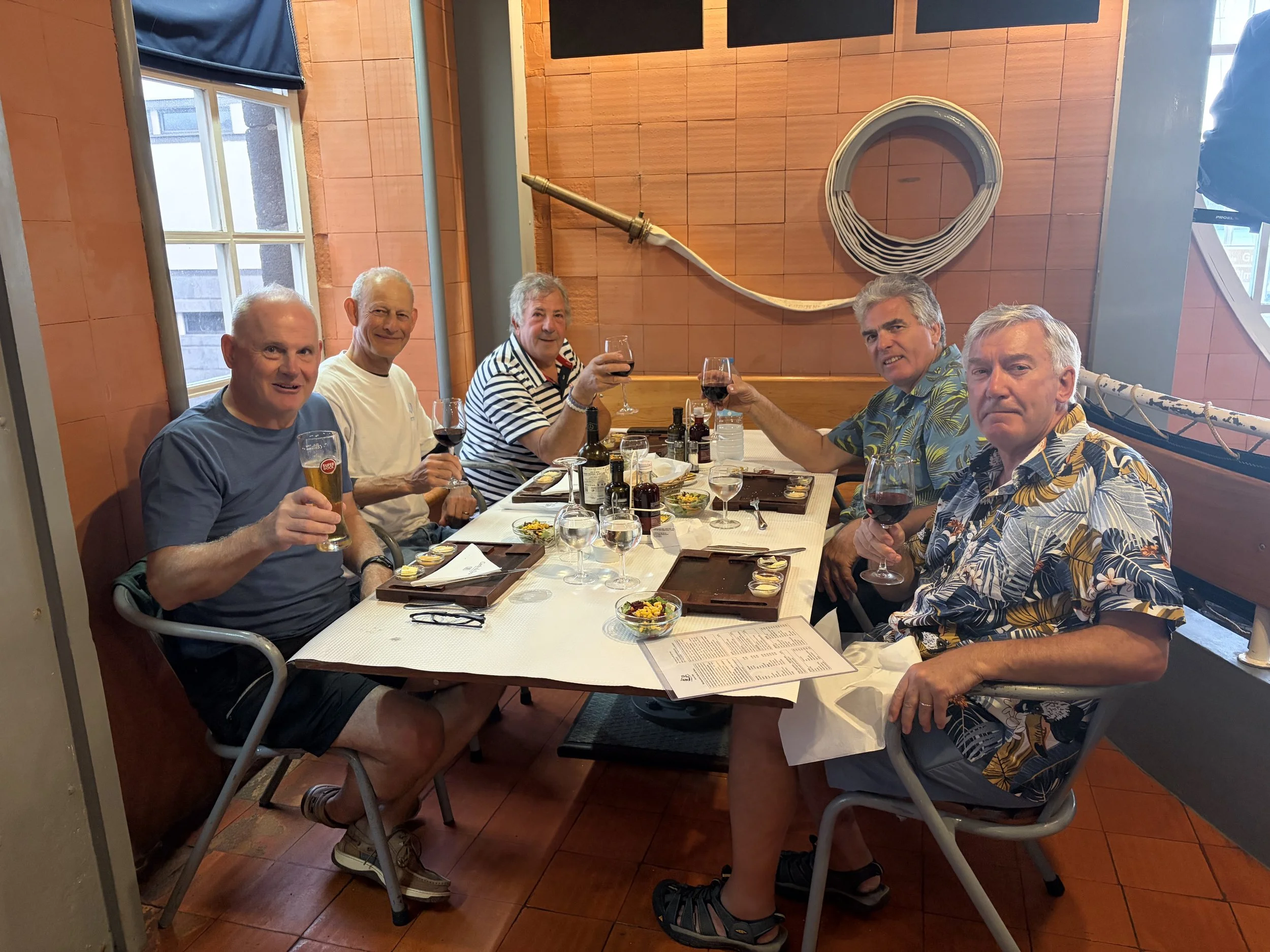
We had a sundowner and this was our last night in Faial. We decided to go to a restaurant at which you cook on hot lava rock. This was most enjoyable. A fitting last night before we depart to the UK.
The picture of the day is the 5 of us (with Keith Winstanley this time) in the restaurant.
Need/Opportunity Year Three
I am now at the Azores and hope to head back to the UK on about 9 October 2026. At present I am full for the final passage back to the UK with some old veterans returning David Mark, Keith Watson (Watty) and of course Keith Winstanley -the Commodore.
The blog will continue as we continue the journey. If you have any comments or suggestions about the blog then do email me on hine.nick9@gmail.com