Year 3 -6 June 2026 – Grand Baie- Mauritius
It is my cousin Ben’s birthday so Happy Birthday Ben.
We were up about 7.00am and luckily it was another lovely morning. We had pineapple, yoghurt and Granola for breakfast and then a good cup of coffee. I then did my usual general briefing for Hisham about the boat. I then went through the boat with him from front to back.
Carolyn in the meantime got on with putting the leather on the ladder steps which looks good.
We headed ashore when we were ready for a day of adventure in the car Hisham had hired. We first drove to what is called L’Aventure Du Sucre. It is now a large museum but what was called the Beau Plan -a genuine 19th century sugar which until 1999 was a working factory. The original buildings and machinery are still there and it is one of the largest and most interesting museums on the island.
Sugar Cane was first introduced by the Dutch at the end of the 16th century. This transformed the landscape and profoundly influenced the islands society, economy and politics and the balance of power. Sugarcane originated in New Guinea where it was simple chewed raw and the craft of making cane sugar was an Eastern tradition. In fact it was in India in the 6th century that people first learned to extract the juice from the sugarcane and boil it into solid sugar loaves. For centuries it remained an incredible rare luxury in Europe transported at great cost along the same trade routes as silks and spices, often across deserts by caravan. During the middle ages and Crusades they encountered Eastern sugar and brought it back mainly through Venice to Europe.
In the 16 & 17c with colonial expansion production soared and prices reduced and it became more accessible to what has now become a global commodity. There used to be about 280 factories but by 1943 there were only 36 refineries and now there are only 3 but they control all the production.
So how do we make sugar?
The sugarcane is planted and will produce a crop for 7 years before it is ploughed and replanted. The sugarcane takes a year to grow (growing 2-5m) and when they cut it they leave a little and it grows into the next years crop. There are fertilisers used and a certain amount of water used to get the growth required. The crop is cut and brought in lorries to the factory. In the past of course it was cut by hand before modernisation and machines. It was originally brought by horse and cart, then train and now by lorries.
Once it gets to the factory it is crushed by machines to make mush and extract the juice and as much of the foreign bodies are removed. It is then gradually heated to 75c. This makes it more fluid. The juice is then clarified by using lime milk (a mixture of water and ground limestone). It is then heated a second time to 104c which causes the impurities to stick together. It is then decanted or clarified and the impurities known as mud are filtered to give the remaining juice. The waste is removed and then used as fertiliser. The remaining juice is then transferred towards the evaporators. The aim is to concentrate the juice into thick juice by removing 80% of the water and this is done through the evaporators. The juice flows through tubes heated by steam and this thickens the juice. The syrup that’s produced is then ready for crystallisation.
The syrup is then put into cooking pans which is heated by steam and the flow with the steam encourages crystal formation without caramelisation. Gradually thousands of grains form to what is called massecuite which is a mixture of crystals suspended in a thick syrup.
The massecuite is then transferred to mixers. It is then slowly stirred and cooled by pipes carrying cold water. This process allows the crystals to grow, layer by layer, over a period of 4-36 hours. Once ready the massecuite is sent to a centrifuge which forces the thick molasses to be expelled leaving the sugar crystals behind. The molasses is then used amongst other things to make rum. The crystals can make all sorts of different types of sugars.
We followed this process by going through the whole factory with most of the machinery still there to view.
We then went to the shop where you could taste all sorts of sugars and buy all sorts of paraphernalia. They also had a rum tasting area as they make the Lady Dodo rum here. We must have tasted a range of rums some made direct from the sugar cane juice and some made from Molasses. Hisham and I ended up buying some as -when you are in Rome!
We were now hungry and they conveniently had a restaurant attached to the museum. We had a pleasant lunch in the gardens. After lunch we decided to go to the Botanical Gardens at Pamplemousse.
This is a 75-acre site and was first created when the French Governor Mahe de Labourdonnais bought the land and created the estate of Mon Plaisir in 1736. The garden started as an experiment to acclimatise food crops. However, Pierre Poivre bought the garden in 1767 and concentrated on spices such as nutmeg, cloves and other such spices but this failed.
It later became known as the King’s garden and by 1785 contained over 600 species of different plants from over the world and it then developed from there.
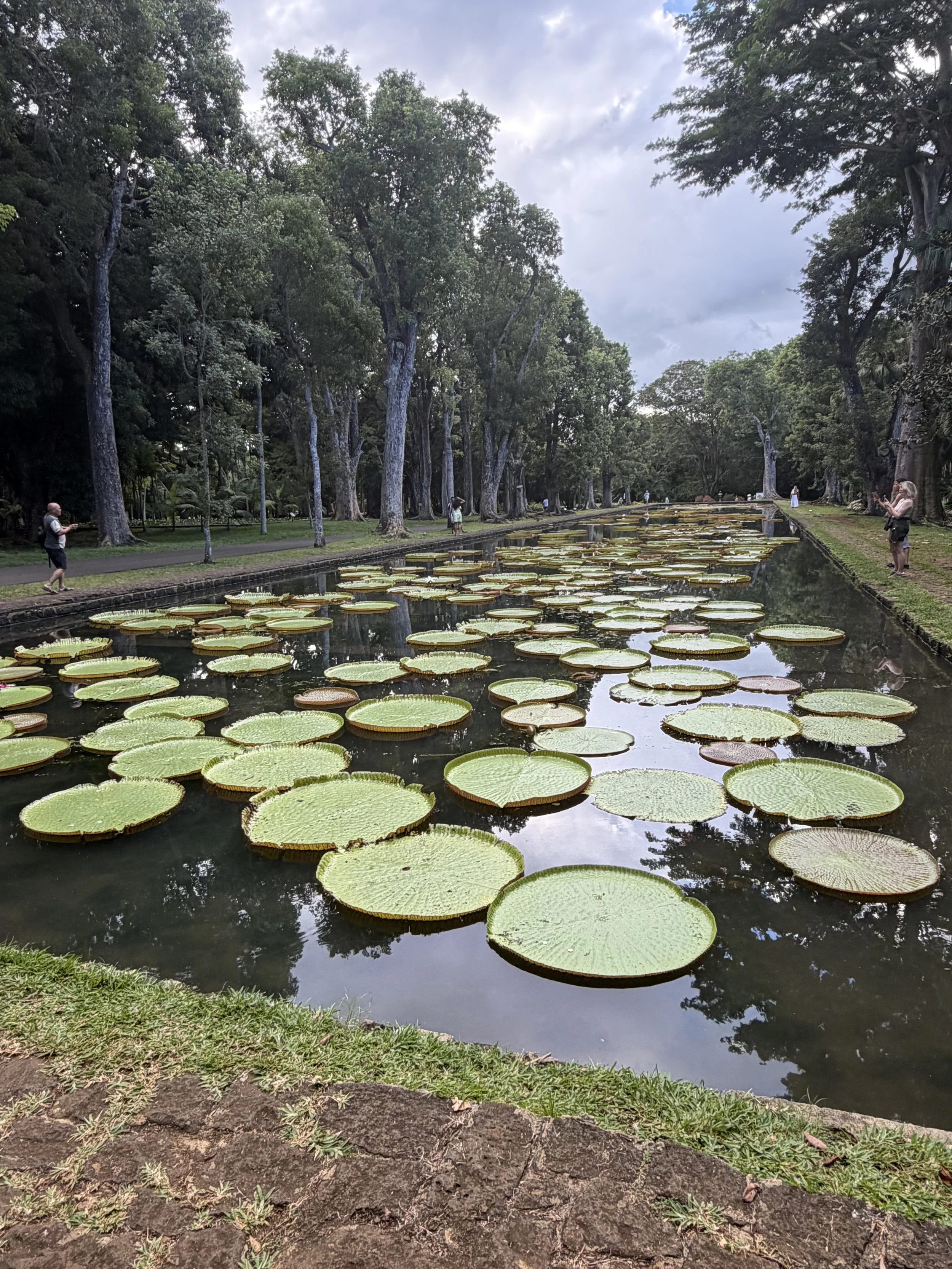
We had a good walk around the gardens which now holds an amazing collection of trees and over 1,000 of different species of plant/trees. I would say mostly of trees. There were some ponds and we came across one which had the Giant Water Lily which was discovered by a German Botanist in 1809. This lily was introduced to the garden in 1927. They can grow up to 3m wide and the flowers are white for the first day, purple for the second and on the third day the flower sinks to deploy up to 500 seeds.
We had a good walk around the gardens and as said was mostly trees and shrubs with little colour. It was an impressive collection.
We the returned to the car and drove to Mon Choisy beach to show Hisham and then to have an ice cream. We then found the Boulangerie we had gone in and bought some French bread. We then returned to the yacht club and had a sundowner.
We returned to Stormbird having had a good long day. Hisham volunteered to cook his pasta pomodoro dish he does with salad. This we had in the cockpit with salad.
I realised Keith is not coming tomorrow but on the 8th. We will therefore see what we do tomorrow.
The picture of the day is Giant Water Lillies.
Need/Opportunity Year Three
I am now in Mauritius and will be going to Reunion, Cape Town, St Helena, Azores and back to the UK.
I have now found additional crew for Mauritius to Durban. There may be space from Durban to Cape Town from about the beginning of July and we should arrive in Cape Town on about 25-30 July 2026. If at all interested contact me on my email below or WhatsApp +44 7931360372.
The blog will continue as we continue the journey. If you have any comments or suggestions about the blog then do email me on hine.nick9@gmail.com