Year 3 -5 March 2026 – Another Relaxing Day in the Indian Summer Palace - Mavatupuzha-India
We were up early as we were visiting a Toddy Tapper. We were picked up by a tuk tuk who took us with the manager Suresh to meet a man who was a Toddy Tapper. He was now about 46 and had started at the age of 19.
The journey took us through some of Mavatupuzha which is quite a busy town and then we turned off into the country and a rural agree and amongst the trees. We saw some very large houses on the way and Suresh says they would cost about £50-60,000!!
Toddy Tapping is essentially getting the sap out of a Toddy palm. It does not produce coconuts but produces a sort of long sprouting flower from which you can collect the juice which is naturally already a little alcoholic and if having tapped it you leave it within a few hours it will naturally ferment and become even stronger and more bitter. It is what the Sri Lankan’s call Arak and we drank some (others drank regularly more!) in Sri Lanka.
We met the man and he took us to a palm tree which he is Toddy Tapping. When in flowerhe can tap the tree twice a day for 3 months and he taps about 6-8 trees everyday morning and early evening. When we arrived at the tree which was in a bit if jungle there was some tarpaulin or cover over the flower and a metal sort of pole/ladder going up the tree to the flower and it was secured around the tree in parts. He climbed the tree and unwrapped the cover and you could see an earthenware pot hanging from the flower. He tipped the contents into a plastic container using a little funnel. He then took what looked like a flat machete and sliced a little bit around the flower as if trimming it and he then replaced the earthenware pot and the cover and came back down again. You could see the flower dripping when the cover and pot was off.
He came down and then poured some into 2 glasses that Suresh had brought and we stated it. It was a little sweet but had an earthy taste. He must have collected about 3-4 lts. The man takes it to the local co-operative and it is made into an alcoholic drink and sold and drunk by locals. It had been interesting to see how it was collected. He nuts have climbed about 20 metres for this tree.
We returned by tuk tuk and had a good breakfast and James and Margaret joined us. They were leaving about 11.45am to go and get a light home via New Delhi and Almaty.
After breakfast we relaxed by the pool for some hours swimming and reading although I had emails to do liaising with the Indian Agent over visas for the crew arriving later this month and relating to the works on Stormbird. I was also liaising with the Maldives Agent who needed me to sign and stamp various documents. Each day there is always something to do.
We had lunch and then returned to the pool until 4.00pm when Suresh was taking us out again. We initially walked round from the villa to the Mavatupuzha River. We were then met by a man who had a long canoe and we got in tentatively and were taken across the river which was about 200 meters wide. It must have been flowing about 2 kts and goes all the way to Kochi and the Andaman Sea. We got off the other side and then walked along a narrow lane through the trees with houses dotted here and there. Suresh pointed out various trees on the way- including Cocao trees from which you make cocoa and chocolate, mango, coffee trees etc.
He took us after about 15 minutes to a building near the road which was a traditional tea house which was about 120 years old and was being run by a 3rd generation of the family. It provided tea and snacks for travellers consisting of banana fitters and fried lentil cake which were delicious. A tea cost 15 rupees, as did a plate of banana fitters and lentil cakes. To put it is perspective 15 rupees us 12 pence!! It was a pleasant stop and people came and went.
We then hopped into the tuk tuk again and Suresh took us into Mavatupuzha and he showed us an old concrete bridge which had been built by the British and it is apparently the first concrete bridge built in the whole of Asia. We were dropped off by a different bridge and we walked along the edge of a river for about 15 minutes which was pretty and you felt you were in a jungle really and we came to a point where three rivers met which is how Mavatupuzha got its name. The path ran out and then we climbed some steps and came to a Hindu Temple which Suresh wanted to show us and which was ran by a Brahmin.
Brahmin is a varna (theoretical social classes) within Hindu society. The other three varnas are the Kshatriya (rulers and warriors), Vaishya (traders, merchants, and farmers), and Shudra (labourers). The traditional occupation of Brahmins is that of priesthood (purohit, pandit, or pujari) at Hindu temples or at socio-religious ceremonies, and the performing of rite of passage rituals, such as solemnising a wedding with hymns and prayers.
Traditionally, Brahmins are accorded the supreme ritual status of the four social classes, and they also served as spiritual teachers (guru or acharya). In practice, Indian texts suggest that some Brahmins historically also became agriculturalists, warriors, traders, and had also held other occupations in the Indian subcontinent. Within the jati (caste) system, Brahmins similarly occupy the highest position, though that is complicated by strict stratification even among Brahmins and historical attempts by other castes and sub-castes to challenge Brahminical dominance.
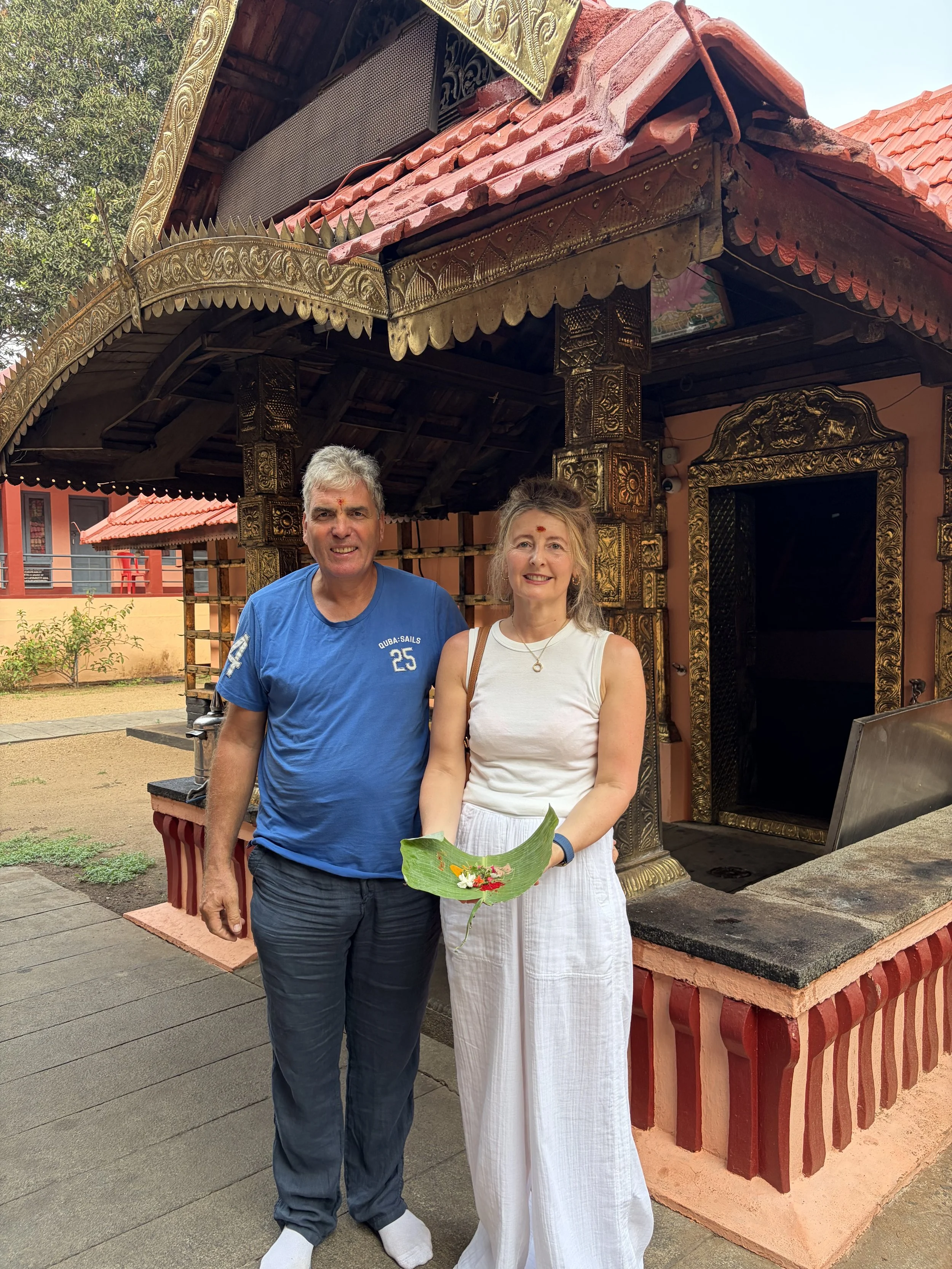
Suresh had arranged for us to receive a bindi from the Brahmin.
A bindi meaning "point, drop, dot or small particle") is a coloured dot or, in modern times, a sticker worn on the centre of the forehead, by Hindus, Jains and Buddhists from the Indian subcontinent in place of the tilak.
In Hinduism, Buddhism, and Jainism the bindi is associated with the ajnachakra, and Bindu is known as the third eye chakra. Bindu is the point or dot around which the mandala is created, representing the universe. The bindi has a religious, historical and cultural presence in the region of India and with the Hindu, Indian diaspora around the world.
We had to cover our legs to enter the Temple and men had to take their shirts off. It was a simple temple and had three shrines. It had a lot of candles and oil lamps burning and was quite hot. The Brahmin took into one shrine a banana leaf and then said our names and put some flowers on the banana leaf and three colours white, hello and red. Suresh then put the three colours on our forehead and we were given it as a gift. It was like have a blessing at home and wishing you luck good health and wisdom.
Hinduism is considered the world’s oldest living religion, with roots and customs dating back over 4000 years.
We felt honoured and took some pictures. We were then picked up by our tuk tuk man and transported back to the Summer House. We showered and got ready for supper. They had made special barbecue supper by the pool with candles all around the pool. It was a lovely meal and a good end to a lovely day.
The picture of the day is Jules and I having received our bindi.
Need/Opportunity Year Three
In year three I will be going from Thailand to Sri Lanka, India, Maldives and then on to Mauritius, Reunion, Cape Town, St Helena, Azores and back to the UK.
I am looking for one crew from Mauritius/ Reunion Island to Cape Town (mid June to end of July). If of any interest do email me.
The blog will continue as we continue the journey. If you have any comments or suggestions about the blog then do email me on hine.nick9@gmail.com