Year 3 -5 April 2026 –A trip to Male - Maldives
We woke to another hot day and had breakfast. We had arranged for all of us to go to Male on the first ferry at 1.30pmm to provision. When we looked at what we had there was not a lot for us to get as we still had quite a bit of fruit and some vegetables. We did need a few things. We had heard from Stig & Cari who were not feeling that well having caught a bug in India. They decided when they fly to Male they will have a night in a hotel before joining us on the 7th.
I had made contact with the engineers and the windlass motor was being worked on and it was likely to be finished tomorrow. I asked them to please come and fit it tomorrow if possible. They said they would try and keep me posted.
Miranda was not feeling great and Keith did not need another visit to Male so they opted to stay behind and so J & I decided to go. We spent the rest of the morning relaxing at the beach club. It was Easter Sunday but it did not feel like it but they had put Easter bunnies everywhere which gave it a more Easter feel.
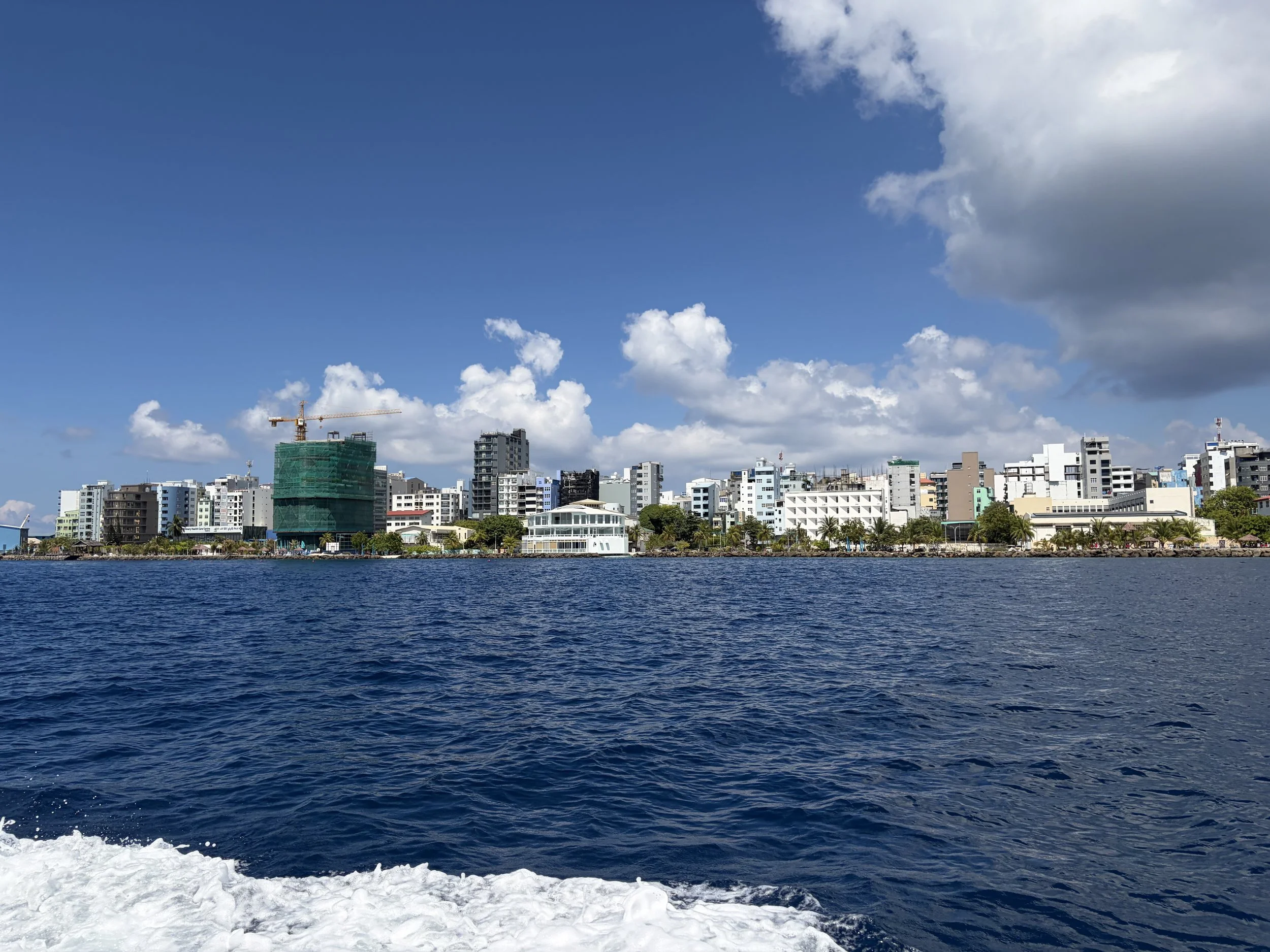
J and I caught the ferry to Male at 1.30pm and as you approach Male they have been building a road which connects a number of the islands and there are still sections right out in the sea being built. Male looked like a busy place with its high-rise block on a relatively small island and a sort of mini Hong Kong.
Malé is the capital and most populous city of the Maldives. With a population of 211,908 in 2022 within its administrative area and coterminous geographical area of 8.30 square kilometres (3.20 sq mi), Malé is one of the most densely populated cities in the world. The city is geographically located in the southern edge of North Malé Atoll (Kaafu Atoll). Administratively, the city consists of a central island, an airport island, and five other islands presided over by the Malé City Council.
Traditionally it was the King's Island, from where the ancient royal dynasties ruled and where the palace was located. The city was then called Mahal. Formerly it was a walled city surrounded by fortifications and gates (doroshi). The Royal Palace (Gan'duvaru) was destroyed along with the picturesque forts (koshi) and bastions (buruzu) when the city was remodelled under President Ibrahim Nasir's rule in the aftermath of the abolition of the monarchy in 1968. However, some buildings remained, namely, the Malé Friday Mosque. In the last few decades, the island has been considerably expanded in size through land reclamation. Over the years, Malé has been the centre of political protests and milestone events.
Islam has played a central role in the city's history since 1153 CE, when the Maldives converted from Buddhism to Islam under the influence of North African traders and missionaries. This religious shift deeply influenced Malé’s cultural and architectural identity, visible today in the form of mosques such as the 17th-century Hukuru Miskiy (Friday Mosque), built from coral stone and considered one of the oldest mosques in the country. Over the centuries, Malé has remained not only the capital but also the symbolic and historical core of the Maldives.Malé in 2022, with a bridge to the airport and Hulhumalé
Although Malé is geographically located in Kaafu Atoll, administratively it is not considered part of
The central part of the city is formed by the island of Malé. Six more islands form part of the city which includes Hulhulé, Hulhumalé, Villimalé, Gulhifalhu, Thilafushi and Giraavarufalhu.
A commercial harbour is located on the central island and serves as the heart of all commercial activities in the country. Velana International Airport is located on the Island of Hulhulé.
The central island is heavily urbanised, with the built-up area taking up essentially its entire landmass. Slightly less than one-third of the nation's population lives in the capital city, and the population has increased from 20,000 people in 1987 to 100,000 people in 2006. Many Maldivians and foreign workers living in other parts of the country find themselves in occasional short-term residence on the island since it is the centre of administration and bureaucracy. Most of the population of Malé live in small houses or apartment complexes, often shared with external family or roommates. This led to the development of Hulhumalé and the extension to Phase 2.
The Indian expatriate community in the Maldives stands as the second-largest, comprising around 27,000 individuals. Among them, a substantial portion consists of construction workers, doctors, nurses, health professionals, and teachers, who play vital roles in the Maldivian infrastructure, healthcare, and education sectors. Additionally, Indian and Bangladeshi nationals contribute significantly as skilled workers, alongside a sizable presence of unskilled laborers, as well as other professionals and members of the business community.
The whole island group, the Maldives, is named after its capital. The word "Maldives" means "the islands (dives) of Malé".
The most revered place in Malé is the Medhu Ziyaaraiy, across the street from the Malé Friday Mosque: the tomb of Abu al-Barakat Yusuf al-Barbari, considered to have converted the Maldives to Islam in 1153.
Malé has a tropical monsoon climate (Am) under the Köppen climate classification. The city features a mix of both wet and dry seasons, with the wet season lasting from April through January and the drier season covering the months of February and March. Unlike several cities with this climate, Malé experiences relatively consistent temperatures throughout the year, with an average high of 30 °C or 86 °F and an average low of 26.5 °C or 79.7 °F, which is equivalent to many equatorial cities' average year-round daily mean. The city averages slightly more than 1,900 millimetres or 75 inches of precipitation annually. The temperature is constantly high year-round.
The island of Malé is the eighth most densely populated island in the world, and it is the 160th most populous island in the world. Since there is no surrounding countryside, all infrastructure has to be located in the city itself. Water is provided from desalinated ground water; the water works pumps brackish water from 50–60 m (160–200 ft) deep wells in the city and desalinates that using reverse osmosis. Electric power is generated in the city using diesel generators. Sewage is pumped unprocessed into the sea. Solid waste is transported to nearby islands, where it is used to fill in lagoons. The airport was built in this way, and currently the Thilafushi lagoon is being filled in.
Many government buildings and agencies are located on the waterfront. Velana International Airport is on adjacent Hulhulé Island which includes a seaplane base for internal transportation. Several land reclamation projects have expanded the harbour.
Tourism is the largest industry in the Maldives, accounting for 28% of GDP and more than 60% of the Maldives' foreign exchange receipts. The GDP per capita expanded by 265% in the 1980s and a further 115% in the 1990s. Over 90% of government tax revenue comes from import duties and tourism-related taxes. Malé, the capital, has many tourist attractions and nearby resorts. Maldivian, the airline of the Maldives, has its head office in Malé, as does the airline Villa Air.
The central harbour and port of the Maldives are located in Malé, the centre for all commercial activities.
Each of the islands of Malé is served by a dense network of paved roads, which are named magu (thoroughfare or street), hingun (road or street), and goalhi (small road or alley). Road traffic is heavy, especially on Malé Island.
Malé and Hulhulé Island are linked by the Sinamalé Bridge, which was opened to traffic in October 2018, while Hulhulé and Hulhumalé are linked via a causeway, thus allowing the road networks of the three islands to be connected.
Malé is the seat of the Maldivian government. Most national government ministries, departments and authorities are based in Malé. There are 16 MPs representing Malé in the People's Majilis; 12 from the People's National Congress, 3 from the Maldivian Democratic Party and 1 from the Maldives National Party as of September 2025.
As we arrived we passed under the road sections being built and could see the densly packed in buildings and the port. We got off opposite the Police Station and walked round and through the square which contained the Medhu Ziyaaraiy mosque which looked impressive.
We found the main shopping area and I decided to get another printer as I cannot use the ones I have on board. This must be about the 5th I have bought on my trip. They either run out of ink which I cannot replace or they will not print unless you have Wifi. I found one which I think will work and got a spare ink as well. J got a new rod and reel for casting as the old one has lost its end and the reel is a bit knackered.
We found a few things in the supermarket and enjoyed walking round the fruit and veg market and the fish market. We bought some red snapper and some vegetables.
It was a busy place – very Muslim with lots of mopeds which seems to be the best way to travel around. There was a reasonable sized shopping area and the port was constantly busy with ferries and private transfers to various islands. We stopped for a coffee and some water but were soon ready to get our ferry back to get the fish into the freezer. It had been interesting to see it but with all these lovely islands and atolls to explore you only go there if you need to.
The ferry took us 30 minutes and Miranda and Keith were on Stormbird as we arrived. We then went for a shower and met in the bar. The beach club had set out a buffet on the beach with Easter decorations and the poor staff in the heat had to dress up as Easter bunnies.
We decided to have the buffet and had a table right on the beach overlooking the sea. The buffet was great and we washed it down with some South African Pinotage.
I hope the windlass will be fixed tomorrow but let’s see.
The picture of today is a picture of Male.
Need/Opportunity Year Three
I will be going shortly from India to the Maldives and then on to Mauritius, Reunion, Cape Town, St Helena, Azores and back to the UK.
I am looking for one crew from Mauritius/ Reunion Island to Cape Town (mid-June to end of July). If of any interest do email me.
The blog will continue as we continue the journey. If you have any comments or suggestions about the blog then do email me on hine.nick9@gmail.com