Year 3 -31 March 2026 - Stormbird -arriving to the Maldives
I took over from Keith and Jamie at 2.00am and they were surrounded by fishing boats. These were probably fishing boats from the Maldives or that’s what AIS said. There were also a number of cargo ships traversing North and South as well.
The watch was relatively quiet once we were through the traffic and we motored with an expected arrival time of about 8.00am to the waypoint at the entrance to the atoll. The moon was out but went behind the odd cloud from time to time. The wind was not strong enough to sail and from the wrong direction to make any decent speed.
I handed over to J & Miranda and go some rest but then got up about 7.00am and they had just spotted land- the islands of the Ihavandhippolhu Atoll and in particular Uligan which is where we were headed.
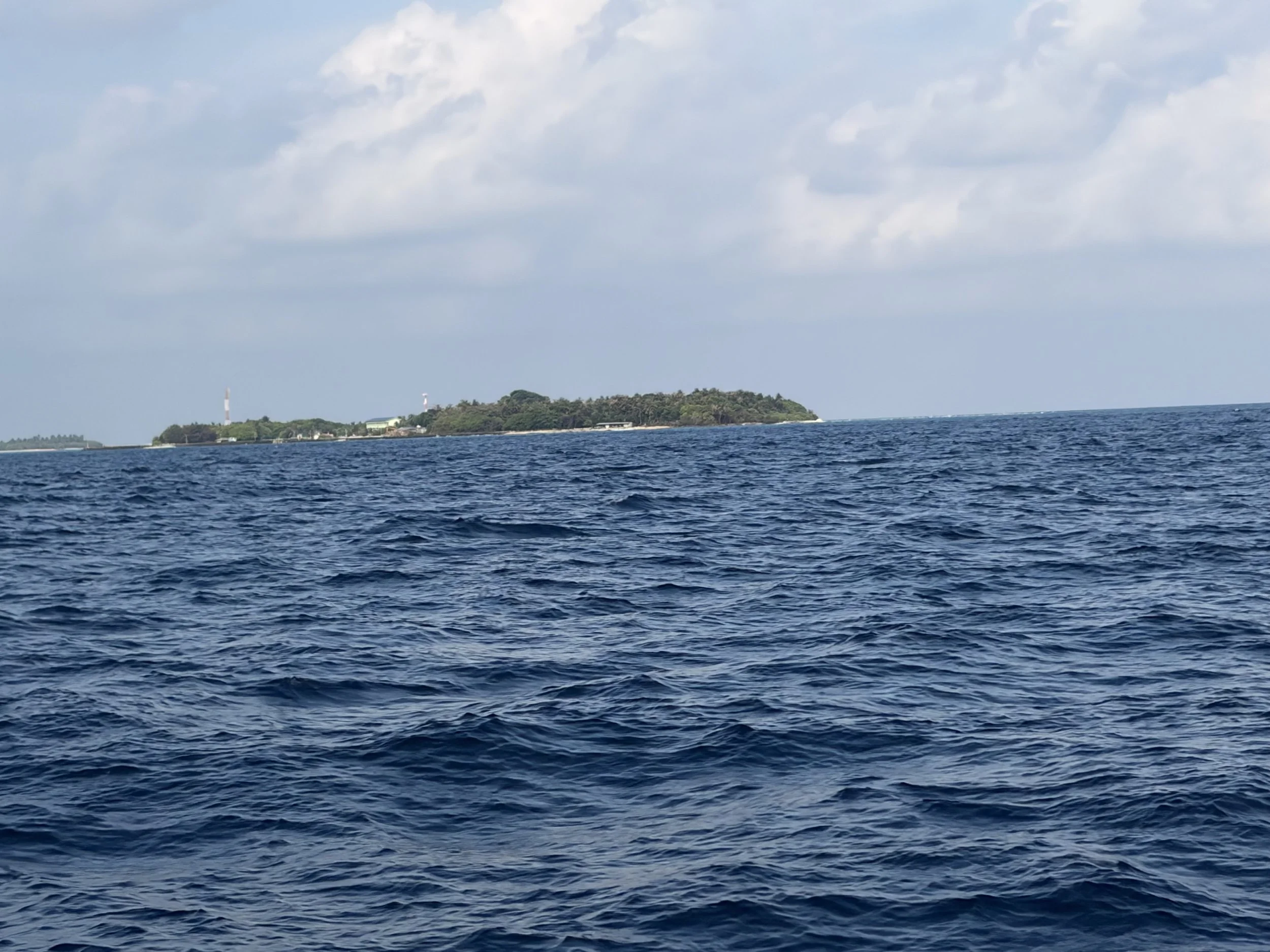
We motored on and came to our waypoint at about 8.00am and motored into the atoll and then round toward the lagoon of Uligan. There was one yacht anchored and a fishing type vessel. The island was shaped like a crescent shaped moon with trees all over it and you could see some buildings and a dock area. You could also see the different colours of the water especially the light blue which must be sand.
We came round and initially anchored not far from the other yacht but then realised we were around coral so we went further out which is where we thought the sand was.
I was called up by customs who asked where we had come from and I explained and who was our agent. They then needed certain documents which was able to send as Miranda had some data. They said they would come back to us.
Miranda and Jamie were desperate for a swim and in they went. J and I got the dinghy down and then Jamie helped get the larger engine down and I tested it. Then customs said they would come at about 2.00pm.
We relaxed and I had a swim and inspected the hull which was clean but it was not a perfect job but most of the crud was gone. I also checked the engine fan which has some loose wire at the back of it. I will need to take it off properly to have a look. However, the engine room was too hot at present.
I then made a fish taco style lunch cooking the mahi mahi we had caught the day before in butter and garlic and we had this with guacamole with tomatoes and coleslaw. It was delicious if I said so myself.
The agent, customs, coastguard and Immigration came about 2.30pm and checked our passports and out came the Stormbird boat stamp and we stamped a number of documents. They gave me my entry clearance documents which were wrong as they spelt my surname wrong which had to be corrected. We will need to have a tracker on board which they will give me. They left and we agreed to meet the agent at 5.00pm and they suggested we moved closer to the reef.
Once they left we tried to retrieve the anchor and the windlass was quite laboured. It had not been used since Galle. I was somewhat annoyed about this as it had been fully serviced in Phuket. We had to recover 80 m and very slowly it came up and when we got to 10m it stopped and the fuse blew. Ahhh. I changed the fuse and as soon as the button was pressed it blew again. I think we had an electrical problem. How were we going to get this up and we have many anchorages between now and South Africa- what a pain.
I then had the idea to use the snubber which has a hook on it and you hook it to the chain. I then led this to the winch at the mast. You could then wind in 2 m and then you stopped it on the windlass and repeated the exercise. It was slow but worked. We got in the last 10 m and then had to work out how we were going to drop it again. We tied a rope to the anchor and then put on deck 30m of chain.
We motored over to a sandy spot off the reef and managed to get the anchor starting to go down. It took some time and eventually we got it to hold. By this time it was 5.00pm and I did not think it sensible to go ashore in this situation so we messaged the agent and agreed to meet him at 9.00am and I asked him whether there was a good electrician on board.
This was all very annoying and we decided to retire to the aft deck for a sundowner as the sun was begging to drop.
We sat there in a lovely breeze overlooking a number of islands dotted around the atoll in the azure blue sea. We had arrived safe and sound and had travelled 274nm in 46 hours and 20 minutes.
We had another meal of the chicken curry from the night before which we added to which was lovely. We sat dining under stars and using our candle type lights which are solar and we had a great evening. I could forget for a few hours about the windlass and other issues and enjoy the moment.
We went to bed gently rocking at anchor.
So what about the Maldives. Maldives, officially the Republic of Maldives, and historically known as the Maldive Islands, is an archipelagic country in South Asia, located in the eastern Arabian Sea, within the northern Indian Ocean. Maldives is southwest of Sri Lanka and India, about 750 kilometres (470 miles; 400 nautical miles) from the Asian continent's mainland. Maldives' chain of 26 atolls stretches across the equator from Ihavandhippolhu Atoll in the north to Addu Atoll in the south.
Maldives is the smallest and extremely remote country in Asia. Its land area is only 298 square kilometres (115 sq mi), but this is spread over roughly 90,000 square kilometres (35,000 sq mi) of the sea, making it one of the world's most spatially dispersed sovereign states. With a population of 515,132 in the 2022 census, it is the second least populous country in Asia and the ninth-smallest country by area, but also one of the most densely populated countries. Maldives has an average ground-level elevation of around 1.5 metres (4 ft 11 in) above sea level, and a highest natural point of only 2.4 metres (7 ft 10 in), making it the world's lowest-lying country. Some sources state the highest point, Mount Villingili, as 5.1 metres or 17 feet.
Malé is the capital and the most populated city, traditionally called the "King's Island", where the ancient royal dynasties ruled from its central location. Maldives has been inhabited for over 2,500 years. Documented contact with the outside world began around 947 AD when Arab travellers began visiting the islands. In the 12th century, partly due to the importance of the Arabs and Persians as traders in the Indian Ocean, Islam reached the Maldivian Archipelago. Maldives was soon consolidated as a sultanate, developing strong commercial and cultural ties with Asia and Africa. From the mid-16th century, the region came under the increasing influence of European colonial powers, with Maldives becoming a British protectorate in 1887. Independence from the United Kingdom came in 1965, and a presidential republic was established in 1968 with an elected People's Majlis. The ensuing decades have seen political instability, efforts at democratic reform, and environmental challenges posed by climate change and rising sea levels. Maldives became a founding member of the South Asian Association for Regional Cooperation (SAARC).
Fishing has historically been the dominant economic activity, and remains the second largest sector, behind the rapidly growing tourism industry. Maldives rates "high" on the Human Development Index, with a per capita income significantly higher than other SAARC nations. The World Bank classifies Maldives as having an upper-middle income economy.
Maldives is a member of the United Nations, the Commonwealth of Nations, the Organisation of Islamic Cooperation, and the Non-Aligned Movement, and is a Dialogue Partner of the Shanghai Cooperation Organisation. It temporarily withdrew from the Commonwealth in October 2016 after being threatened with expulsion from the organisation for its human rights infringements and democratic backsliding. It was readmitted to the Commonwealth on 1 February 2020 after showing evidence of reform and functioning democratic processes.
Ihavandhippolhu Atoll is the northernmost atoll in the Maldives. It is a small natural atoll 22 kilometres (14 miles) in length.
It has 25 islands lying all around the boundary reef. One long barrier reef forms the western side of the atoll. There are several coral patches in the lagoon and the general depth in the centre is 20 to 30 fathoms (35 to 55 m).
Ihavandhippolhu is bounded in the north by the broad channel known as Māmalē Kandu (or Maliku Kandu) which separates the islands of Maldives from those belonging to India.The picture of today is the sighting of Uligan.
Need/Opportunity Year Three
I will be going shortly from India to the Maldives and then on to Mauritius, Reunion, Cape Town, St Helena, Azores and back to the UK.
I am looking for one crew from Mauritius/ Reunion Island to Cape Town (mid June to end of July). If of any interest do email me.
The blog will continue as we continue the journey. If you have any comments or suggestions about the blog then do email me on hine.nick9@gmail.com