Year 3 -31 January 2026 - Habarana -Sigiriya -Sri Lanka
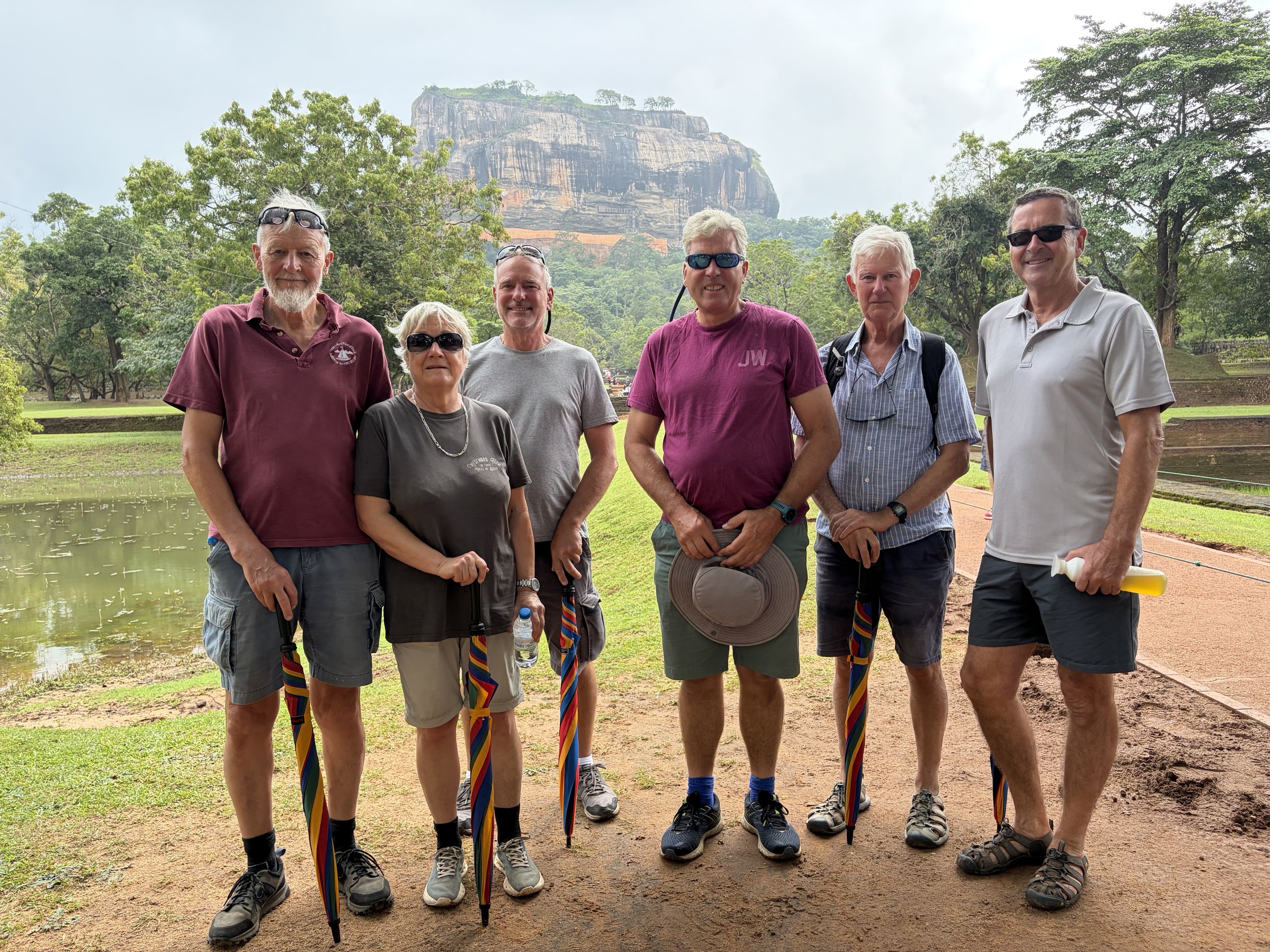
We had agreed to meet Chinta at 9.00am for our trip to Sigiriya – which literally means “Lion Rock”. It is one of the 8 wonders of the world it is claimed and regarded like Machu Picchu.
Sigiriya is an ancient rock fortress located in the northern Matale District near the town of Dambulla in the Central Province, Sri Lanka. It is a site of historical and archaeological significance that is dominated by a massive column of granite approximately 180-200 m (590 ft) high and is climbed by about 1200 steps.
It is likely that the area around Sigiriya was inhabited since prehistoric times. There is clear evidence that the many rock shelters and caves in the vicinity were occupied by Buddhist monks and ascetics from as early as the 3rd century BCE.
The towering rock is one of Sri Lanka’s most spectacular landmarks. It looks over the surrounding plains and its extraordinary remains are one of the most remarkable medieval royal palaces. The creator King Kassapa chose the almost inaccessible summit for his new royal palace; a courtly paradise of elegant pavilions set amid gardens and pools. The rock was transformed into an immense recumbent lion by the addition of a brick-built head and foreparts of which only the paws remain.
King Kassapa reigned between AD 477-495. He was the son of King Dhatusena. Kassapa was born to a non-royal consort. On learning that his younger brother Mogallana, but of royal blood, was proclaimed Dhatusena’s heir, Kassapa seized the throne and imprisoned his father who he subsequently killed. Mogallana fled to India intending to raise an army and return to reclaim his throne.
King Kassapa made his palace at Sigiriya and it had beautiful gardens, fountains, fabulous sculptures and a picture gallery of heavenly maidens and it was constructed in 7 years. It became a fortress and broad moats (5m deep) and stone perimeter walls were constructed with an outer moat which could be flooded between the two moats to make it more difficult for any approaching enemy. A boulder catapult system still remains.
Mogallana attacked in AD 495s some 18 years later. Kassapa in a moment of strange bravado or folly descended from his lofty palace and fortress and mounted an elephant to confront Mogallana and his army on the plains below. It is said at the height of battle that Kassapa’s elephant turned and fled. His troops took it as a sign that the King was retreating and was giving up the fight and left. Kassapa was left alone and facing capture. Realising his situation Kassapa drew his sword and plunged it into his own throat showing a certain honour in death which he had failed to show in his life. Mogallana seized the throne and returned to the then capital of Sri Lanka- Anuradhapura and gave Sigiriya back to the monks.
We met Chinta at the hotel entrance at 9.00am and then drove 30 minutes to the car park a little distance from the base of the rock. We saw Sigiriya rising sheer up as we drove. At the car park we were given a guide called Lanta and he walked us first to the first moat which was large and apparently 5m deep. We crossed and were the into a very long stone pathway (they fired the bricks in those days). We came to an area where there was some large pools. These were apparently swimming pools and Kassapa had 500 maidens just for himself!! These pools were used by the women and the King could watch etc. After the pools were some fountain gardens and the fountain holes are still there. A very sophisticated system was created where rainwater was collected in many tanks not only on the plains but also on the rock itself and with tunnels it was fed to where it was needed. In addition using windmills water from a surrounding lake could be pumped up to the rock.
After the fountains we came to the Boulder Gardens – where there was another large pool and a large rock which looked like an elephant. A groove was cut into this rock which was apparently used to create a diving board. In fact in many rocks there were steps cut which were used as supports for walls and in many large boulders and on the main rock itself vertical grooves had been cut to collect and channel rainwater.
Although only some of the walls remain Lanta explained that the walls were built up and buildings were erected with wooden rooves. In addition Kassapa had his summer palace down here with the pools and his winter palace (rainy season) on the rock.
We began to ascend and there were two entrances between 2 massive boulders and the steps continued up. Two large boulders had been placed with stone rollers/supports effectively underneath so that if an enemy approached these could be released and would roll down crushing anything in its path.
We continued to climb and got to a large terrace area after a while. This was where the Lion’s head had been built which was no longer there but you could see the paws and the steps rose up between them.
From this terrace a metal wrought iron staircase went up about 90-100 metres and was shared so those who went up had to come down the same way. It did not look that new so as we went up I focused on my feet rather than look down!! We eventually (as it was very busy and a bit of a snail’s pace) got up to the top and the top was reasonably flat with more terraces and pools (swimming pools and tanks) set out across the top. There were great views from the top although it was a little hazy. This was an amazing place and to think that they had this sophistication in those days is thought provoking. It must have been an amazingly opulent palace and what a place to be King and his 500 maidens.
Once we had enough of viewing the top we descended down the metal staircase. We then went on a walkway along the sheer edge of the rock which had been created. This was a highly polished wall plastered with a mixture of burnished lime, egg white, beeswax and wild honey. It was covered with graffiti but was made so the King could walk along it and see in reflection the murals which had been painted on the main rock face.
Once through this we ascended up a vertical wrought iron staircase which took us to a cave where there are the Sigiriya Damsels. This extensive mural featured 21 beautiful bare-chested women swathed in a layer of fluffy clouds from the waist down. These were impressive and are the only ones left. Originally there was 150 m of murals and would have claimed to be the largest open-air gallery.
Once we had seen this we descended a different way and back through the Boulder gardens and back to the van. What a trip and a fantastic and impressive place to visit.
We then went for a coffee and a snack and then returned to our hotel for 30 minutes. We then got in jeeps and went into the Elephant park for another safari. We saw lots of elephants mainly but also some birds and water buffalo. At the end we had a sundowner of Arak (a coconut spirit) cocktail beside an old man-made lake.
We returned to the hotel and then I went for a Aywaneda massage which was good with a steam bath after.
I returned to the hotel and we had another nice supper. It had been another full day.
The picture of the day is the 6 of us with the Sigiriya Rock behind us.
Need/Opportunity Year Three
In year three I will be going from Thailand to Sri Lanka, India, Maldives and then on to Mauritius, Reunion, Cape Town, St Helena, Azores and back to the UK.
I am looking for crew from Mauritius/ Reunion Island to Cape Town (mid June to end of July) and from Cape Town to the Azores and then to the UK (mid August onwards). If of any interest do email me.
The blog will continue as we continue the journey. If you have any comments or suggestions about the blog then do email me on hine.nick9@gmail.com