Year 3 -3 May 2026 –Depart Gan for Chagos
We slept well and when I got up Sabre 2 – Brice’s boat had gone. It seemed a pleasant morning and we prepared to leave for Chagos. We had our usual breakfast and then set about getting the dinghy up on the davits.
We had agreed to take Stormbird to the local harbour at 9.00am where a fuel truck was going to fill us up with diesel. I estimated that we would need about 350-400lts. I had pumped the fuel from the port to starboard tank. At about 08.40am we started to raise the anchor and took our time and it seemed to come up quite well. It takes time to bring up 80 m of chain.
Once up we headed round to the port and arrived there at about 09.10am and moored against the concrete harbour wall. The depth was about 3m.
That morning the main burner igniter on the gas stove had broken and it will not ignite the gas properly. I therefore sent the ladies off to buy a cigarette lighter or something suitable to light the gas. I had messaged the local agent to say we were there and ready to refuel. He just said ok. Keith and I saw a local café and went in to get a coffee and the local agent was there. He said the fuel truck was on its way somewhere in a Maldavian way
We had a coffee and then chatted. We were waiting for our departure documents as well. The fuel truck eventually came about 1.5 hours later and we filled up using my special filter which worked well. We put in 395 lts. This was good to be leaving with full tanks as the next chance to get diesel will be Mauritius.
We returned to the café where the girls were on their phones and got the departure documents as well.
Once we were ready we got on Stormbird, slipped the lines and headed out of the harbour. We were leaving the Maldives after about a month. I had not seen as much as I would like due to the windlass issues but it is a beautiful country and there is so much to explore.
We motored out of the South pass and then turned South toward Chagos.
The Chagos Archipelago or Chagos Islands (formerly Bassas de Chagas, and later the Oil Islands) is a group of seven atolls comprising more than 60 islands in the Indian Ocean about 500 kilometres (310 mi) south of the Maldives archipelago. This chain of islands is the southernmost archipelago of the Chagos–Laccadive Ridge, a long submarine mountain range in the Indian Ocean. In its north are the Salomon Islands, Nelsons Island and Peros Banhos; towards its south-west are the Three Brothers, Eagle Islands, Egmont Islands and Danger Island; southeast of these is Diego Garcia, by far the largest island. All are low-lying atolls, save for a few extremely small instances, set around lagoons.
The islands were first permanently settled by Europeans. From 1715 to 1810, the Chagos Islands were part of France's Indian Ocean possessions, administered through Isle de France—which was a colony of France (later renamed as Mauritius). Under the Treaty of Paris in 1814, France ceded Isle de France and the Chagos Islands to the United Kingdom.
In 1965, the United Kingdom split its administration of the Chagos Archipelago away from Mauritius and into the British Indian Ocean Territory (BIOT), to allow the United States to build Naval Support Facility Diego Garcia, which operates under a special agreement allowing significant US military presence. The islands were formally established as an overseas territory of the United Kingdom on 8 November 1965.
The only permanent inhabitants are employees of the military, including civilian contracted personnel, on Diego Garcia. The Chagos Islands are the homeland of the Chagossians, a Bourbonnais Creole–speaking people, though since 1971 no Chagossians have been allowed to live there. The United Kingdom expelled the entire Chagossian population from the archipelago at the request of the United States between 1967 and 1973. The main forcible removal of Diego Garcia's population took place in July and September 1971. In 2026, a group of Chagossians returned to the archipelago without government permission in an effort to reestablish the settlement on Île du Coin, and began legal action to establish their right to stay permanently As you know we know the yacht and Skipper who facilitated this.
Mauritius engaged in a sovereignty dispute with the UK, claiming the Chagos Archipelago as part of Mauritius. The International Court of Justice (ICJ) in 2019 and the International Tribunal for the Law of the Sea (in 2021) both stated that the UK had an obligation to return the islands to Mauritius. In October 2024, the British government announced it would transfer the Chagos Islands to Mauritius subject to finalisation of a treaty. The transfer agreement was signed on 22 May 2025, with the provision that the island of Diego Garcia would be leased back to the UK for at least 99 years. The UK government expected the treaty to be ratified sometime in 2025, but the legislation is indefinitely on hold due to both US opposition, as well as domestic political opposition in the UK. Opinion polling in the UK has consistently shown more opposition to the deal than support from the UK population. The UN Committee on the Elimination of Racial Discrimination has expressed "deep concern" at the terms of the deal. Opponents of the deal have cited Article 298 (b) of the United Nations Convention on the Law of the Sea (UNCLOS) as giving the British government an invokable legal exemption from "disputes concerning military activities, including military activities by government vessels and aircraft engaged in non-commercial service", and have argued that the British government's case was misleading.
The archipelago is about 500 kilometres (310 mi) south of the Maldives, 1,880 kilometres (1,170 mi) east of the Seychelles, 1,680 kilometres (1,040 mi) north-east of Rodrigues Island (Mauritius), 2,700 kilometres (1,700 mi) west of the Cocos (Keeling) Islands, and 3,400 kilometres (2,100 mi) north of Amsterdam Island.
The land area of the islands is 56.1 km2 (21.7 sq mi), the largest island, Diego Garcia, having an area of 32.5 km2 (12.5 sq mi). The total area, including lagoons within atolls, is more than 15,000 km2 (5,800 sq mi), of which 12,642 km2 (4,881 sq mi) are accounted by the Great Chagos Bank, the largest acknowledged atoll structure of the world (the completely submerged Saya de Malha Bank is larger, but its status as an atoll is uncertain). The shelf area is 20,607 km2 (7,956 sq mi), and the Exclusive Economic Zone, which borders the corresponding zone of the Maldives in the north, has an area of 639 km2 (247 sq mi) (including territorial waters).
The Chagos group is a combination of different coralline rock structures topping a submarine ridge running southwards across the centre of the Indian Ocean, formed by volcanoes above the Réunion hotspot. Unlike the Maldives, there is no clearly discernible pattern in the atoll arrangement, which makes the whole archipelago look somewhat chaotic. Most of the coralline structures of the Chagos are submerged reefs.
The Chagos contain the world's largest coral atoll, The Great Chagos Bank, which supports half the total area of good quality reefs in the Indian Ocean. As a result, the ecosystems of the Chagos have so far proven resilient to climate change and environmental disruptions.
In addition to the seven atolls with dry land reaching at least the high-water mark, there are nine reefs and banks, most of which can be considered permanently submerged atoll structures. The number of atolls in the Chagos Archipelago is given as four or five in most sources, plus two island groups and two single islands, mainly because it is not recognised that the Great Chagos Bank is a huge atoll structure (including those two island groups and two single islands), and because Blenheim Reef, which has islets or cays above or just reaching the high-water mark, is not included. Features are listed in the table from north to south:
The main natural resources of the area are coconuts and fish. The licensing of commercial fishing used to provide an annual income of about US$2 million for the British Indian Ocean Territory authorities. No licenses have been given since October 2010, however, and the last expired after the creation of the no-take marine reserve.
All economic activity is concentrated on the largest island of Diego Garcia, where joint UK–US military facilities are located. Construction projects and various services needed to support the military installations are done by military and contract employees from the UK, Mauritius, the Philippines, and the US. There are currently no industrial or agricultural activities on the islands. All the water, food and other essentials of daily life are shipped to the island. An independent feasibility study led to the conclusion that resettlement would be "costly and precarious". Another feasibility study, commissioned by organisations supporting resettlement, found that resettlement would be possible at a cost to the British taxpayer of £25 million. If the Chagossians return, they plan to re-establish copra production and fishing, and to begin the commercial development of the islands for tourism.
Once we set our course we put up the sails and made the best course we could. Due to the wind angle this meant we were between 35-40 degees off course but the wind may come round more to the west later and so we can make up the cross-track error.
I did the first watch 12,00noon to 4.00pm and we saw 2 huge Mersk container ships pass us. Lunch was prepared and it was a lovely sunny day with fair weather clouds. We sailed on well but were not in a rush as technically we should not be in our atoll until 6 May 2026.
The afternoon wore on and I handed over to Carolyn and Joyce and at times the wind died and then came back and went from Southwest to South and became quite variable. I could see all sorts of rain clouds so we tacked out of their way and missed them. The wind then settled down again.
Keith and Erika heated up the vegetable curry which we had with rice and yoghurt which was nice and we settled down to another night. I tried to rest but could not sleep. As it began to get dark I saw some red footed boobies rest on the pulpit. I have not seen any since the Galapagos in the spring of 2024.
Keith and Erika took over at 8.00pm and then about 9.30pm I sensed the wind strengthen and we were in a thunderstorm and the wind was all over the place. We took in the genoa and then motor sailed and then tacked away from the rain clouds and once things settled down we put up the sails again and are now making up our crosstrack error. The wind is light and we can sail slowly at about 4-5 kts but that is fine.
We have a red footed boobie on the top of the mast and at least one on the pulpit. I am sure they are going to make a great mess.
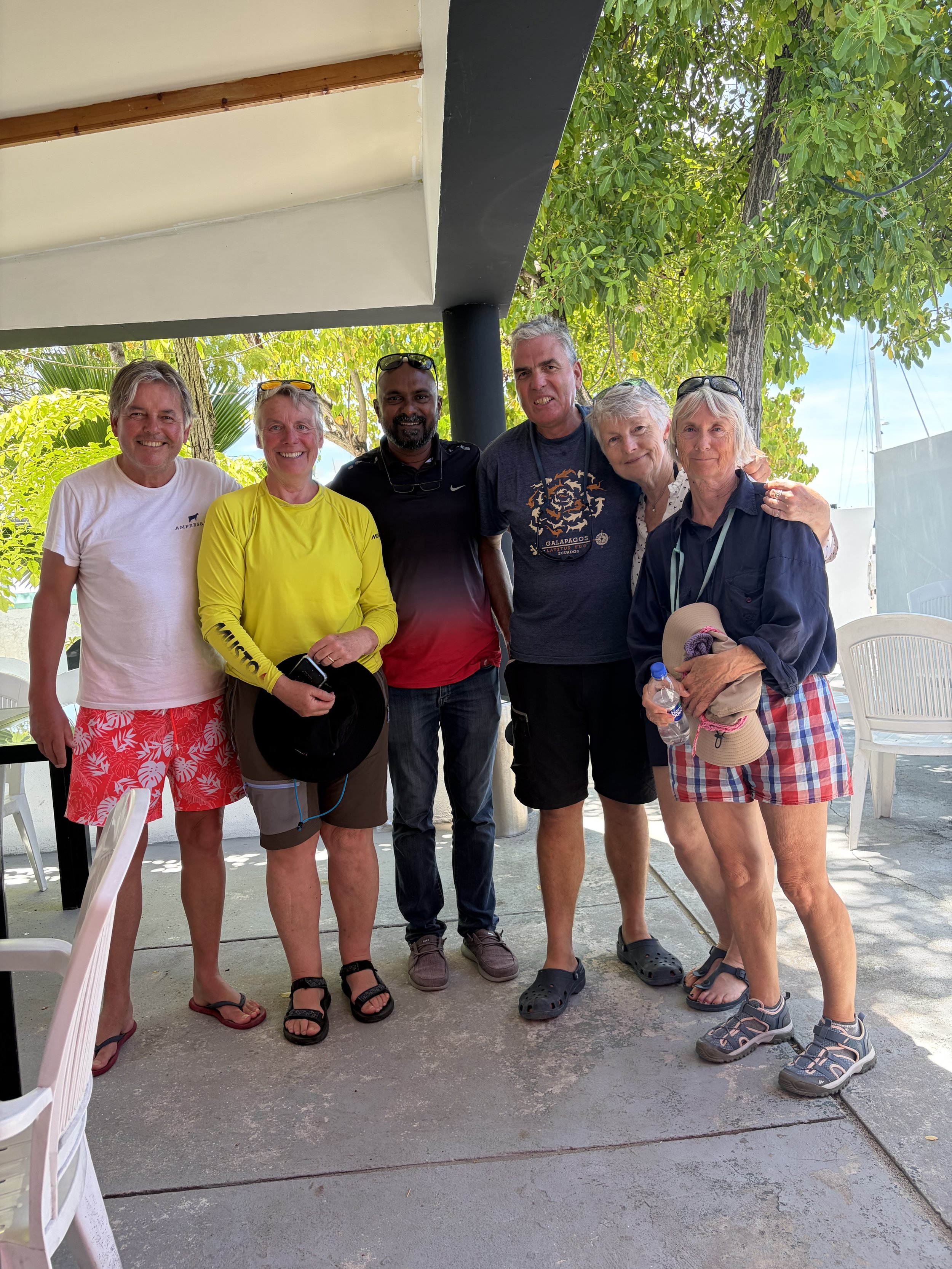
The picture of the day is the 5 of us with the local agent Mathi.
Need/Opportunity Year Three
I will be going shortly from India to the Maldives and then on to Mauritius, Reunion, Cape Town, St Helena, Azores and back to the UK.
I am currently in need of potentially 2 crew from Mauritius to Cape Town from about 10 June 2026 and we should arrive in Cape Town on about 25-30 July 2026. If at all interested contact me on my email below or WhatsApp +44 7931360372.
The blog will continue as we continue the journey. If you have any comments or suggestions about the blog then do email me on hine.nick9@gmail.com