Year 3 -3 February 2026 -Trincomalee – Anuradhapura-Sri Lanka
We met Chinta at 9.00am in reception having had a good breakfast. We were driving to Anuradhapura – a former capital of Sri Lanka.
This journey took us through the centre of the island and through agricultural country. There were many miles of paddy fields and in some areas the farmers were using half the road to dry the rice. There were some combine harvesters being used in some areas and Chinta explained that the young do not want to go into farming and get dirty and dusty and that they prefer to do other things so technology has to replace them. They were also growing other crops such as maize and the area had a rural beauty about it. We passed through bustily villages and towns where everyone was busy and going about their business.
Farming in Sri Lanka is a cornerstone of the economy, employing over 27% of the population and heavily focused on rice cultivation, tea, rubber, coconut, and spices. Centered around the monsoon-driven Maha (wet) and Yala (dry) seasons, agriculture is vital for food security. While traditional paddy farming methods are culturally deeply rooted, the sector is increasingly adopting technology and facing challenges like drought.
Around eighty different varieties of fruits and vegetables are grown in Sri Lanka's varied agro-climatic areas. The cool and salubrious climatic conditions in the hill country are ideal for temperate crops such as carrot, leek, cabbage, cauliflower, salad leaves, beet, bean, bell pepper, and salad cucumber. The well-demarcated low country and dry wet areas are suitable for a variety of tropical fruits and vegetables ranging from green chilli, red onion, pumpkin, bitter gourd, melon, sweet and sour banana types, queen pineapple, papaya, mango, lemon and gherkins.
Sri Lanka produces more than 800,000 metric tons of fruits and vegetables annually and exports both fresh and processed varieties to many destinations in the world. 90% of the fresh produce is exported to the Middle East and the Maldives and approximately 75% of the processed products go to the European market.
In 2019, Sri Lanka produced 1,499 Metric Tons of cocoa beans (2018: 2,115) and was number 32 among the cocoa-producing countries.
Sri Lanka’s most famous export, cinnamon is the island’s premier spice export. Industry insiders classify the spice into two forms, Ceylon cinnamon, and Cassia Cinnamon. Ceylon cinnamon is the costlier variety and is considered to be a much more upmarket product by those in the West. Sri Lanka exported USD 128 million worth of cinnamon in 2014, which accounted for 28% of global cinnamon exports for that year.
Black pepper is the second largest export spice in Sri Lanka. Most black pepper is exported to India. But India and Vietnam re-export to Europe Sri Lankan pepper under the Indian/Vietnam label.
Cardamom, one of the most important spices in the traditional cuisine of Sri Lanka, but 90 to 95% percent of the cardamon which is harvested is consumed in the country itself.
We eventually came to the outskirts of Anuradhapura and we found a nice place to have a coffee. We picked up our guide for the city Mr Karrapa (Mr K).
Anuradhapura is a major city located in the north central plain of Sri Lanka. It is the capital city of North Central Province and the capital of Anuradhapura District. The city lies 205 kilometres (127 mi) north of the current capital of Colombo in the North Central Province, on the banks of the historic Malwathu Oya. The city is now a World Heritage Site famous for its well-preserved ruins of the ancient Sinhalese civilisation.
While records places the founding of the city in 437 BCE, the site has been inhabited for much longer, making it a major human settlement on the island for almost three millennia and one of the oldest continuously occupied cities in Asia. It is the cradle of the Hydraulic Sinhalese civilisation, Theravada Buddhism, and the longest-serving ancient capital of Sri Lanka that has survived for 1500 years. Moreover, it was the first capital of the Sinhala Kingdom of Rajarata, following the kingdoms of Tambapanni and Upatissa Nuwara. Anuradhapura was also the centre of Theravada Buddhism for many centuries and has been a major Buddhist pilgrimage site with ruins of many ancient Buddhist temples, including the famous Anuradhapura Maha Viharaya and the Jaya Sri Maha Bodhi, the oldest still-living, documented, planted tree in the world believed to have originated from the original Bodhi tree at Bodh Gaya (Bihar, India) under which the Buddha attained enlightenment. These vast networks of ancient temples and monasteries now cover over 100 square kilometres (40 mi2) of area of the city today.
The city was mostly destroyed and largely deserted after 993 CE, with the Chola invasion from South India. Although several attempts were made by later Sinhalese kings to return the capital to Anuradhapura, it was not reestablished as a major population centre of the island until the British colonial era in the 19th century CE. Despite its decline as a political centre, Anuradhapura remained a vital pilgrimage site for Buddhists throughout the medieval period and continues to be a significant spiritual destination today. The modern revival of Anuradhapura began in the 1870s under British colonial rule, with infrastructure and urban planning initiatives aimed at supporting administration and accommodating pilgrims. The contemporary city, much of which was moved during the mid-20th century to preserve the site of the ancient capital, is a major road junction of northern Sri Lanka and lies along a railway line. The city is the headquarters of Sri Lanka's archaeological survey, and tourism is a significant factor in its economy.
Mr K took us initially to a colonial building which the British built and which is now a museum. It houses a lot of old relics which he wanted to show us as they are relevant to what we will see on his tour. It is very clear that the civilisation some 2,000-2500 years ago was sophisticated (remember Sigiruiya). They had water systems and used terracotta pipes. They had toilets with a filter system of sand to filter the waste before it sunk into the ground. They had steps which fitted inside each other, pots and jugs and other cooking and storage jars. They also created amazing carvings and had what they called Guard posts at the side of steps and a moonstone (a half-moon carved stone pattern) at the bottom of steps to hold them in place.
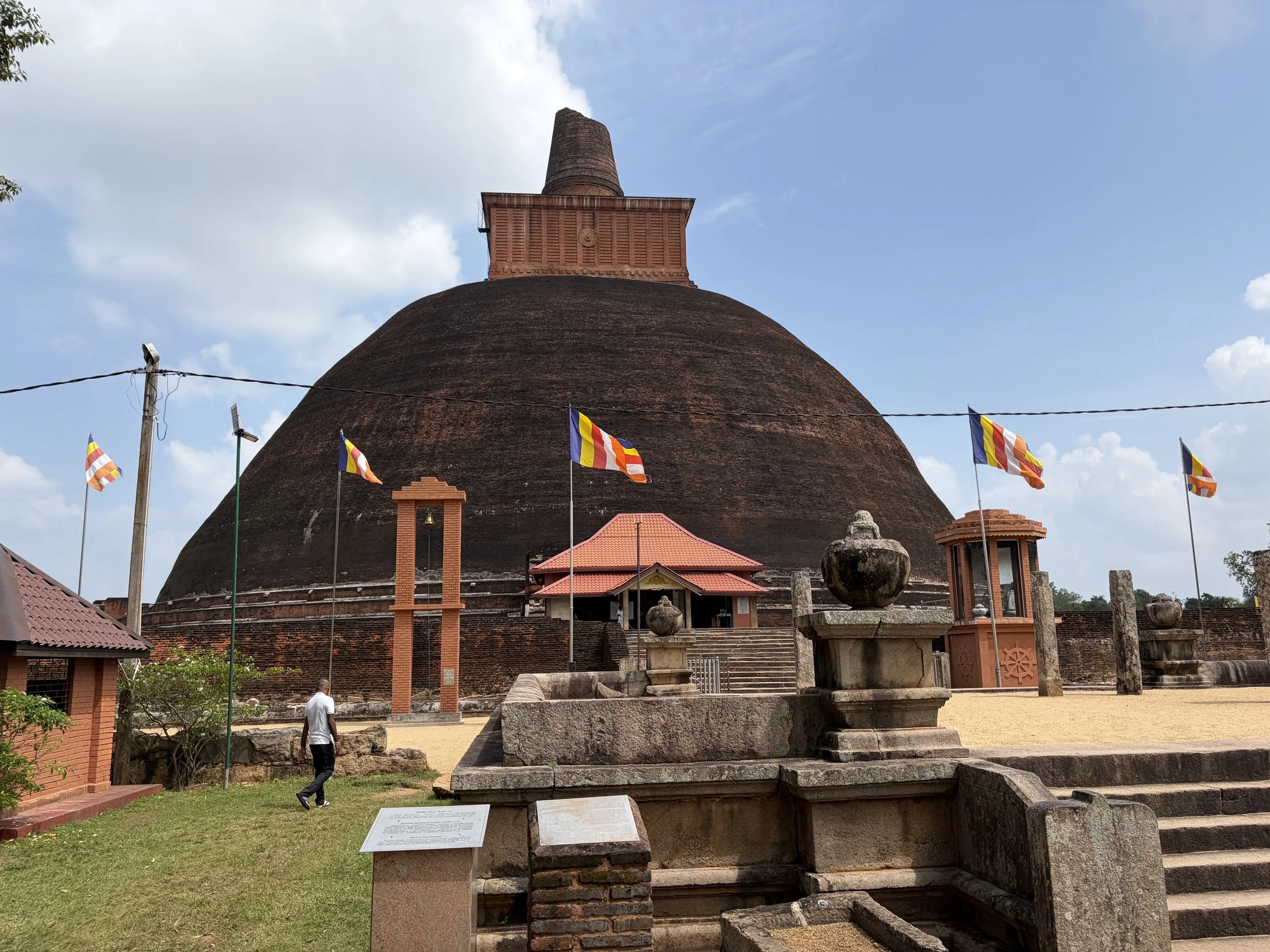
We got back in the van and were taken to a large brick coloured Stupa called Jetavana Stupa -Built by King Mahasena (273–301 AD), this is the tallest stupa (originally 122m, now 71m and holds a part of the Buddha's belt. It is 1600 years old and a world heritage site. They think it is made of 25 million bricks which could be placed between Edinburgh and London. Around the stupa 3,000 monks lived and were looked after by the local people. In fact the whole area is ruins which are gradually being uncovered and restored. These include dormitories and it will take years and really started when the British took over and began to help. But what is a Stupa?
In Buddhism, a stupa is a domed hemispherical structure containing several types of sacred relics, including images, statues, metals, and sometimes—the remains of Buddhist monks or nuns. It is used as a place of pilgrimage and meditation.
Walking around a stupa in a clockwise direction, known as pradakhshina, has been an important ritual and devotional practice in Buddhism since the earliest times, and stupas always have a pradakhshina path around them. The original South Asian form is a large solid dome above a tholobate, or drum, with vertical sides, which usually sits on a square base. There is no access to the inside of the structure. In large stupas, there may be walkways for circumambulation on top of the base as well as on the ground below it. Large stupas have, or had, vedikā railings outside the path around the base, often highly decorated with sculpture, especially at the torana gateways, of which there are usually four. At the top of the dome is a thin, vertical element, with one or more horizontal discs spreading from it. These were chatras, symbolic umbrellas, and have not survived, if not restored. The Great Stupa at Sanchi in Madhya Pradesh, is the most famous and best-preserved early stupa in India.
Apart from very large stupas, there are many smaller stupas in a range of sizes, which typically have much taller drums, relative to the height of the dome. Small votive stupas built by or paid for by pilgrims might be less than a metre high, and laid out in rows by the hundred, as at Ratnagiri, Odisha, India.
We have seen many Stupas on our travels but the ones here are some of the oldest and largest in Sri Lanka.
Once we had seen this Stupa we went to see some pools which the monks used for bathing which had been created for them. They had sand filtering systems and were well made. We then went to see some ruins of the refectory when 5,000 monks were fed and they had long stone rice and curry troughs which they used to take the food from. We also saw other old, ruined temples and monk gathering places.
We then went to a large white stupa called Thuparamaya which had been restored. Thuparamaya is the earliest documented Buddhist temple in Sri Lanka. dating back to the reign of King Devanampiya Tissa (247-207 BC). This dates back to the arrival of Mahinda Thera (Mahindagamanaya) and the introduction of Buddhism to the island. Originally they were all white and the first one when restored was not covered in plaster and then painted. This one was and did not look old. It was 75m high and had 4 small stupas -one on each corner and 338 elephants on the outside walls as if to be guarding it.
We finally went to the Jaya Sri Maha Bodri which is the remnants of a 2,300-year-old tree brought from India and planted 2,300 years ago. Only a branch of the tree remains supported by gold supports and it has become a very religious Buddhist place and temple. There were lots of people praying and chanting and apparently it is visited by a lot of people each day.
The Jaya Sri Maha Bodhi is a sacred Bo tree located in the Mahamewuna Garden, within the historic UNESCO World Heritage City of Anuradhapura, Sri Lanka. It is believed to be a tree grown from a cutting of the southern branch from the historical sacred bo tree, Sri Maha Bodhi, which was destroyed during the time of Emperor Ashoka, at Bodh Gaya in India, under which Siddhartha Gautama (Buddha) attained enlightenment. (About 2,600 years ago, Lord Gautama Buddha sat with his back against an Esathu (Aśvattha) tree on the banks of the Neranjana River in Bodhgaya, India. It was at this moment, as he sat against the tree, that the Buddha is said to have achieved enlightenment. In doing so, the tree also gained a venerated status. It became known as the Bodhi tree, and pilgrims came to see it even within the lifetime of the Buddha.) In 236 BC, the Buddhist nun Sangamitta Maha Theri, a daughter of Indian Emperor Ashoka, brought the tree cutting to Sri Lanka during the reign of Sinhalese King Devanampiya Tissa. At more than 2,300 years old, it is the oldest living human-planted tree in the world with a known planting date. Today, the Jaya Sri Maha Bodhi is situated on a high terrace, about 6.5 meters above the ground, and surrounded by 4 other lower-level terraces with Bo trees called "Parivara Bodhi" planted for its protection. It receives millions of pilgrims each year. The site is open to visitors and continuously hosts numerous acts of worship throughout the year. However, access to the uppermost terrace where the bo tree is located is restricted due to the old age of the tree and various acts of vandalism it has endured throughout history, including a terrorist attack by the LTTE in 1985, where around 146 pilgrims were massacred.
This concluded our tour for the day and we then went to our hotel Lolu Village which was just outside the area. It was a lovely small hotel and we had a swim. We then had a small buffet supper and quite different from the larger hotels which was nice for a change.
The picture of the day is of Jetavana Stupa we visited.
Need/Opportunity Year Three
In year three I will be going from Thailand to Sri Lanka, India, Maldives and then on to Mauritius, Reunion, Cape Town, St Helena, Azores and back to the UK.
I am looking for crew from Mauritius/ Reunion Island to Cape Town (mid June to end of July) and from Cape Town to the Azores and then to the UK (mid August onwards). If of any interest do email me.
The blog will continue as we continue the journey. If you have any comments or suggestions about the blog then do email me on hine.nick9@gmail.com