Year 3 -28 August 2026 -Day 10 Cape Town-St Helena
For those looking at the tracking page -due to my Starlink problems it is not updating as it should. I hope to resolve this shortly by changing WIFI so I hope it will be updating shortly.
We continued to sail into the night at a reasonable speed as the wind was not that strong. However, in the early hours the wind died to about 6kts and we had to motor. Julian and I took over at 8.00am and we were still motoring. We had a range of breakfasts namely smoothies, pineapple and granola and yoghurt and Paul did a Keith Watson and cooked bacon and eggs again!
We did our daily checks and then the wind started to come up again so we sailed but then had to motor again at 10.00am but by 12.00noon it had filled in and we started sailing again. The 24-hour run to 12,00noon due to the wind was only 156nm.
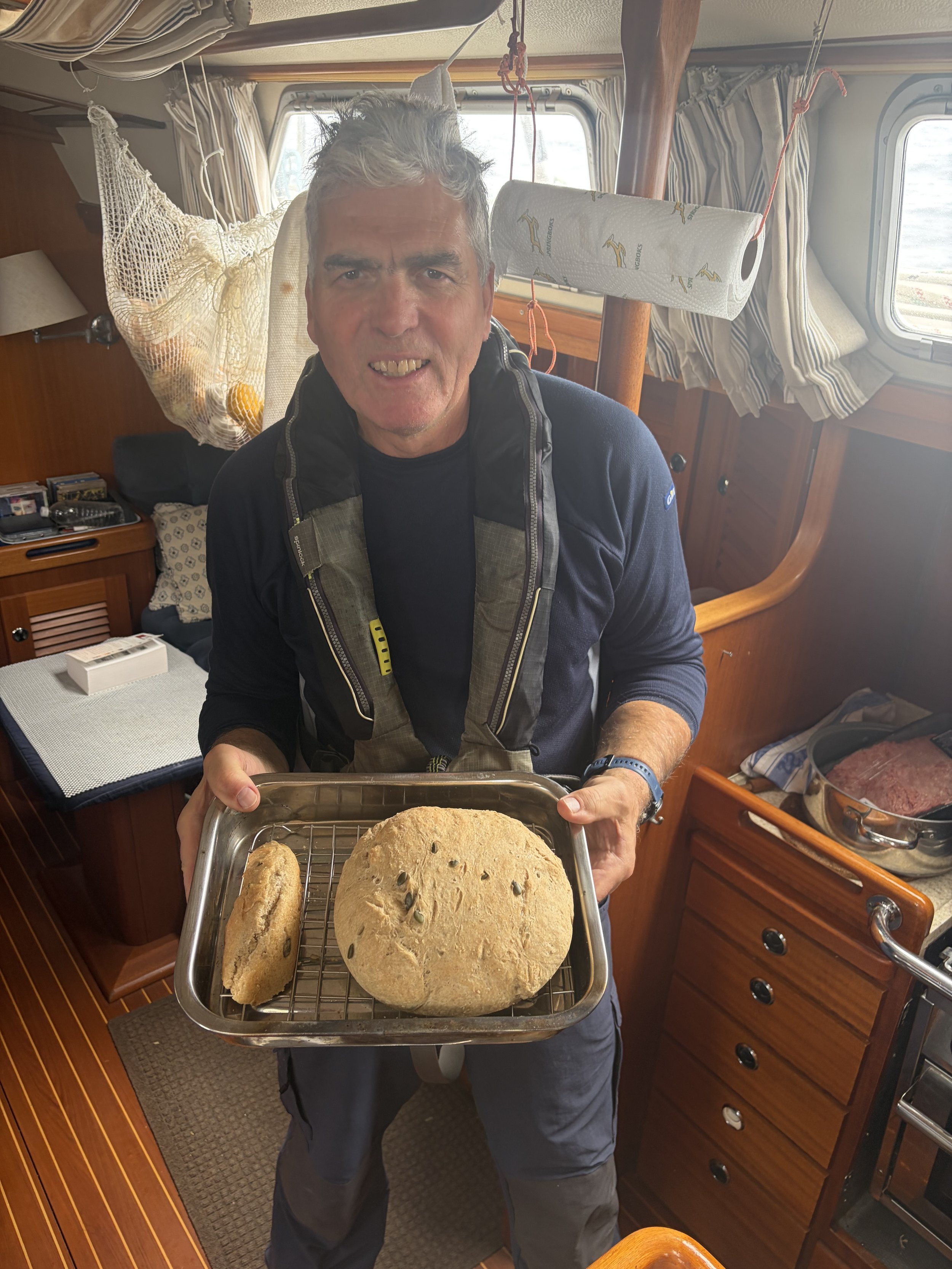
I made another loaf of bread- see today’s picture and the oven is working a lot better after Mark and my clean of the oven jet.
I made contact again with Port Control St Helena to tell them that we would arrive tomorrow night and to seek permission to go ashore as Sunday and Monday customs and immigration would be closed but I received no reply. Derek Richards (Chris Boock’s friend) was in touch and he had started our shopping list which was great. I mentioned to him about Port Control and he would try and make contact with them. I also emailed the Harbour Master to see if he could check that my emails had been received.
We had lunch and we were fishing again. The wind was in the right direction at present and so we are able to sail directly toward St Helena and we are likely to arrive at about 10.30pm. We will have to anchor and it should be fine to arrive in the dark although ideally we would arrive in the light.
We rested, chatted and did our watches. Paul mended the wooden holder for the kitchen roll which was good.
So where are we going?
St Helena is one of the remotest islands on Earth. The subtropical British Overseas Territory sits in the midst of the South Atlantic Ocean, 1,200 miles from Africa and 1,800 miles from South America. The only other near landmass is Ascension Island, which is 807 miles to the northwest. St Helena is situated at 15° 56′ South and 5° 45′ West. St Helena is just 47 square miles.
With a tight-knit, extremely low-crime community of just 4,439 (2021 Census) it can be freely explored and it has natural and built attractions and provides peace and tranquillity. As a subtropical island, St Helena’s climate is temperate year-round (15-28°C). While the four seasons are not recognised on St Helena, the ‘cooler months’ are generally June to September and the ‘hotter months’ are December to March.
St Helena is generally not affected by extreme weather events, with even thunderstorms only occurring perhaps once a decade. Until 2017, St Helena did not have an airport and was only accessible by sea. Reaching the island meant a five-day ship voyage from Cape Town, South Africa. However, since October 2017, the island’s first and only airport has enabled passengers to reach the island in just a six-hour flight. St Helena’s environment is of global significance.
The island’s isolation between its emergence 12 million years ago and its settlement in 1659, gifted it with spectacularly well-preserved scenery and biodiversity. More than 500 species of plants and animals are found on St Helena Island that are found nowhere else on Earth – this means the tiny, remote island is home to a massive 1/3 of all the unique species found within the UK and its Overseas Territories. Additionally, the island boasts the last natural cloud forest on British soil. Plus, the island is surrounded by a Category VI Marine Protected Area nearly the size of France.
St Helena’s environment is also visually stunning. The amount of microclimates and diversity of landscapes surprises even the most well-travelled. It’s hard to believe so many microclimates and varieties of landscape exist within one tiny volcanic outpost. Some walks feature ‘paint palettes’ of rolling, multi-coloured hills; some feature geologically stunning, barren cliff faces falling drastically into the sea; some feature Jurassic Park-like jungles of ferns and eucalyptus.
The ‘Post Box Walks’ are 21 walks each ending with a ‘post box’ containing a signature book and stamp. The difficulty of each walk varies, some only for the most experienced walkers and others family friendly. The distance of the walks is 1.5km-12km, and time taken is generally about one hour to about half or a full day. Low levels of pollution mean St Helena enjoys excellent air quality. The near-total lack of light pollution (protected in legislation), coupled with St Helena’s location near to the equator, enable world-renowned stargazing.
For commitment to environmental protection and promotion, St Helena was recognised by World Commerce Review as the Best Eco-Location and Sustainable Tourism Destination 2022. The transient nature of the mid-Atlantic island led to a true melting pot of people (descended from Europeans, Chinese, Portuguese, Africans and more); however the islanders, known as ‘Saints’, mainly identify as British.
The small community is extremely close-knit – everyone knows everyone, stops to say hello to each other on the streets, and the driver of each passing car waves to each other on the roads. Saints are also renowned for being friendly and welcoming to visitors. Serious crime is a rarity, and the island is free from war and political unrest. Cultural values include a deep connection to the natural environment (both land and ocean), a sense of resilience and resourcefulness, strong family, community and charitable values, and a great pride in ‘being Saint’.
St Helena has its own laws and legal system, with links to English law; is English-speaking (though often with a strong local dialect); and uses the St Helena Pound is pegged to the British Pound Sterling at parity. Pound Sterling is also accepted.
In 1815, the British government selected Saint Helena as the place of exile for Napoleon Bonaparte (1769–1821), following his defeat at Waterloo and subsequent abdication. He was taken to the island in October 1815. Napoleon stayed at the Briar’s pavilion, on the grounds of the Balcombe family's home, until his permanent residence at Longwood House was completed in December 1815. He died there six years later on 5 May 1821 due to stomach cancer. He was buried on the island and with the British government’s permission his remains were taken back to Paris and he is now buried there.
The afternoon wore on and we were expecting stronger winds and in fact it crept up to 25/26kts and we were sailing nicely toward the island. The wind gusted up to 30 kts and so we changed the genoa for the staysail and put 3 reefs in the main. This is probably our sail plan for the night.
Julian cooked and we ate a tasty spaghetti bolognaise which we all eat in the cockpit with the swishing of water around us as the swell increased and is likely to get up above 3 m during the night with winds late 20’s early 30’s so Force 7 potentially 8.
We settled down for the night and Julian and I took the first night watch at 8.00pm with the winds likely to increase more in the early hours.
The picture of the day is of me with my loaf of bread.
Need/Opportunity Year Three
I am now on the way to St Helena, Cape Verde, Azores and back to the UK.
The blog will continue as we continue the journey. If you have any comments or suggestions about the blog then do email me on hine.nick9@gmail.com