Year 3 -28 April 2026 – Himmufushi -North Male Atoll – Maldives
We woke reasonably early as we were taking the 8.00am speed boat to Male to provision and of course now to visit Keith. We had been working on the provisioning list over a few days and realised it would be an onerous task but it would be best to do it in Male rather than anywhere else. We grabbed all our shopping bags, had a quick breakfast and headed ashore. I had had a message in the night from Naashiz that Keith was sleeping which was reassuring.
We decided to shut all the hatches as rain was predicted during the day and then went ashore getting some more cash out of the ATM.
The journey to Male was 15-20 minutes and we got off and walked to the hospital Keith was in. It took us a little time to find his ward but we were soon at the reception and were allowed into Keith’s room. He was dozing when we arrived and a man -Naashiz as snoring away in the corner on a small bed. In fact he continued to snore during our whole visit and never work up once.
Keith was looking quite positive and they had taken bloods at 5.30am and he had been on antibiotic drips all night. His leg was less swollen and he said it was less painful. A Dr came in when we were there and she felt Keith’s leg and he described the pain out of 10 yesterday as 8 and today at 4. In fact it was more discomfort than pain. She said that the Dr in charge of his case would visit and let’s see the result of the bloods. Keith was more himself and we joked about the snoring and the fact that although it was a private room the walls did not go up to the ceiling so you can hear everything that is going on. He had been able to walk to the loo twice and said that he had a fever last night but that had now gone. He looked in good spirits which was good to see.
Carolyn and Joyce went to find Keith some breakfast and whilst this was happening the Dr in charge of his case came in. He said he had not seen the blood results yet but he think it was an insect bite or something like that. The rash was a bit of cellulitis but with the antibiotics this would all go fairly quickly. He said he should stay in hospital today and overnight and we can review tomorrow.
We then had a discussion about Stormbird’s plans etc and the fact that once we left the Maldives there would be no access to medical help for about 2 weeks. The Dr was fairly relaxed about that and said that he should have a few days rest and if we went to Gan he could fly down. He said if the antibiotics work well then this could be possible. Well we will see how the next 24-48 hours go. I agreed with Keith that one of us will bring his bag and all his stuff tomorrow to the hospital. This therefore leaves all options open and he has everything if he is not able to come back on board. He agreed this was sensible.
We said our goodbyes buoyed by the fact that Keith was on the mend and it was not anything more serious like DVT or dengue fever etc. We had plenty of time so we decided to walk in the direction of the supermarket Fantasy we had been recommended. We came to a nice café and had a coffee and pain au chocolat.
After that we came on our route to a building called the Mulee-Aage. The plot of land on which the current building stands was originally called Muleege constructed by Katheeb of the island of Mulee in the Meemu Atoll, the grandfather of the Sultan Hassan Izzudhdheen for his family. The current building was constructed in 1914 by a different Sultan as the palace for the heir to the throne. It is now the residence of the 7th President of the Maldives.
Opposite the Mulee- Aage was The Malé Friday Mosque, also known as the Malé Hukuru Miskiy, or the Old Friday Mosque, which is a Sufi Sunni mosque, located in the city of Malé, Kaafu Atoll, Maldives.
Completed in 1658, the mosque is the oldest and most ornate mosque in the Maldives. Coral boulders of the genus Porites, found throughout the archipelago, are the basic materials used for construction of this and other mosques in the country because of its suitability. Although the coral is soft and easily cut to size when wet, it makes sturdy building blocks when dry. The mosque was added to the tentative UNESCO World Heritage cultural list in 2008 as unique examples of sea-culture architecture.
Master carpenters of the Malé Hukuru Miskiy were Ali Maavadi Kaleyfaanu and Mahmud Maavadi Kaleyfaanu from Kondey, Huvadu. The calligrapher was Chief Justice Al Faqh Al Qazi Jamaaludheen. In terms of artistic excellence and construction technique using only interlocking assembly, it is one of the finest coral stone buildings of the world.
The mosque is opposite to the Medhu Ziyaaraiy which is the tomb of a Sunni Muslim visitor named Abu al-Barakat Yusuf al-Barbari who introduced Islam to the Maldives in 1153 CE.
Construction of the mosque commenced in 1656 and was concluded in 1658, during the reign of Ibrahim Iskandar I (1648–1687). It was built over an earlier mosque constructed in 1153 by the first Muslim Sultan of Maldives, Dhovemi, after his conversion to Islam. Although the older mosque was reportedly refurbished by Ahmed Shihabuddeen in 1338, there are no written records attesting this. In 1656, Iskandar began building a new mosque when the old one became too small to accommodate the increasing number of devotees. Its construction, which took one and a half years, was completed in 1658. Built primarily of coral, the mosque originally had a thatched roof (common during the period). After his 1668 Hajj, Ibrahim I began building a munnaaru (minaret) and a gate at the southern end of the mosque. The minaret, patterned on those at the entrance to Mecca, is surrounded by a 17th-century cemetery with intricately carved tombstones and mausoleums.
In 1904, Muhammad Shamsuddeen III (1902–1934) replaced the thatched roof and southern gateway with corrugated-iron sheeting. Further renovations were made in 1963, converting the roof supports to teak wood and replacing the corrugated-iron sheeting with aluminium. In 1987 and 1988, an Indian team from the National Research Laboratory for Conservation of Cultural Property and the National Centre for Linguistic and Historical Research in Malé did conservation work on the mosque.
The mosque has been in continuous use since it was built. The mosque was reportedly built over an ancient temple which predated Islam; the original temple faced the setting sun, rather than Mecca.
The Malé Friday Mosque is oriented west. Its prayer carpet is angled towards the mosque's northwest corner, so worshippers can face Mecca while they pray. Devotees enter the mosque from either of the two entrance gates that lead to the mosque's dhaala.
It has intricate carvings, with inscriptions in Quranic script. The mosque, in a walled enclosure, is made of interlocking coral blocks with its hypostyle roof supported by cut-coral columns. With three entrances, the mosque has two prayer halls surrounded by antechambers on three sides. Its vaulted, decorated ceiling is indented in steps. Local master carpenters, known as maavadikaleyge, fashioned the mosque's woodwork, roof and interior, and its wall panels and ceilings have many culturally significant examples of traditional Maldivian woodcarving and lacquerwork. The mihrab, with a mimbar (pulpit) at one end, is a large chamber. The main building, used for daily prayers, is divided into three sections: the mihtab (used by the imam to lead the prayers), the medhu miskiy (the mosque's central area) and the fahu miskiy (the rear of the mosque). A long, carved 13th-century panel memorialises the introduction of Islam to Maldives.
The mosque's adjoining large, round blue-and-white minaret (built in 1675) resembles a wedding cake, with a wide base similar to a ship's funnel. Built of coral stones, it is braced with metal strips. The minaret is surrounded by a graveyard with carved coral tombstones distinguishing males, females, sultans and their families. Women's tombstones have rounded tops; men's have pointed tops, and inscriptions for royalty are gilt. For family members, small mausoleums with intricately decorated stone walls were built.
This mosque and the other Maldives coral mosques were added to the cultural UNESCO World Heritage tentative list in 2008 for meeting criteria two (use of sea cultures for creating unique architecture), three (a historic cultural tradition with no parallel elsewhere in the world), four (the tongue-in-groove technique shows a highly developed building level for the period) and six (the buildings are associated with both religious and social practices of cultural significance). According to the UNESCO appraisal, "The architecture, construction and accompanying artistry of the mosque and its other structures represent the creative excellence and achievement of the Maldivian people.
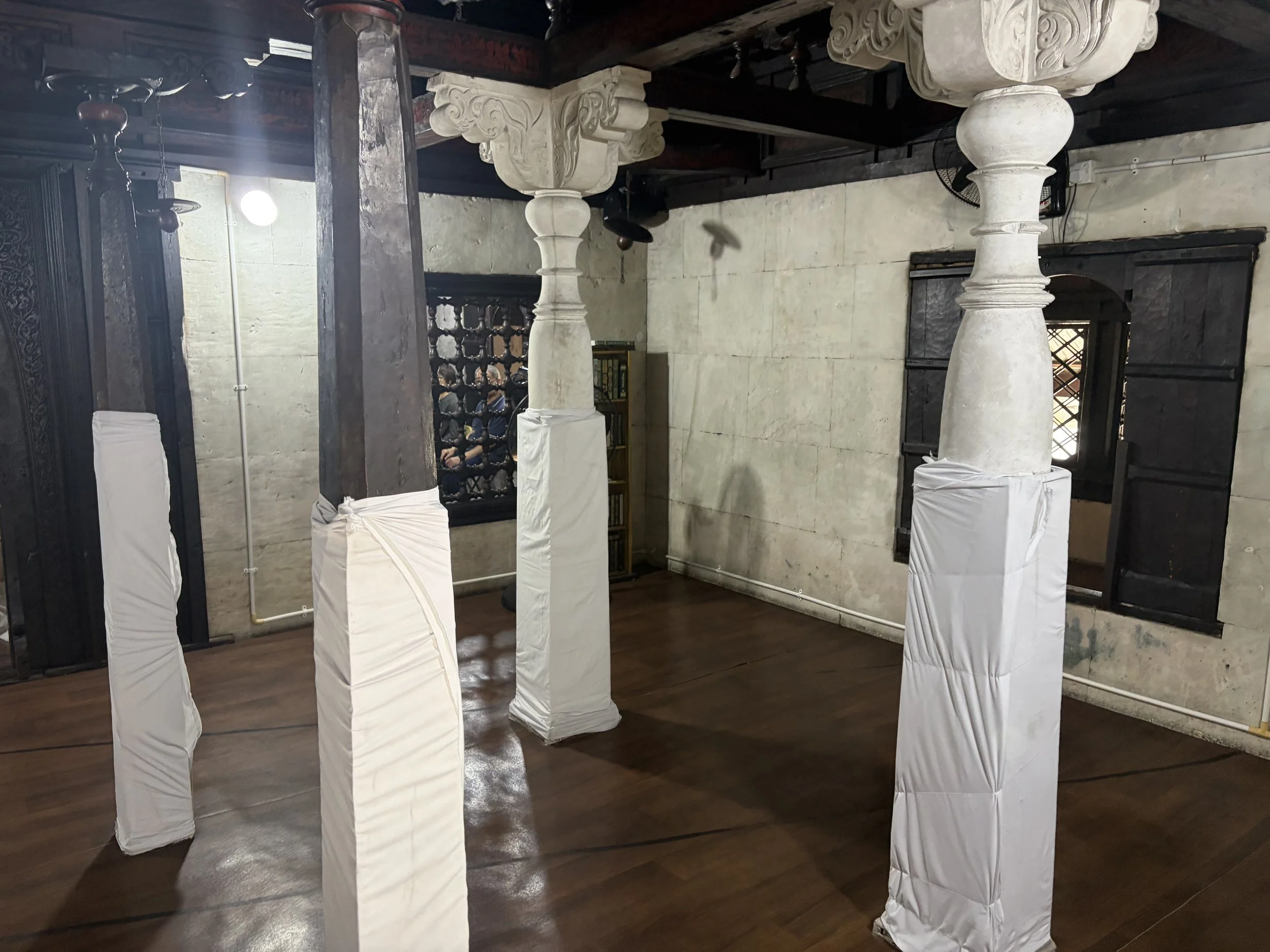
We walked around the gardens and a kind man said we could go in but we would need to cover up and he had suitable coverings. We therefore accepted his offer and went in. We could see the intricate carving of the coral and wood and it was a lovely old and religious building but seemed a shame to have a corrugated iron roof.
We continued on our trip and found the Fantasy supermarket and noted what it had. We therefore decided we would go there last as we wanted to buy some dairy products. We therefore went to another café where we had some soft drinks. I went out and bought a new kettle for the stove as the current one is rusting. We then went to the fruit and vegetable market in a green warehouse.
We bought a whole load of fruit and vegetables and filled a number of bags which we could barely carry. We therefore took all this to a local café and we piled up our bags and had a drink. We then left Joyce and went back to Fantasy and bought all we wanted. We could not carry everything in one go. Carolyn and I then carried what we could to a shady spot at the ferry terminal. I then went and got Joyce and together we carried the bags to where Carolyn was. I then returned to Fantasy and got the rest of the stuff and went back to the ladies who had started loading the ferry. We must have had about 10 bags and 3 rucksacks worth. It was a relief to get on the ferry.
I had been in contact with the agent and he agreed to put the full cylinder on the MTCC ferry which should arrive in Himmafushi at about the same time as we arrived.
We did arrive and put all our stuff on the dock – it was quite a pile. Then I saw the MTCC ferry come in and our full cylinder was out on the dock which was great. It was good when things come together.
We somehow got all of the stuff, cylinder and the 3 of us into the dinghy and laden to the gunnels brought everything back to Stormbird. There is then the task of putting it all away and where certain things go. This all takes time but we managed it. There are just a few things to get now like eggs etc which we will do tomorrow.
We thought about going to the Floating bar nearby but by 5.00pm the heavens opened and we all went out in our swimming costumes and had a shower in the rain whilst we put things away and took things down. We were swinging about and there was thunder and lightning. This went on for some hours and so we had a simple omelette supper with the last eggs.
The rain continued throughout the evening and was anticipated to continue overnight. Keith Watson and Erika arrive tomorrow so we will be back to 5 again and hopefully if Keith will get well enough to join us in Gan.
The picture of the day is the old mosque interior with the coral columns.
Need/Opportunity Year Three
I will be going shortly from India to the Maldives and then on to Mauritius, Reunion, Cape Town, St Helena, Azores and back to the UK.
I am currently full which is great but if things change I will make this clear.
The blog will continue as we continue the journey. If you have any comments or suggestions about the blog then do email me on hine.nick9@gmail.com