Year 3 -27 July 2026 -Cape Town -South Africa
We slept well and went out at 9.00am to the café in the
Watershed Hut for breakfast. We as a crew thought of coming for breakfast there before. We had a good breakfast and then decided to get on the Hop on Hop off bus. Although I have done this before Alex had not and it is a very good way to see round the Cape.
The difference about today was that there was a strong East/South East wind which whipped through Cape Town and when we stopped at the Foreshore Stop the bus was shaking quite a lot with the wind and people were wandering around in their coats and holding on to them.
I contacted the riggers and luckily they started early as they got the mast off before the wind started to get strong. Chris suggested that it would not be a good idea to take the boat back today and suggests we do that tomorrow morning. At least they had got the mast off.
We continued through to Long Street and then on up Table Mountain to a certain height and then on towards Devil’s Peak and then round it passing the Kirstenbosch Gardens and then on to Newlands, the wettest area in the Cape.
We continued on through Constantia to Haut Bay where there is some shanty towns on the side of the hill. We got out at the Mariners Wharf and almost were blown over. It was a cold harsh wind and the bay was full of white horses and it looked quite evil. We thought of walking down the quay and looking at the fishing fleet but it was a bit cold and we did not have a lot of warm gear with us. We went into the fish market which had a large fishing boat as a backdrop and you could buy fish and wine there including snook.
In South Africa, snoek (spelled with an "ee") is a popular, long and thin marine food fish (Thyrsites atun) belonging to the snake mackerel family, known for its sharp teeth, oily flesh, and cultural significance in the Western Cape. We had bought some before and it was like eating a smoked kipper.
We walked around the harbour and there were a number of fish factories there and as you can imagine it smelt of fish!!
We then went into the restaurant in the wharf itself that we had lunch in before and we enjoyed looking at all the boat memorabilia and paraphernalia. As it was so early and we were not ready for lunch. We continued on the bus and as we came to the beaches the sea looked like it was on fire. It was very disturbed with white water and froth. You could see the spume coming off the waves and you could see gusts about 100 yards long sweeping over the sea and spray going up into the air. The winds must have been Force 8/9 to create the scene in front of us. The scenery looked stunning as the sun came out with the boulder strewn coast, the sea and the waves as described and the mountainous backdrop. It would not be nice to be in boat out there. One could cope but it would not be comfortable.
We got off the bus at Camps Bay and the beach had large waves crashing on to it and the sand was blowing off the beach. We walked right along it and were being buffeted again.
We had lunch at the Surfshack again which was good but we had to sit inside but we had a window seat and could look out over the frothing bay. It was lovely to sit here and chat with this fantastic vista in front of us.
Once we were done we got back on the bus back to Cape Town.
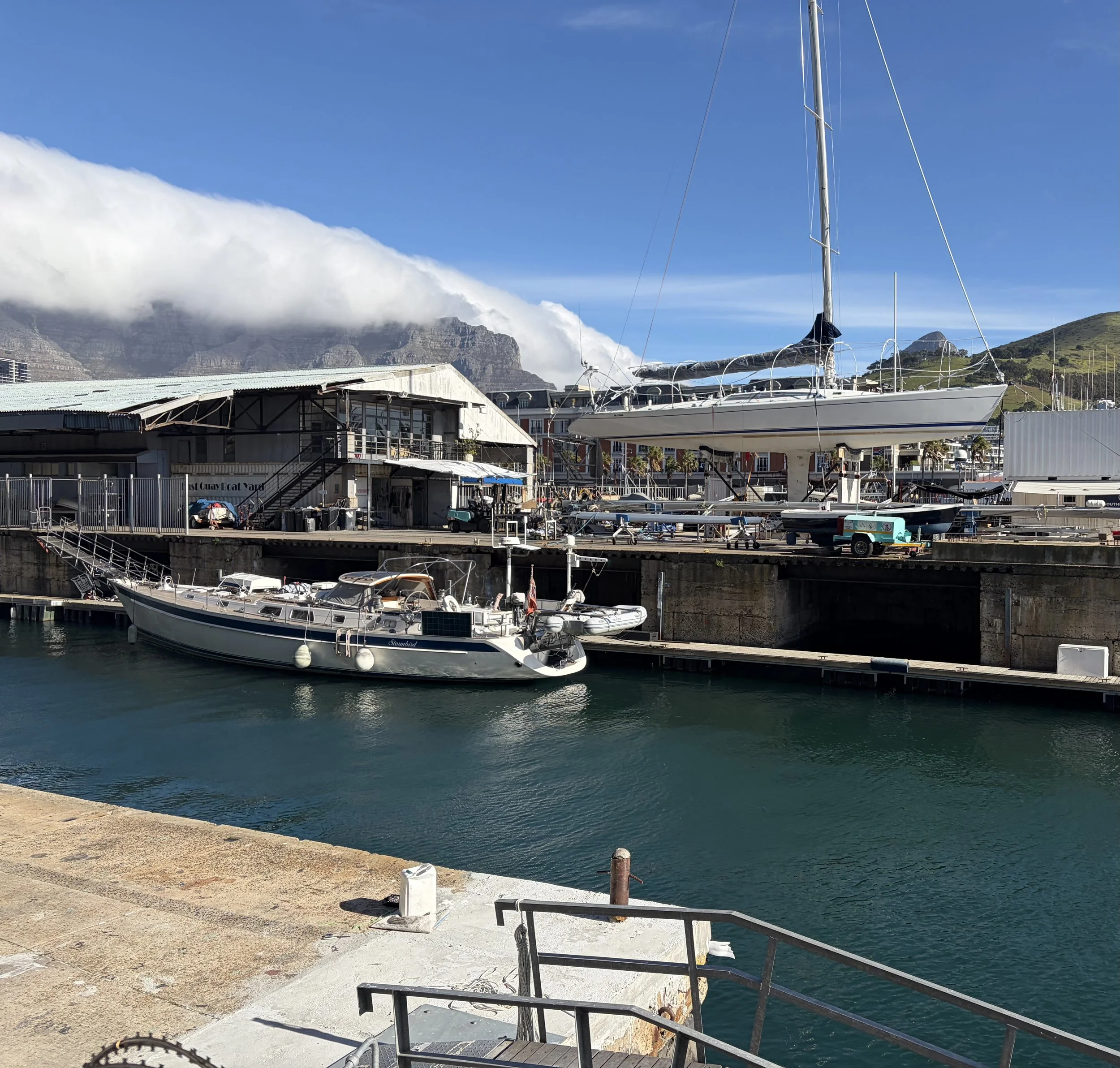
We decided to walk over and check Stormbird who was sitting at the pontoon with her mast and boom on the shore.
I looked up at Table Mountain and it was astonishing to see the clouds rushing off the South Easterly side of Table Mountain. The clouds were moving very fast and it was in that direction that we saw the wind on the sea in Haut Bay. It was astonishing and I have not see any cloud move that fast. I guess it was like a Katabatic Wind.
A katabatic wind (named from Ancient Greek 'descent') is a downslope wind caused by the flow of an elevated, high-density air mass into a lower-density air mass below. The spelling catabatic is also used. Since air density is strongly dependent on temperature, the high-density air mass is usually cooler, and the katabatic winds are relatively cool or cold.
Examples of katabatic winds include the downslope valley and mountain breezes, the piteraq winds of Greenland, the Bora in the Adriatic, the Bohemian Wind or Böhmwind in the Ore Mountains, the Santa Ana winds in southern California, the oroshi in Japan, or "the Barber" in New Zealand.
A katabatic wind originates from the difference of density of two air masses located above a slope. This density difference usually comes from temperature difference, though humidity may also play a role. Schematically, katabatic winds can be divided into two types for which the mechanisms are slightly different: the katabatic winds due to radiative cooling (the most common) and the fall winds. In general, colder air becomes denser than warmer air, which allows it to move downslope due to the gravity.
After we had looked at Stormbird we went to the Seitz Art Museum which I have discussed before which use to be the grain silos. Architecturally it is amazing inside and it is as it the silos have been dissected and cut in half. The contemporary art was less interesting although thought provoking.
We had some tea on the way back and came back to our hotel for a break. We then went out to a Spanish restaurant for a good meal. The wind was still howling and blowing us about and hopefully it will then calm down overnight.
The picture of the day is of Stormbird without a mast in front of Table Mountain with the clouds rushing off the mountain. You can see the silver line of the mast and boom on the shore.
Need/Opportunity Year Three
I am now on the way to Durban and will then head for Cape Town and then on to St Helena, Azores and back to the UK.
The blog will continue as we continue the journey. If you have any comments or suggestions about the blog then do email me on hine.nick9@gmail.com