Year 3 -26 May 2026 – Another Recovery Day (Patch on) -Port Louis- Mauritius
I woke at 6.00am to put in my first drops and then rested for a bit and then got up. I felt ok but still a little tired. We had fruit and yoghurt for breakfast and I got on with the blog.
After coffee we decided to go and see the old pagoda here. It was only a 12 minute walk and it would do me good to get off the boat. A large cruise ship on a world cruise called the Crown Princess was in dock and there was a constant flow of people from this ship trapsing past. It was huge and can take 3090 people with 1200 crew and was on a 114 day trip round the world from Sydney to Sydney. A number stopped to admire Stormbird.
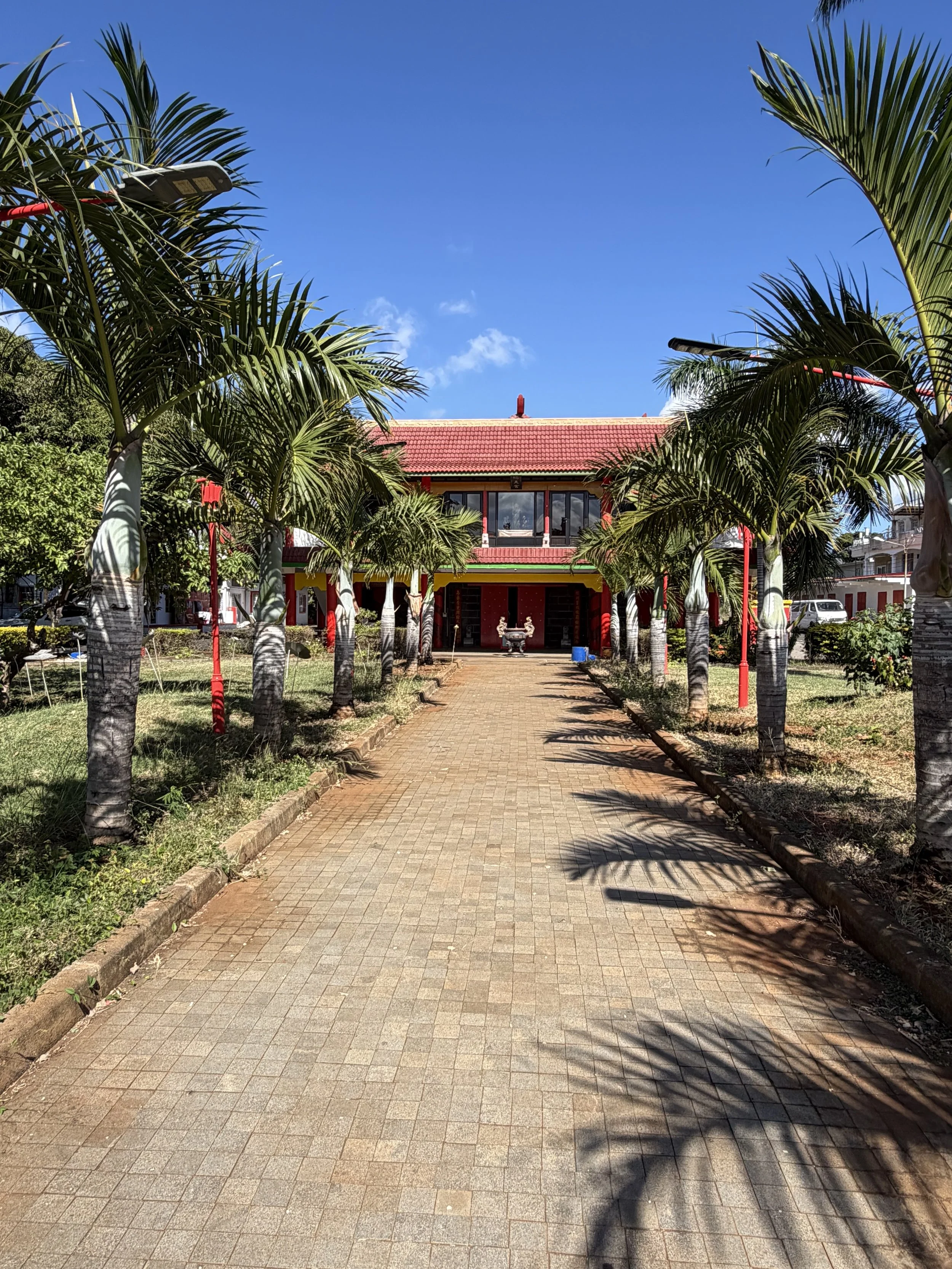
Carolyn, Joyce and I got off and walked toward the cruise ship and past the aquarium which I noted to visit another time. Walking was ok but your vision is limited and perspective with one eye is a little different so steps, pavements and ramps mean you need to pay extra attention to them. The pagoda was not too far and is called Kwan Tee.
The Kwan Tee or Guan Di Pagoda is the oldest in the Southern Hemisphere and the oldest one in Mauritius. Located at Les Salines, on a Longitude of -20°9'42.12" and Latitude 57°29'31.2", it faces the sea and against the mountains. Its construction and location abides by the principles of spirituality. The pagoda is a very peaceful place with its majestic piece of land and beautiful gardens full of coconut trees in the front of the yard and at the back and a few seasonal fruit trees. The Kwan Tee pagoda is an oasis of peace and tranquillity though located in one of the most busiest and stressful place and capital of Mauritius. It is a perfect place for meditation.
The pagoda was built by Hahime Choissane. and his coterie was inaugurated on 29 January 1842 as the Cohan Tai Biou or Kwan Tee. Hahime, the Kapitan retreated with his followers into a secret society called the Zhongyitang association grouped around the Kwan Tee pagoda.
The cult of Kwan Tee is associated with the god of wealth - Choisan. Kwan Tee or Guan Di is also the god of war and the righteousness and the benefactor. There are smaller altars inside the pagoda like Ma Chou protector of sailors and Kwan Yin, giver of Children. There is also an ancestor cult altar. The oldest tablet in the pagoda was affixed there circa 1841 and was restored in 1890. There is also a bell which dates back from 1871. Another tablet was offered in 1868 by the disciples of the Zhongyitang association which is believed to have been created by Hahime Choissane.
The red, green and yellow are the predominant colours in the Chinese pagoda: they represent happiness, prosperity and purity.
Each year, the 24th day of the sixth lunar month, Guan Di's birthday is celebrated. "This celebration is known as" Fête Mine", an important event in the city of Port Louis. That day, offerings are made to the highest rank of warrior deity. After a religious ceremony, fried dishes noodles are distributed to the guests.
We walked round when we arrived and it had its own area and was well cared for. We noticed 3 large tortoises in a cage and two wandering around inside the pagoda and a large one on its own eating the grass. We met a man who said that his grandfather, who came from China was part of the original society when it was formed, and his father was involved and now he is part of it. The pagoda was originally built as a house and then became a pagoda. It was gifted to the Chinese people by the owner. The tortoises were gifted to them so they look after them. It was interesting to see the pagoda and a place of tranquillity in a busy city.
We wandered back and it was quite hot and I was trying to protect my eye with a hat and sunglasses which were difficult to wear with my patch which can come off tomorrow and I cannot wait. Joyce made scrambled egg for lunch which was nice.
Did you know that the dodo (of which there is a stuffed bird in the National History Museum) is endemic to Mauritius. The dodo is an extinct flightless bird that was endemic to Mauritius. The dodo's closest relative was the also-extinct and flightless Rodrigues solitaire (being an island 50 minutes away from Mauritius). The two formed the subtribe Raphina, a clade of extinct flightless birds that are a part of the group that includes pigeons and doves (the family Columbidae). The closest living relative of the dodo is the Nicobar pigeon. A white dodo was once thought to have existed on the nearby island of Réunion, but it is now believed that this assumption was merely confusion based on the also-extinct Réunion ibis and paintings of white dodos.
Subfossil remains show the dodo measured about 62.6–75 centimetres (2.05–2.46 ft) in height and may have weighed 10.6–17.5 kg (23–39 lb) in the wild. The dodo's appearance in life is evidenced only by drawings, paintings, and written accounts from the 17th century. Since these portraits vary considerably, and since only some of the illustrations are known to have been drawn from live specimens, the dodos' exact appearance in life remains unresolved, and little is known about its behaviour. It has been depicted with brownish-grey plumage, yellow feet, a tuft of tail feathers, a grey, naked head, and a black, yellow, and green beak. It used gizzard stones to help digest its food, which is thought to have included fruits, and its main habitat is believed to have been the woods in the drier coastal areas of Mauritius. One account states its clutch consisted of a single egg. It is presumed that the dodo became flightless because of the ready availability of abundant food sources and a relative absence of predators on Mauritius. Though the dodo has historically been portrayed as being fat and clumsy, it is now thought to have been well-adapted for its ecosystem.
The first recorded mention of the dodo was by Dutch sailors in 1598. In the following years, the bird was hunted by sailors and invasive species, while its habitat was being destroyed. The last widely accepted sighting of a dodo was in 1662. Its extinction was not immediately noticed, and some considered the bird to be a myth. In the 19th century, research was conducted on a small quantity of remains of four specimens that had been brought to Europe in the early 17th century. Among these is a dried head, the only soft tissue of the dodo that remains today. Since then, a large amount of subfossil material has been collected on Mauritius, mostly from the Mare aux Songes swamp. The extinction of the dodo less than a century after its discovery called attention to the previously unrecognised problem of human involvement in the disappearance of entire species. The dodo achieved widespread recognition from its role in the story of Alice's Adventures in Wonderland, and it has since become a fixture in popular culture, often as a symbol of extinction and obsolescence.
As no complete dodo specimens exist, its external appearance, such as plumage and colouration, is hard to determine. Illustrations and written accounts of encounters with the dodo between its discovery and its extinction (1598–1662) are the primary evidence for its external appearance. The bird was sexually dimorphic; males were larger and had proportionally longer beaks. Weight estimates have varied from study to study. In 1993, Bradley C. Livezey proposed that males would have weighed 21 kg (46 lb) and females 17 kg (37 lb). Imagine if they were still around today – they would have been quite a sight.
In the afternoon I had to do some admin and write letters for crew arriving here and in Reunion and I liaised with the agent about this and the battery charger which hopefully will arrive tomorrow.
Carolyn and Joyce decided they would go off to Rodrigues for a few days from tomorrow. I would not go as if anything happened to my eye I need to be here and also to look after Stormbird.
We rested for the rest of the afternoon and Jerome did not come. I did not chase him as when the charger arrives he can hopefully do the lot in one go.
We had a sundowner and then Carolyn cooked a chicken curry which was nice with spinach. I did my drops every 3 hours during the day with the last 2 at 9.00pm. I can get the patch off tomorrow and cannot wait.
The picture of the day is of the pagoda we visited.
Need/Opportunity Year Three
I am now in Mauritius and will be going to Reunion, Cape Town, St Helena, Azores and back to the UK.
I have now found additional crew for Mauritius to Durban. There may be space from Durban to Cape Town from about the beginning of July and we should arrive in Cape Town on about 25-30 July 2026. If at all interested contact me on my email below or WhatsApp +44 7931360372.
The blog will continue as we continue the journey. If you have any comments or suggestions about the blog then do email me on hine.nick9@gmail.com