Year 3 -25th September 2026 - Sao Vicente, Cape Verde to Faial -Azores – Day 6
I had the 2.00am to 5.00am watch. I had a good look at the weather and it does appear that the front is coming over the Azores on the 28th September and that our strategy to delay getting to Waypoint 2245 is correct as that will allow the worst of it to pass before we get there. In addition that it is right that we should get to Faial on the morning of the 29th as the aftereffects of the system, notably the swell will get worse during the day (as the effect of the system takes time to increase the swell). However, we needed to be going a little quicker than we were so I put out a little more sail as I calculated we needed to be doing about 6.5 kts and we had only been doing about 5.5-6.0 kts.
It was a pleasant night with a large moon illuminating the ocean and giving it that silvery sparkly complexion. The stars were out but there was more cloud than we have had previously. In fact at one point it started to rain but luckily it did not last long.
So what is it like to do a watch on your own at night? Well apart from being up when you would rather be in bed, it is quite pleasant really. You have the boat to yourself as everyone is in bed. You can look at the stars and moon and ocean and you are conscious everyone’s life is potentially in your hands if you do not keep a good look out and watch. I have time to look at the weather and think about it and the best strategy. I have time to write the blog. You have time to contemplate life and to appreciate how lucky you are to be here in the ocean doing what I am doing. You have the routine of doing the log each hour, watching the instruments and listening to the sound of the boat and engine if on. You think about things you need to do and to plan ahead. You have space as it were. You have to make your own hot drinks but you can raid the naughty cupboard with no eyes looking at you! In short having got up it is a pleasant few hours and you are playing your part of the 24-hour Stormbird system as you are allowing others to sleep and rest and they will in turn do the same to allow you to rest and sleep. It is then great to be able to climb into bed knowing a good job done. It is of course more fun when you have a watch buddy as you talk about all sort of things. However, as described it is also good to be on your own from time to time.
I handed over to Mark and Dave at 5.00am and I explained my weather deliberations and strategy which was to stick to what we had agreed. I went to bed and was ready for it.
During Mark & Dave’s watch (about 6.00am) the wind died and so the engine went on and we then motor sailed (keep the main up to give us stability and some forward motion) just off the wind so the main gave us some lift.
When I woke they had all had breakfast and were mentioning that I said I would make smoothies. I made some scrambled eggs on toast for myself and Paul and John were on watch and starting to do the daily checks. Paul thought there was some water in the bilge and we checked the bilges and they were fine. I checked the engine room and the engine was running well and the generator seemed fine after I had run it last night and made water.
It was another lovely sunny day and we were motor sailing just off course as set by Mark in order to get the wind lift from the main.
I checked the weather and there will now not really be any useable wind until we get to Waypoint 2245 which should be about 4-6.00pm on the 27th. We will therefore be motoring until then. This is just before the system starts to sweep through. It looked to me that it was coming through a little earlier than previous forecast but still bringing 25-32kt winds and swell up to 3.1 m (down from 3.6m). Whilst a little unpleasant this should not be an issue for Stormbird or us if we manage it well and plan ahead. This should still mean we get into Faial – Horta by breakfast on the 29th.
I looked at the National Hurricane Centre website and Fay has been upgraded to a Tropical Storm again although it is a long way West of us and going West so not an issue. The AEW near Cape Verde has now been upgraded into a Tropical Storm and been given the name Gonzalo – Tropical Storm Gonzalo. This will move North toward us but only at about 9 kts. It will give the Cape Verde islands some wet and windy conditions and we were right and lucky to leave when we did.
I decided to make an early lunch smoothie which I did and it was much enjoyed by all using up some of the more mature bananas and coconut milk.
I took over at 12.00noon and we were still motor sailing although a bit off course. The wind is supposed to die at about 2.30pm so I monitored the situation.
It was warm and sunny and the sea relatively flat. It was a shame that what wind there was, was on the nose so we could not use it properly. Our 24 hour 12.00noon run was 144nm which is about what we needed.
Mark set out the lunch which was our usual cheeses and meats and salad and so that everyone is not disappointed he made some more coleslaw!!
We motor sailed on but by 2.20pm we were some way off course and the wind had lessened so I decided to take in the main and to motor directly to our Waypoint 2245.
I did the fruit and vegetable (not that we have much left now) turning with the help of Paul who was in the galley preparing supper.
The afternoon continued with the lovely weather continuing and the gentle rise and fall on the small swell we had. Dave made a loaf and then went to sleep but we all congregated in the cockpit for some more tea and lemon drizzle cake which was still excellent but not as good as yesterday when it was only a few hours old.
I handed over to Mark and Dave who were still fishing but again we drew a blank.
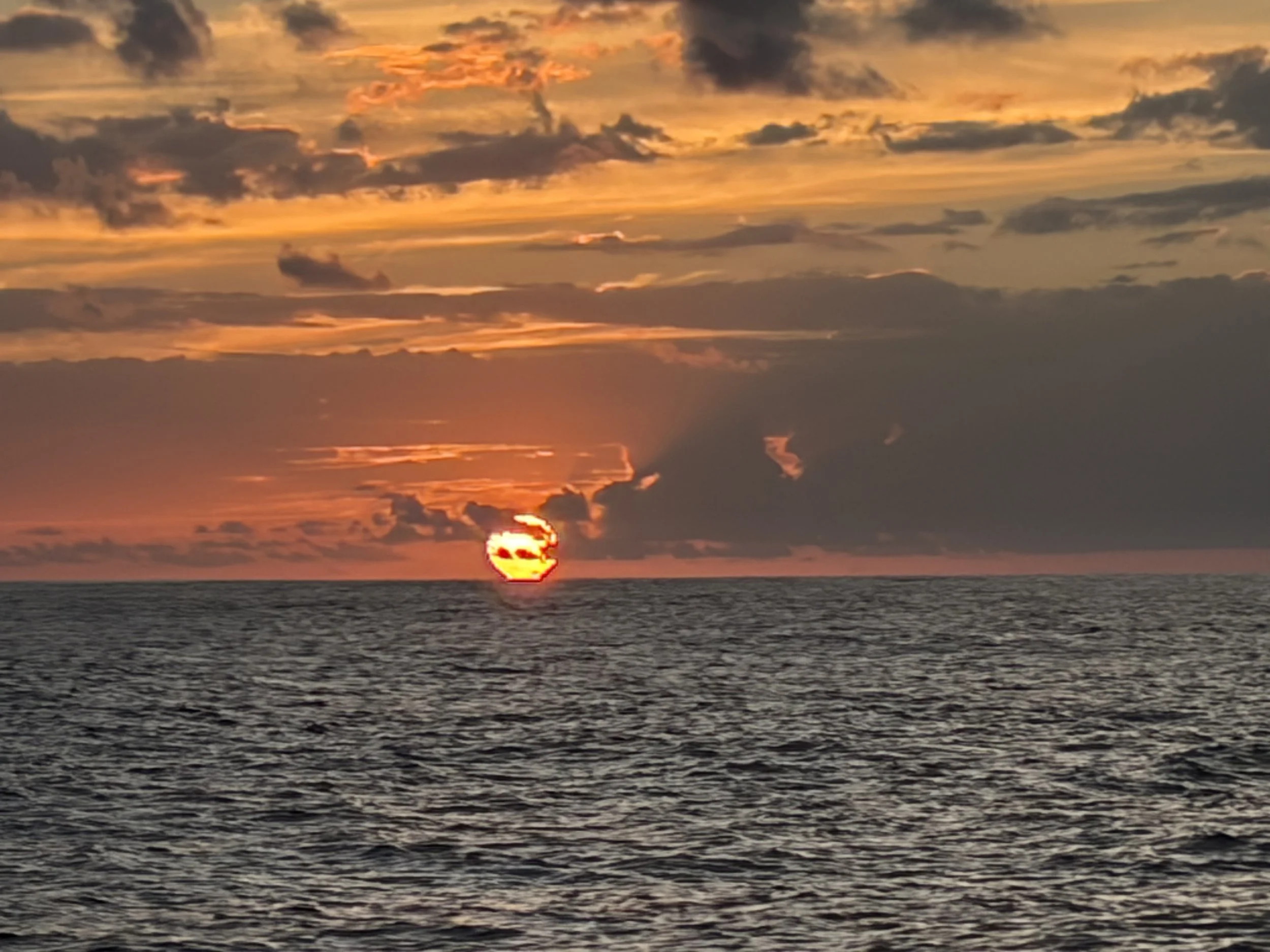
The sun began to go down and we had a fantastic sunset. Paul served us a tuna Thai curry with rice and courgettes which was very tasty.
The others went to bed and I stayed with Mark and Dave until it got dark about 8.15pm. I was on again at 11.00am and the question arises – do you go to bed or stay up? I decided to go and read my book in bed and drifted off at some point.
We have another day of motoring tomorrow which is a little frustrating but we are gradually getting there and lucky we have such pleasant conditions as it could be a lot worse and will get worse with the system coming in.
Well what do you know about the Azores which is where we are heading? It is quite a cruising ground for sailors and almost as many arrive by boat as they do by air
The Azores, officially the Autonomous Region of the Azores, is an archipelago of Portugal, in the Atlantic Ocean, about 1,400 km (870 miles) west of the Portuguese mainland. Politically and administratively, together with Madeira, it is one of the two autonomous regions of Portugal and a special territory of the European Union. It is the westernmost point and region of Portugal.
The Azores is an archipelago composed of nine volcanic islands in the Macaronesia region of the North Atlantic Ocean. There are nine major Azorean islands and an islet cluster, in three main groups. These are Flores and Corvo to the west; Graciosa, Terceira, São Jorge, Pico, and Faial in the centre; and São Miguel, Santa Maria, and the Formigas islets to the east. They extend for more than 600 km (370 mi) and lie in a northwest–southeast direction. All the islands have volcanic origins, although some, such as Santa Maria, have had no recorded activity in the time since the islands were settled several centuries ago. Mount Pico on the island of Pico is the highest point in Portugal, at 2,351 m (7,713 ft). If measured from their base at the bottom of the ocean to their peaks, the Azores are among the tallest mountains on the planet. The Azores are located at the seismically active Azores triple junction plate boundary where the North American plate, Eurasian plate and Nubian plate meet. It is interesting to note that the lava in the Azores is about 4 million years old only whereas in Cape Verde it is 120million years.
The climate is mild, being influenced by its distance from the continents and by the passing Gulf Stream. Because of the marine influence, temperatures remain mild year-round. Daytime temperatures normally fluctuate between 16 and 25 °C (61 and 77 °F) depending on season. Temperatures above 30 °C (86 °F) or below 3 °C (37 °F) are unknown in the major population centres. It is also generally wet and cloudy.
Its main industries are agriculture, dairy farming, livestock, fishing, and tourism, which has become a major service activity in the region. In the 20th century and to some extent into the 21st, the Azores have served as a waypoint for refuelling aircraft flying between Europe and North America. The government of the Azores employs a large percentage of the population directly or indirectly in the service and tertiary sectors. The largest city is Ponta Delgada on San Miguel and I went there to bring Stormbird back to the UK in about July 2022. The culture, dialect, cuisine, and traditions of the islands vary considerably, because these remote islands were settled sporadically over a span of two centuries.
n 1943 during World War II, the Portuguese leased air and naval bases in the Azores to Great Britain. The occupation of these facilities in October 1943 was codenamed Operation Alacrity by the British. This was a key turning point in the Battle of the Atlantic, enabling the Royal Air Force, the U.S. Army Air Forces, and the U.S. Navy to provide aerial coverage in the Mid-Atlantic gap. This helped them to protect convoys and to hunt hostile German U-boats.
In 1944 the U.S. constructed a small and short-lived air base on Santa Maria. In 1945 a base was constructed on Terceira, named Lajes Field. Lajes Field is a plateau rising out of the sea on the northeast corner of the island, which had been a large farm. The base is a joint American and Portuguese venture that continues to support American and Portuguese Armed Forces. During the Cold War, U.S. Navy P-3 Orion anti-submarine warfare squadrons patrolled the North Atlantic Ocean for Soviet Navy submarines and surface warships. Since its opening, Lajes Field has been used for refuelling American cargo planes bound for Europe, Africa, and the Middle East. The U.S. Navy keeps a small squadron of its ships at the harbor of Praia da Vitória, three km (1.9 mi) southeast of Lajes Field. The airfield also has a small commercial terminal handling scheduled and chartered passenger flights from the other islands in the Azores, Europe, Africa, and North America.
In 1976, the Azores became the Autonomous Region of the Azores (Região Autónoma dos Açores), one of the autonomous regions of Portugal. In 2003 the Azores gained international attention when United States President George W. Bush, British Prime Minister Tony Blair, Spanish Prime Minister José María Aznar, and Portuguese Prime Minister José Manuel Durão Barroso held a summit there days before the commencement of the Second Iraq War.
The picture of the day is of a lovely sunset we had. How lucky we are to see such things where we are.
Need/Opportunity Year Three
I am now on the way to Cape Verde, Azores and back to the UK. At present I am full and there will be a change of 3 crew in the Azores for the final passage back to the UK.
The blog will continue as we continue the journey. If you have any comments or suggestions about the blog then do email me on hine.nick9@gmail.com