Year 3 -23 March 2026 - Stormbird -Another busy day in Kochi - India
It was a beautiful morning and so about 7.00am I started to polish the davits (holds the dinghy up) which is quite fiddley and I had to climb around the stern of the boat. I had sent a message Keith to see if on the off chance he could get a new Windex when he comes.
I then wrote the blog and had breakfast and prepared my shopping list. I contacted the agent to see if there was any update on the gas and remaining diesel situation. He said he could not get any gas as it is like gold at present and in terms of the diesel go to a luxury car station. I was not so sure about this.
Varghese came at 9.30am as arranged and I spoke to him about the diesel and he knows the station where the fishing boats fill up with marine diesel so we will go there later. I explained to him about the Windex and he contacted the marine shop who suggested another shop who also did not have it. He contacted his son who looked up various places online but if ordered online then it would not arrive until mid-April so that was no good. In short I am not easily going to get one here. Keith replied saying he would be unable in the time to help. I will just have to get one of the future crew to bring one at some point.
Varghese therefore took me to the supermarket to get a few things for lunches etc bearing in mind the crew coming out. We will do a further shop nearer the time before we leave. He also took me to the market area which was filled with fruit and vegetables and lorries and everyone being very busy. We were trying to find some more plastic scrapers to clean the hull but they only had metal scrapers. The market was interesting and this is the place to come when we buy our fruit and veg.
We also went to get some more wine and beer as we will not be in many places in the Maldives where this is available. The problem is that the beer is mostly strong beer and I wondered why? The reply surprised me a bit but I guess is logical. Think of the tramps in the UK -they always wanted to drink Special Brew in my day.
Strong beer dominates the Indian market—accounting for over 85% of sales—primarily because consumers seek "value for money," desiring higher alcohol content (typically 6–8% ABV) at a similar price point to milder options. It aligns with a preference for intense,, rich malty flavours, a culture accustomed to spirits, and a preference for maximum intoxication with fewer bottles.
What about wine. Imported wines carry an import tax of 150% and so we have been drinking some Indian wines – Fratelli, Grover, Sula etc and they are not too bad and drinkable. The modern Indian Wine market is small but growing; annual per capita consumption of wine in the country is a mere 9 millilitres, approximately 1/8000th that of France. Hard liquor and beer has nearly 98% of the alcoholic drinks market, with wine taking 2%. The viticulture in India has a long history, dating back to the time of the Indus Valley civilization when grapevines were believed to have been introduced from Persia. Winemaking has existed throughout most of India's history but was particularly encouraged during the time of the Portuguese and British colonization of the subcontinent. The end of the 19th century saw the phylloxera louse take its toll on the Indian wine industry, followed by religious and public opinion moving towards the prohibition. Following the country's independence from the British Empire, the Indian government encouraged vineyards to convert to table grape and raisin production. In the 1980s and 1990s, a revival in the Indian wine industry took place as international influences and the growing middle class started increasing demand for the beverage. By the turn of the 21st century, demand was increasing at a rate of 20-30% a year. The city of Nashik in the state of Maharashtra is called the "Wine Capital of India".
While a large portion of the Indian subcontinent is not ideal for viticulture, the large diversity of climate and geology does cover some areas with suitable terroir for winemaking to thrive. The summer growing season in India tends to be very hot and prone to monsoons. Many of India's wine regions also fall within the tropical climate band. Vineyards are then planted at higher altitudes along slopes and hillsides to benefit from cooler air and some protection from wind. The altitude of India's vineyards typically range from around 200 m in Karnataka, 300 m in Maharashtra, 800 m along the slopes of the Sahyadri to 1000 m in Kashmir. Summertime temperature can get as hot as 45 °C and wintertime lows can fall to 8 °C. During the peak growing season between June and August, rainfall averages 625-1,500 mm.
Vineyards in India range from the more temperate climate of the northwestern state of Punjab down to the southern state of Tamil Nadu (the next adjacent state). Some of India's larger wine producing areas are located in Maharashtra, Karnataka near Bangalore and Telangana near Hyderabad. Within the Maharashtra region, vineyards are found on the Deccan Plateau and around Baramati, Nashik, Pune, Sangli and Solapur. The high heat and humidity of the far eastern half of the country limits viticultural activity.
The heat and humidity of India's wine region dictate many of the viticultural choices that are made in the vineyards. Vines are often trained on bamboo and wire in a pergola to increase canopy cover and to get the grapes off the ground where they would be more prone to fungal diseases. The canopy protects the grapes against sunburn and rows are spaced wide to help with aeration between the vines. Irrigation is essential for the vines given the hot weather. The tropical conditions often promote high yields which requires frequent pruning throughout the year. Harvest normally takes place in February and is usually done by hand. In the very warm wine regions of Tamil Nadu, Karnataka, and Andhra Pradesh, grapevines can produce a crop twice a year.
Southern India is home to several indigenous table grape varieties that can also be used in wine production with Anabeshahi, Arkavati and Arkashyam being the most common. Popular non-native grapes include the Bangalore Blue (Isabella) and Gulabi (Black Muscat). The Turkish grape Sultana is the most widely planted grape in India, cover more than half of the 148,000 acres (60,000 ha) planted in the country. In addition to the imported French varieties that Chateau Indage planted, Sauvignon blanc, Zinfandel, Chenin blanc and Clairette Blanche have started to establish a presence in the Indian wine industry.
We have been drinking Chenin Blanc and Sauvignon Blanc for white and Cabernet Sauvignon, Cabernet Franc/Shiraz mostly. The three best known wineries are Fratelli, Sula and Grover.
Fratelli is considered a premium Indian wine brand with a large vineyard that has been producing several varietals since 2009. “Utmost care is taken to produce the best quality grapes in our own vineyards to ensure we make premium wines from Indian terroir,” says Kapil Sekhri, Founder Director at Fratelli Wines. In fact, most of their wines pair well with Indian cuisine, especially Sangiovese red that goes well with biryani, and Chardonnay with grilled fish.
Perhaps one of the most popular wine brands in India, Sula (which has about 55% of the market) is also known for its annual music festival and vineyard experience. Says Karan Vasani, Senior Vice President & Chief Winemaker at Sula, “Our aim is not only to make good wine, but to make good wine with minimal environmental impact. With the widest selection of wines at best prices.
Then there is Grover. This brand's journey began in 1970s when Kanwal Grover visited some wineries in France, and was taken aback with the beauty of the winemaking process. But it was only in 1992 that he set up the first vineyard. Since then, Grover Zampa has launched several award-winning varietals with grapes from two of its vineyards located in Nandi Hills and Nashik Valley.
Once we stocked up we returned to Stormbird and had to carry the shopping, beer and wine back to the boat - a hot and sweaty job. I then grabbed the 3 jerry diesel containers and we set off to the station beside the wharf. I made sure it was marine diesel and so I got 60 lts. Therefore I have two full tanks (1610 lts) and 100 lts in jerry cans. I think in the circumstances this was the sensible thing to do. I could not get any gas but I have 2 full cylinders which will last me a while and if necessary I have 2 electric portable hobs.
We returned to Stormbird and of course had to carry the diesel undo the lazarette and pack it away. I then had to stash away the beer and wine and get rid of all the boxes.
It was time for a late lunch and to relax a bit. I could feel my back had had a good workout and may be sore for a few days.
I tidied up inside and cleared everything away. I then pumped up a few of the fenders which had lost some air. I then set about cleaning the deck which has great splodges of white everywhere from you know who?
The deck took a while bit looked quite good by the end and I know once at sea the salt water will clean it.
By this time it was time for a sundowner and I sat on the rear deck enjoying the view. I had spent 9 days of doing jobs and I was looking forward to having some new crew with Jamie, my younger brother’s son arriving tomorrow. I had done a lot and the time had passed quickly really and it will be good to have some company.
I cooked a salad type supper and enjoyed watching the film the Martian with Matt Damon – which I thought was very good.
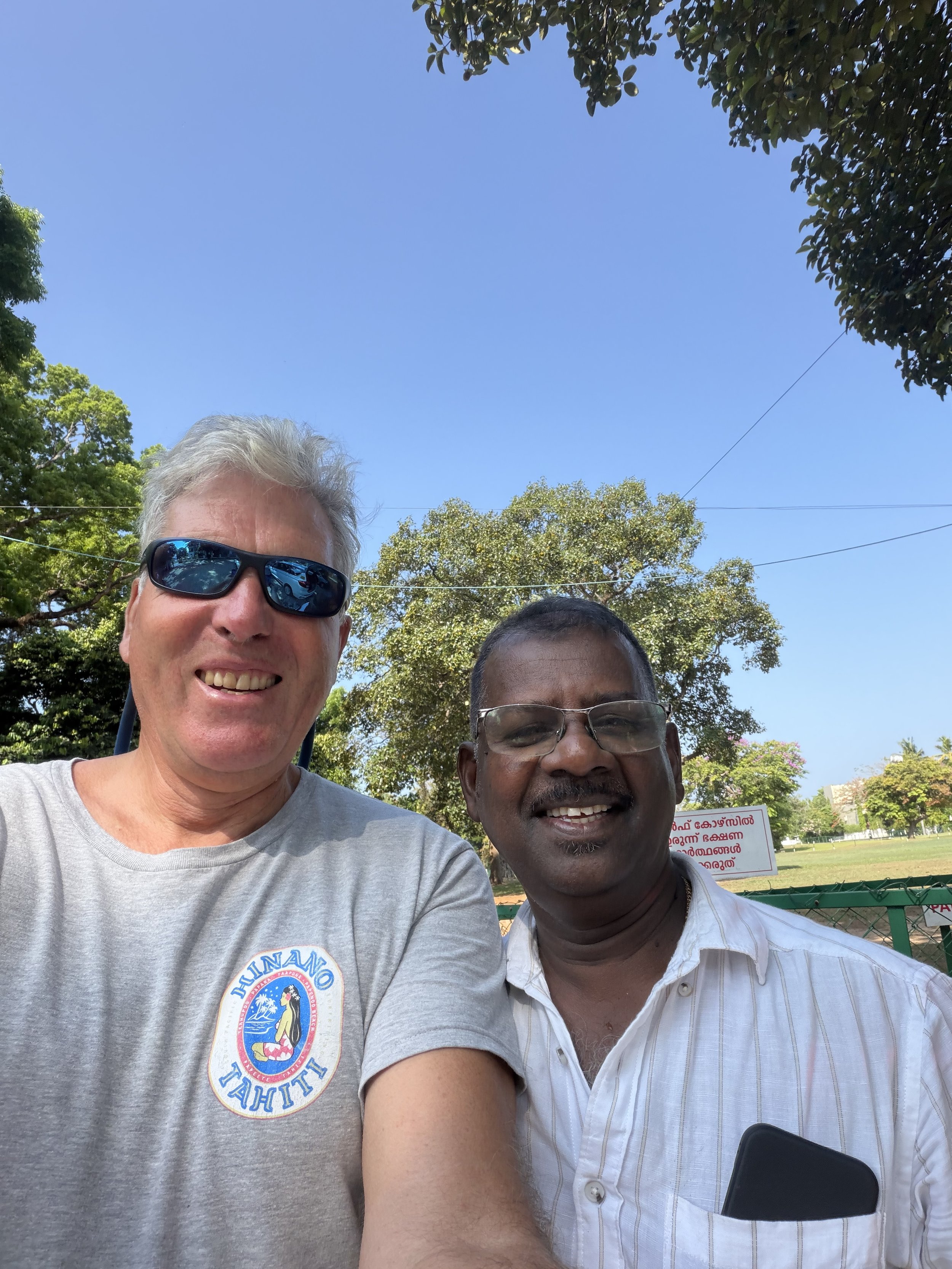
The picture of today is Varghese and I. He has been so helpful to me here.
Need/Opportunity Year Three
In year three I will be going from Thailand to Sri Lanka, India, Maldives and then on to Mauritius, Reunion, Cape Town, St Helena, Azores and back to the UK.
I am looking for one crew from Mauritius/ Reunion Island to Cape Town (mid June to end of July). If of any interest do email me.
The blog will continue as we continue the journey. If you have any comments or suggestions about the blog then do email me on hine.nick9@gmail.com