Year 3 -17 June 2026 -Trip Round La Reunion
We woke at our usual time and I made blueberry smoothies which we enjoyed followed by toast. Overnight there seemed to be a problem with the heads in my cabin. I therefore got out the hose and we put it in the waste fitting on the deck and with some pressure it seemed to clear. I will have to monitor the situation over the next day to see if there is a continuing problem. I also noticed the fridge temperature was up and so turned the other plate on. I suspected the gas had leaked out already.
We decided to leave early to go North on our trip around parts of the island. We drove out of town on to the N1 and this time the road went along the coast and then on to the section built with piles over the sea and is one of the most expensive sections of road in the world. This is where the Grand Tour started their programme when they came. The views over the sea and coastline were lovely and we were driving along over the sea looking at the rock cliffs on our right. The road continued and returned to land and we went through the capital of the island St Dennis. Saint-Dennis; unofficially Saint-Denis de La Réunion is the administrative capital of the French overseas department and region of Réunion, in the Indian Ocean. It is located at the island's northernmost point, close to the mouth of the Rivière Saint-Denis.
Saint-Denis is the most populous commune in the French overseas departments and the twentieth most populous in all of France. At the 2023 census, there were 326,743 inhabitants (about a third of the island) in the metropolitan area of Saint-Denis (as defined by INSEE),
During the Napoleonic Wars, Saint-Denis was captured by British troops on 8 July 1810. The British occupied Saint-Denis and the entire island during nearly 5 years. On 6 April 1815, after the Treaty of Paris, the British officially restored Bourbon Island to France during a ceremony held on the main square of Saint-Denis. Later in October 1815, as news of Napoleon's return to France had arrived in the Indian Ocean, a British fleet from Mauritius presented itself in front of St Denis, asking the French governor of Bourbon Island to surrender the colony to His Britannic Majesty. The French governor refused and the British started a blockade of the island. Eventually on 28 October the news arrived of Napoleon's 2nd abdication and Louis XVIII's return to power, and the British fleet ended its blockade.
The city is located on the north end of the island, and was a port. Saint-Denis was "originally the main port of Réunion, but an artificial harbour at Le Port, on the northwest coast, replaced it in the 1880s, because of unpredictable winds and tides at Saint-Denis." The city includes some of the island's mountains, with a peak elevation of 2,276 meters (7,467 ft) within the metro area, which begins at sea level at the coastline.
We drove on beyond St Dennis and through St Marie and then on to St Suzzane. This was now on the North coast and was an agricultural area with lots of sugar cane fields. We were aiming for a Vanilla Factory called Domaine du Grand Hazier which was off the N1 near St Suzzanne in a village called Bois Rouge.
The farmland of the Domaine has been used since the end of the 17th century and it is one of the eldest farming estates and owned by the Chassagne family. Coffee then cloves followed by sugar cane was gown here. It was turned into a vanilla processing plant in 2009.
Vanilla plants were introduced to Reunion from Mexico and a former slave in 1841 called Edmond Albius discovered the method of pollinating Vanilla plants without bees or other insects. This made a great advance in growing Vanilla on the island. Vanilla believe it or not belongs to the Orchid family and originated in Mexico. Originally it was used in religious ceremonies and to mix with coffee beans before the uses we have today.
In the 19th century Reunion produced the most vanilla in the world at some 200 tons. Today it is 4 tons and Madagascar produces 1800 tons so you can see quite a difference.
Vanilla needs a hot and humid tropical climate to grow and some 2000mm of water per year with temperatures between 25 and 35 degrees C. Most of the plantations are on the East coast where there is more rain. There are 3 types of growing vanilla -forest where it naturally grows on trees, planted on small trees to which the vine attaches and under a sort of greenhouse shade with wooden stakes.
We arrived at the Domaine and decided to join a tour which was only in French but we had an English booklet. As part of visit we saw the greenhouse type and also the small trees and they put coconut shells and the husks inside and leaves to prevent the moisture escaping. The vines grow quite high so they bring them down and tie them down to the bottom again so that they can be reached. They also take a metre of the plant and use them like cuttings and after 3 years the new plant will flower. Any new plant is good for the first 5 years when it is most productive. After this they are less productive and after 15 years they are usually replaced.
When the flowers come on the vanilla plant they only flower for one day and need to be pollinated otherwise the vanilla pods cannot form. One flower produces one pod. The best time to pollinate them (they do this using a small stick or needle) is between 6.00am -11.00am on the day of flowering. You can imagine how labour intensive this is and to go out and see which plant is flowering etc. Once pollinated it takes 2 months for the pod to form and then 9 months for the pod which is green for them to reach maturity, a bit like a human pregnancy.
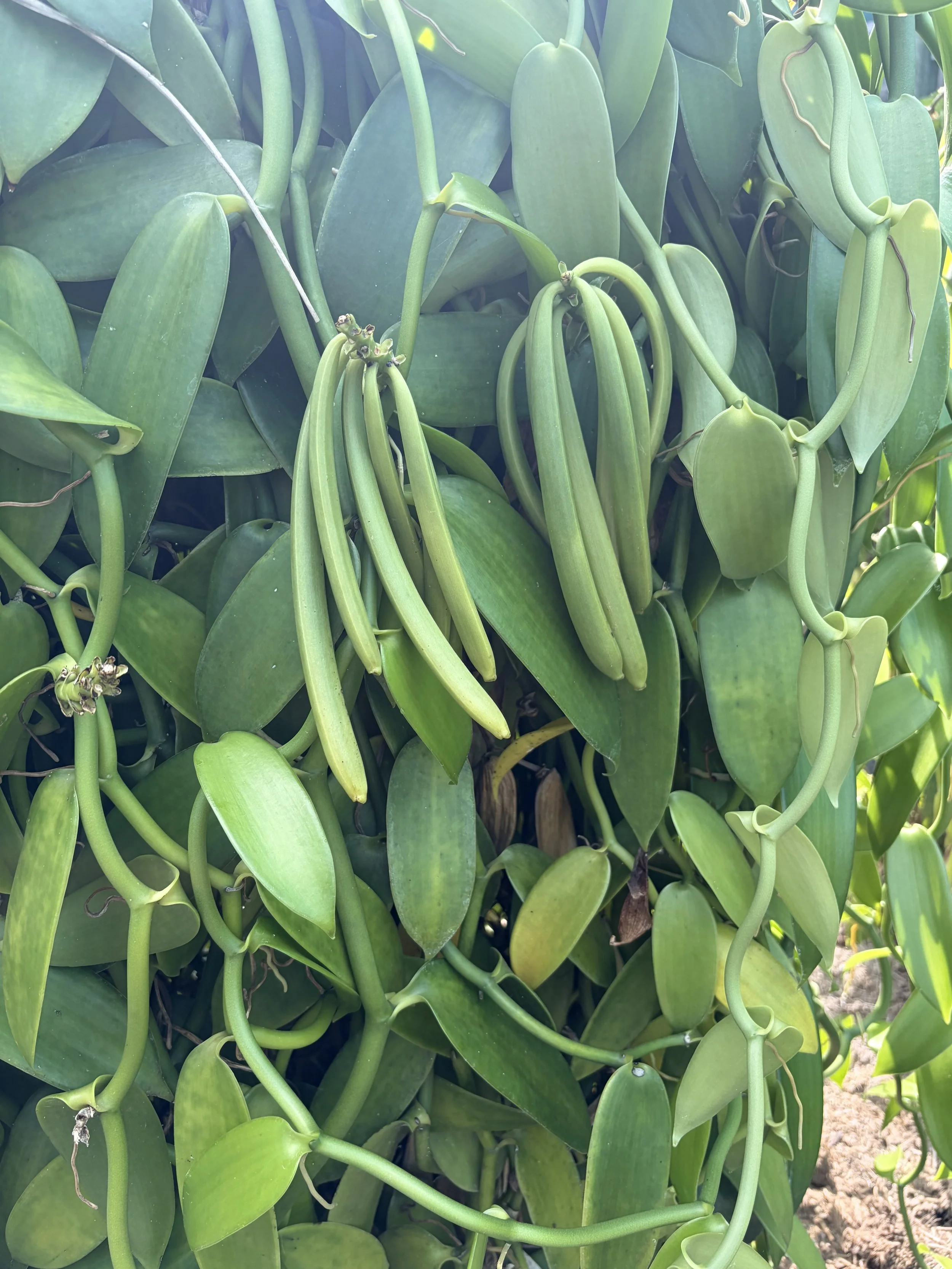
The vanilla pods must be harvested as they are ripe and before they split. When they reach maturity the pod is green but the extremity of the pod turns yellow and if not picked will turn to brown and split. Therefore it is very labour intensive to go out and pick them at the appropriate time. The harvest normally begins in June and ends in mid October. It is very important to get them at the right time.
Once harvested they need to be blanched within 48 hours. This involves immersing them in water heated to 65 degrees C for 3 minutes (this process was developed in 1851 and is still being used now). Once drained they are put in wooden boxes with blankets for 24 hours to make them sweat. This is called the Steaming process. It is during this process that the vanilla pods change from green/yellow to a chocolate colour and the aromas of vanilla start to appear. At this stage they are still full of water and need to be dried.
They put them out on wooden boards for 2 weeks in the sun for 5-6 hours per day to dry and they are turned over once a day. The second stage is drying them in the shade for 2-3 months on wooden boards. They are then sorted in terms of length and put into bundles of 50 of the same size into wooden boxes for at least 12 months when they become slightly oily and have their full flavour. They are then sold as pods in their own right or used to make vanilla sugar, vanilla salt, put into jams, honey, rums etc.
It was a great tour and a most interesting visit. We all bought things from the shop including their flavoured rum.
Talking of rum -we had been told there was a rum factory nearby so we went to see that. It was next to a large sugar factory but they were not doing tours. We decided to pass and go on to a seaside town called St Rose to get some lunch. This meant going along the coast road and villages and this was a main walking/hiking area. We saw a number walking with rucksacks etc. It was quite rural with hills and of course the mountains high above. It was very lush and green and a wide variety of trees, bushes and plants were growing.
We drove on and came to some lava fields below the Volcano Fournaise. The Piton de la Fournaise is an active volcano on the island of Réunion. It erupts often, so it is one of the most active volcanoes on the planet. It is in the southeast of the island and is part of the Réunion National Park, a UNESCO World Heritage site.
The Piton de la Fournaise is very important in Réunion, both culturally and for tourism. Many hiking trails let visitors explore it and see solidified lava flows. During its frequent eruptions, lava flows have mainly remained confined to the crater area surrounding the volcano. However, the eruption which started in mid-February 2026, changed this. The lava flow extended for seven kilometres, reaching the Indian Ocean, and crossing one of the island’s main coastal roads. This represents the first time since 2007 that this important transport route has been cut by lava. We drove along this very road and stopped to look at the lava which came down from the mountain in many places and you could see it going down to the sea and the road must have been repaired since as it looked new and we were on it. It shows the power of nature.
We drove on and found a restaurant called the Poisson Rouge and had a good lunch. By this time we were about 50% round the island. We decided to continue and drive on so we would circumnavigate the island. The East part of the island was rural and there was little development, just a few small villages and towns and you realise it is quite poor and agricultural.
We continued for some time before we got into the more developed areas. The single carriageway continued until St Pierre and then it was dual carriageway back. We could see the white horses out at sea and the waves crashing on the shore. We got stuck in some traffic jams and there are so many cars here that believe it or not rush hour does exist.
We got back to Stormbird about 5.30pm and tried the rum we had bought. It was fine. We then had a snack supper and chatted about the day and put the world to rights with all the problems we have in the UK and the world.
The picture of the day is of a bunch of vanilla pods.
Need/Opportunity Year Three
I am now in Mauritius and will be going to Reunion, Cape Town, St Helena, Azores and back to the UK.
I have now found additional crew for Mauritius to Durban. There may be space from Durban to Cape Town from about the beginning of July and we should arrive in Cape Town on about 25-30 July 2026. If at all interested contact me on my email below or WhatsApp +44 7931360372.
The blog will continue as we continue the journey. If you have any comments or suggestions about the blog then do email me on hine.nick9@gmail.com