Year 3 -17 January 2026 – Galle – Sri Lanka
It was a lovely day when we woke and the air was full of birdsong. We had fruit and yoghurt and banana pancakes for breakfast.
We decided to go off to the fort at Galle and whilst we were waiting we saw a lionfish swim past. Lionfish (genus Pterois) are venomous marine fish native to the Indo-Pacific. They are characterized by conspicuous warning coloration with red or black bands and ostentatious dorsal fins tipped with venomous spines.
Galle Fort, in the Bay of Galle on the southwest coast of Sri Lanka, was built first in 1588 by the Portuguese, then extensively fortified by the Dutch during the 17th century from 1649 onwards. It is a historical, archaeological and architectural heritage monument, which even after more than 437 years maintains a polished appearance, due to extensive reconstruction work done by the Archaeological Department of Sri Lanka.
The fort has a colourful history, and today has a multi-ethnic and multi-religious population. The heritage value of the fort has been recognized by UNESCO and the site has been inscribed as a cultural heritage UNESCO World Heritage Site under criteria iv, for its unique exposition of "an urban ensemble which illustrates the interaction of European architecture and South Asian traditions from the 16th to the 19th centuries.
The Galle Fort, also known as the Dutch Fort or the "Ramparts of Galle", withstood the Boxing Day tsunami of 2004 which damaged part of the coastal Galle town. It has since been restored.
In 1640 the Dutch entered the fray and joined with King Rajasinhe II to capture the Galle Fort. The Dutch, with a force of some 2,500 men under Koster, captured the fort from the Portuguese that year. Although not an ideal situation for the Sinhalese, they were instrumental in building the fort as seen in its present form in the Dutch architectural style. Fortifications were added up to the early 18th century. The establishment consisted of public administration buildings, warehouses, and business houses, and residential quarters. A Protestant church (planned by Abraham Anthonisz) was also built in baroque style in 1775 to cater to the colonists and the local people who were converted to Christianity. The most prominent buildings in the fort complex were the Commandant's residence, the arsenal and the gun house. Other buildings erected in the fort catered to trade and defence requirements such as workshops for carpentry, smithy, rope making, and so forth. They also built an elaborate system of sewers that were flooded at high tide, taking the sewage away to sea.
The British took over the fort on 23 February 1796, one week after Colombo was captured. Sri Lanka remained a British colony formally from 1815 until it became an independent island nation in 1948. The importance of Galle also declined after the British developed Colombo as their capital and main port in the mid nineteenth century.
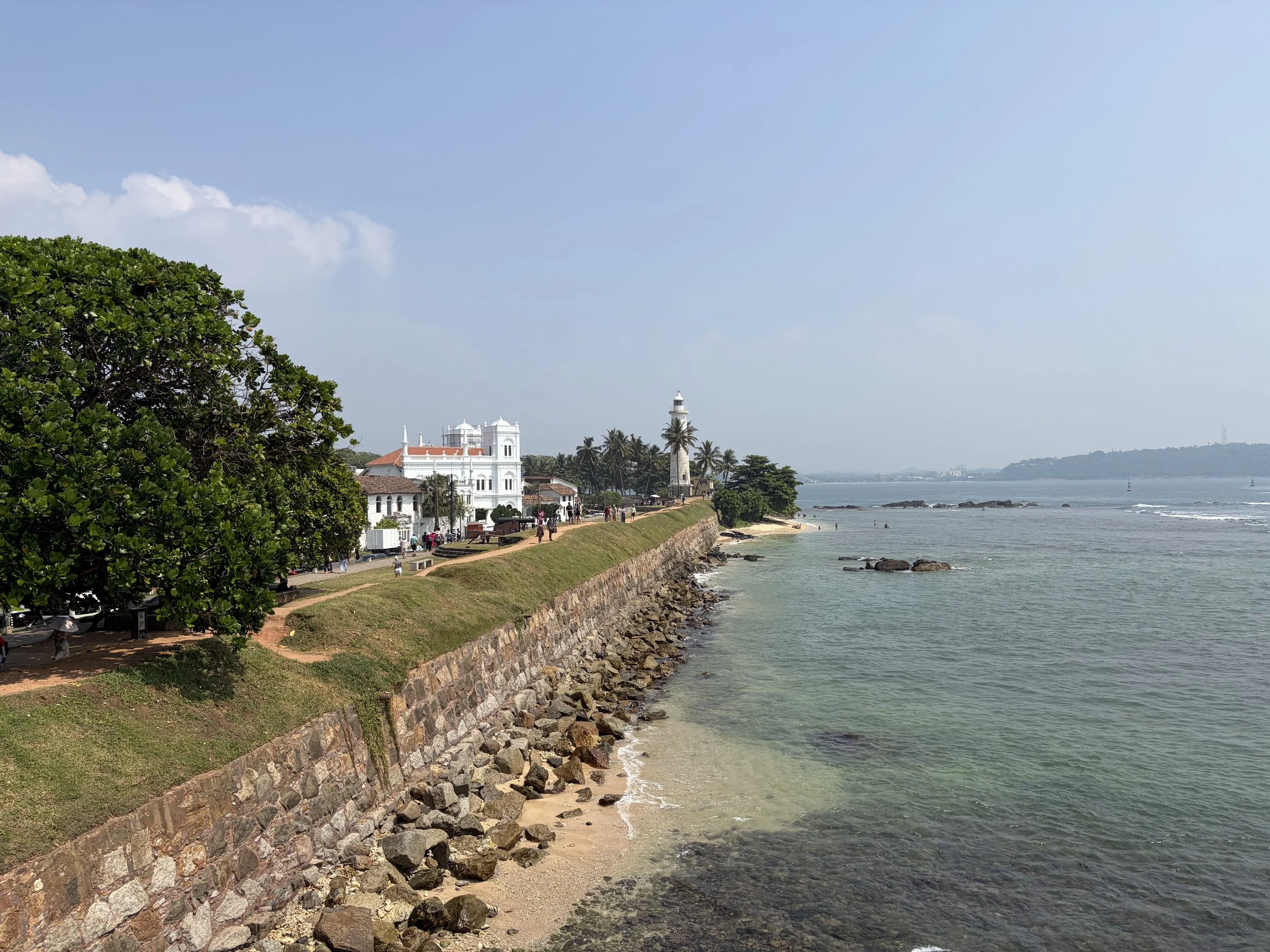
After the fort came under the control of the British in 1796, it remained their southern headquarters. They made many modifications to the fort, such as closing the moat, building houses, a lighthouse on the Utrecht Bastion, a gate between the Moon Bastion and the Sun Bastion. A tower was erected in 1883 to commemorate the jubilee of Queen Victoria. The Second World War saw many more fortifications built to defend the fort. In spite of all the changes made over the years since it was first built between the 16th and the 19th century, the Galle Fort still remains a unique monument complex said to be "the best example of a fortified city with a fusion of European architecture and South Asian traditions built by Europeans in South and Southeast Asia".
The fort, like most of the forts in Sri Lanka, is built on a small rocky peninsula, belonging to the sea as much as to the land. As it exists today, it covers an area of 52 hectares (130 acres).
The Galle city (population 112,000, over an area of 16.5 square kilometres (6.4 sq mi)) has developed around the fort area. The story of the fort is well illustrated by many signs and plaques which provide information about each monument. More than half of the inhabitants inside the fort are Moors, with Sinhalese, Dutch, English, Portuguese and German settlers. Details of the history of the fort are available at the visitor center and at the Dutch-period museum inside the Fort.
The fort area is occupied by mostly artists, writers, photographers, designers and poets of foreign origin, and has boutiques, hotels and restaurants.
Galle Fort has two, formerly portcullis, gates. The oldest of the two was completed by the Dutch in 1669.
The new, Main Gate in the northern stretch of the fortifications, between the Moon Bastion and the Sun Bastion, was opened in 1873. This gate had become necessary after Galle became the administrative centre of the south of Ceylon.
The urban area within the fort has a rectangular grid pattern of streets full of low houses with gables and verandahs in the Dutch colonial style. It has a well-laid-out road network with the peripheral roads aligned parallel to the fort's ramparts. The fort area also has a number of historic churches, mosques, commercial and government buildings. Some local people stroll along the walls of the fort in the evenings.
Many buildings are of Dutch vintage with street names also in Dutch. The sewerage system built in the fort area ensured that the city sewerage was flushed into the sea during the tidal cycle. The Dutch exploited the muskrats in the sewers by exporting them to extract musk oil.
We hired two tuk tuks with 3 in each which was a bit of a squash but worked and we were deposited inside the fort going through the old gate. The fort is very impressive and a lovely place to walk around with many lovely old Dutch buildings which have been restored which now are the homes of shops, museums or restaurants. There is little traffic and there were market stalls selling art, jewellery, antiques and spices. Sri Lanka is known for its gems. Sri Lanka, known as the "Island of Gems," is world-renowned for its rich variety of precious stones, especially sapphires (blue, pink, yellow, star) and rubies, along with other significant finds like chrysoberyl (alexandrite, cat's eye), garnets, tourmaline, spinel, zircon, and beryl. Most gems come from alluvial deposits, particularly around the city of Ratnapura ("City of Gems"), and are extracted through traditional mining methods, making it a top global source for high-quality Ceylon gems. There are many shops in the fort selling gems. In short the fort is a lovely place to spend some time and be.
We walked around for a while and then had a nice coffee and an ice cream at a lovely old café. We then wandered to the end of the main street where there was a restaurant on the 2nd floor and we reserved a table for 1.00pm. We had an hour and a quarter to wonder. I decided to walk all along the ramparts which took me about 45 minutes. It was lovely starting on the seaward side and the walls rang along with a shear drop to the sea below. There were some beach areas where some were swimming otherwise I continued on with some look out areas and then I came across the lighthouse built in 1938.
I continued round and came to a number of Bastions or gun points where cannons stood on their wooden bases. It was quite extensive and clearly they must have been worried by attackers. From time to time there were snake charmers blowing their instrument to attract the cobras out of their baskets to amuse the tourists.
It was a great walk and you could look down and see the streets below set out and the roof tops of the old buildings and of course many churches with the walls.
I had been here with my wife in 2019 but had not walked the full length of the ramparts. I did remember that we had eaten at the Rampart Hotel which had been good so I reserved a table there as well and checked the menu which seemed better than the other restaurant.
I met the others and we had a quick beer and then went to the Rampart Hotel where we had a good meal. The restaurant looked over the ramparts and out to sea which was nice to see.
Once we finished we decided to return to Stormbird. We then all went to the beach for a swim and we hired a surfboard and we all had a go at surfing which was fun.
We returned to Stormbird at sunset and had a salad and cheese and biscuit supper. It had been a great day.
The picture of the day is a view over the fort walls toward the lighthouse.
Need/Opportunity Year Three
In year three I will be going from Thailand to Sri Lanka, India, Maldives and then on to Mauritius, Reunion, Cape Town, St Helena, Azores and back to the UK.
I am looking for crew from Mauritius/ Reunion Island to Cape Town and from Cape Town to the UK. If of any interest do email me.
The blog will continue as we continue the journey. If you have any comments or suggestions about the blog then do email me on hine.nick9@gmail.com