Year 3 -16 May 2026 –Bound for Mauritius-Last full day
I had the 2.00am to 5.00am watch and I took over a full genoa for a while. It was noticeably cooler at night now and for the first time in years I think I needed a coat or a jumper. Perhaps the reality of the fact that I cannot be in hot weather all the time began to sink in. There were rain clouds around which affected the wind but it did not actually rain.
When Keith and Erika came on the wind was very light and all over the place. We therefore took in the sails and they motored for a while and I went to bed. I did not hear them put the engine off as I must have been sound asleep. They had low winds for a while and so we only made slow progress of 4 and 6 nm hours.
I got up about 7.30am and we got more sail up and we started to make good progress again toward Mauritius. It was a lovely sunny morning with fluffy white clouds. We started to make 8 and 9 nm hours as the day wore on.
We had some Bircher Muesli which Carolyn had made which was delicious and then Keith made scrambled eggs on toast which was delicious. I then made another loaf of bread as we get through one a day at present. The morning wore on and then I took over at 12.00noon. I had been in contact with the agent and let them know that we estimated to arrive at about 10.3am-11.30am tomorrow.
My shift went well and quickly and we had good strong winds pushing us along managing 9,8,8,9 nm for the 4 hours. We had lunch on the way with Keith making coleslaw and he had boiled a number of eggs which we are using up which made egg mayonnaise. Our 24-hour run to 12.00noon was 172 which was not too bad in the circumstances. We just need another 24 hours like that and we will be there.
Keith and Erika took over at 4.00pm and within 15 minutes they had rain clouds to contend with and had to take in the genoa and motor through the rain and strong winds it created for about 45 minutes. Then the sails went up again and we were off again eating away the miles to try and arrive tomorrow morning.
However, this was short lived and we encountered more rain clouds which meant reducing sail again.
Carolyn cooked a Thai chicken satay dish with rice and peas which was delicious and a first on Stormbird. They then took over at 8.00pm and I went to have some rest. I was woken by the engine going on and came up to find rain clouds on the radar. The engine was on and the main was up but the genoa furled. They said the wind got up to 27 kts. We motored through the rain clouds and then put up the genoa. I sat with them while we sailed.
After about an hour the wind got up to 23-25 kts and started to go South and not Southwest as forecast. This pushed us off course and I waited for 30 minutes and there was no change. We therefore took in the genoa again and motor sailed as I could sail closer to the wind. The wind continued to come round and then became Southwest. This was totally unhelpful and so I took in the main and motored toward Mauritius. We had 65nm to cover to our waypoint and 20nm beyond that is the main port, Port Louis. I am completing this blog whilst on watch and hope the wind goes back to normal or we are motoring the rest of the way to Mauritius which would be a shame after such a long and tricky passage. So what about Mauritius.
Mauritius, officially the Republic of Mauritius, is an island country in the Indian Ocean, located about 1,100 nautical miles (2,000 km; 1,300 mi) off the southeastern coast of East Africa, east of Madagascar. It includes the main island (also called Mauritius), as well as Rodrigues, Agaléga, and St. Brandon (Cargados Carajos shoals). The islands of Mauritius and Rodrigues, along with nearby Réunion (a French overseas department), are part of the Mascarene Islands. The main island of Mauritius, where the population is concentrated, hosts the capital and largest city, Port Louis. The country spans 2,040 square kilometres (790 sq mi) and has an exclusive economic zone covering approximately 580,000 square nautical miles (2,000,000 km2; 770,000 sq mi).
The 1502 Portuguese Cantino planisphere has led some historians to speculate that Arab sailors were the first to discover the uninhabited island around 975, naming it Dina Arobi. Called Ilha do Cirne or Ilha do Cerne on early Portuguese maps, the island was visited by Portuguese sailors in 1507. A Dutch fleet, under the command of Admiral Van Warwyck, landed at what is now the Grand Port District and took possession of the island in 1598, renaming it after Maurice, Prince of Orange. Short-lived Dutch attempts at permanent settlement took place over a century aimed at exploiting the local ebony forests, establishing sugar and arrack production using cane plant cuttings from Java together with over three hundred Malagasy slaves, all in vain. When French colonisation began in 1715, the island was renamed "Isle de France". In 1810, the United Kingdom seized the island and under the Treaty of Paris, France ceded Mauritius and its dependencies to the United Kingdom. The British colony of Mauritius now included Rodrigues, Agaléga, St. Brandon, the Chagos Archipelago, and, until 1906, the Seychelles. Mauritius and France dispute sovereignty over the island of Tromelin, the treaty failing to mention it specifically. Mauritius became the British Empire's main sugar-producing colony and remained a primarily sugar-dominated plantation-based colony until independence, in 1968. The country became a republic in 1992 but retained the Privy Council of the United Kingdom as highest court of appeal.
Given its geographic location and colonial past, the people of Mauritius are diverse in ethnicity, culture, language and faith. It is the only country in Africa where Hinduism is the most practised religion. Indo-Mauritians make up the bulk of the population with significant Creole, Sino-Mauritian and Franco-Mauritian minorities. The island's government is closely modelled on the Westminster parliamentary system with Mauritius highly ranked for economic and political freedom. The Economist Democracy Index ranks Mauritius as the only country in Africa with full democracy while the V-Dem Democracy Indices classified it as an electoral democracy.
Mauritius ranks 73rd (very high) in the Human Development Index and the World Bank classifies it as a high-income economy. It is amongst the most competitive and most developed economies in Africa. The country is a welfare state. The government provides free universal health care, free education up through the tertiary level, and free public transportation for students, senior citizens, and the disabled. Mauritius is consistently ranked as the most peaceful country in Africa.
Along with the other Mascarene Islands, Mauritius is known for its biodiverse flora and fauna with many unique species endemic to the country. The main island was the only known home of the dodo, which, along with several other avian species, became extinct soon after human settlement. Other endemic animals, such as the echo parakeet, the Mauritius kestrel and the pink pigeon, have survived and are subject to intensive and successful ongoing conservation efforts.
World War I broke out in August 1914. Many Mauritians volunteered to fight in Europe against the Germans and in Mesopotamia against the Turks. But the war affected Mauritius much less than the wars of the eighteenth century. In fact, the 1914–1918 war was a period of great prosperity, due to a boom in sugar prices. In 1919, the Mauritius Sugar Syndicate came into being, which included 70% of all sugar producers.
At the outbreak of World War II in 1939, many Mauritians volunteered to serve under the British flag in Africa and the Near East, fighting against the German and Italian armies. Mauritius served as a settlement destination for Jews deported from the Holy Land.
Mauritius was never really threatened, but in 1943, several British ships were sunk outside Port Louis by German submarines. In the initial stages of the war, locally recruited military formations were raised in order to defend the country in case the British imperial troops had to leave.
A Constitutional Review Conference was held in London in 1961, and a programme of further constitutional advance was established. At the Lancaster Conference of 1965, it became clear that Britain wanted to relieve itself of the colony of Mauritius. In 1959, Harold Macmillan had made his famous "Wind of Change Speech" in which he acknowledged that the best option for Britain was to give complete independence to its colonies. Thus, since the late fifties, the way was paved for independence.
Elizabeth 11 was Queen of Mauritius from 1968 to 1992.
Mauritius adopted a new constitution, and independence was proclaimed on 12 March 1968. Sir Seewoosagur Ramgoolam became the first prime minister of an independent Mauritius – with Queen Elizabeth II remaining head of state as Queen of Mauritius.
In 1973, Mauritius became the first country in Africa to be free from diagnoses of malaria.
In 1981, United States newspapers reported that the Central Intelligence Agency (CIA) was planning a covert operation to support the government of Mauritius as part of CIA strategy in the larger Cold War. According to the Washington Post, citing U.S. government sources, the planned operation was "mainly a quiet CIA effort to slip money" to the Mauritian government. This claim was repeated in a 1987 book by journalist Bob Woodward, who further wrote that the U.S. government feared that Mauritius could become a Soviet naval base if a "pro-Western" government did not remain in power.
So it has an interesting history.
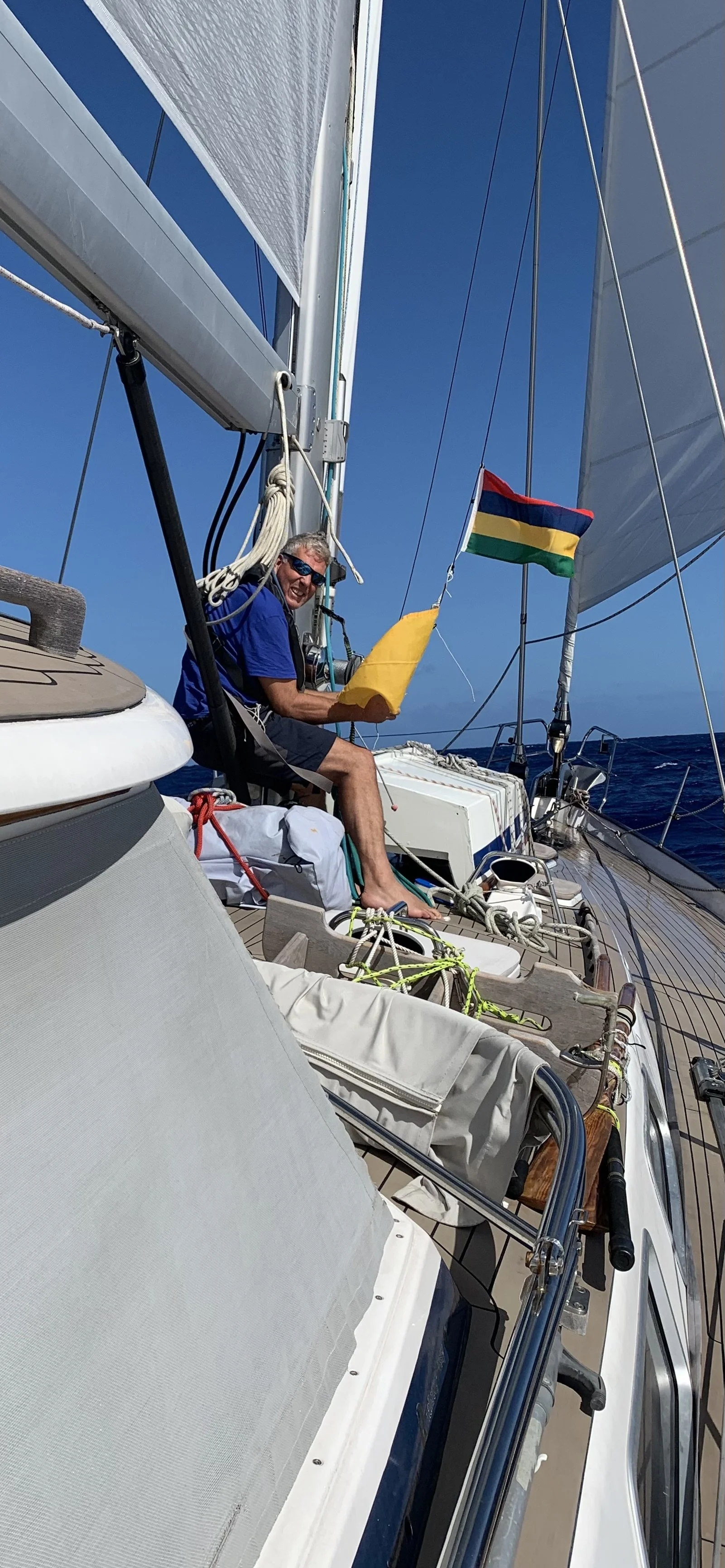
The picture of the day is me putting up the Mauritian courtesy flag and the Q flag.
Need/Opportunity Year Three
I will be going shortly from India to the Maldives and then on to Mauritius, Reunion, Cape Town, St Helena, Azores and back to the UK.
I am currently in need of potentially 2 crew from Mauritius to Cape Town from about 10 June 2026 and we should arrive in Cape Town on about 25-30 July 2026. If at all interested contact me on my email below or WhatsApp +44 7931360372.
The blog will continue as we continue the journey. If you have any comments or suggestions about the blog then do email me on hine.nick9@gmail.com