Year 3 -15 January 2026 – Arrival in Galle- Sri Lanka
Rhys and I had the 5.00am to 8.00am watch and we were only some 6nm from the waypoint which was to the side of the TSS zone on the South side of Sri Lanka. The wind had held well and we were still sailing at 7-8kts with the two headsails. Once we arrive at the waypoint we only have 20nm to go. I calculated that we would be at Galle by about 10.30am-11.00am. I message the agent to let him know.
The sun came up and initially it was quite damp and we gradually began to see the outline of the coast and the hills behind. I had checked the weather and knew we would come to a point when the wind would die so in the meantime I prepared breakfast of fruit (mango and melon) and yoghurt with granola or muesli. Everyone gradually got up and we enjoyed the breakfast and the sun was now shinning. We had had quite a few fishing boats to dodge but they seemed to get out of the way for us.
Sri Lanka, officially the Democratic Socialist Republic of Sri Lanka, formerly known as Ceylon, is an island country in South Asia. It is located in the Indian Ocean, southwest of the Bay of Bengal, and is separated from India by the Gulf of Mannar and the Palk Strait. Sri Lanka shares a maritime border with the Maldives to the southwest and India to the northwest, and lies across the Bay of Bengal from Bangladesh and Myanmar to the northeast and the Andaman and Nicobar Islands of India to the east. Its capital is Sri Jayawardenepura Kotte, while Colombo is its largest city and the political, financial and cultural centre. Sri Lanka's population is 22 million; with the Sinhalese people, who speak the Sinhala language, forming the vast majority—while Tamil is spoken by the large Tamil minority. Other long-established ethnic groups include the Moors, Indian Tamils, Burghers, Malays, Chinese, and Vedda.
The island has a documented history of over 3,000 years, with evidence of prehistoric human settlement dating back 125,000 years. Sri Lanka has been given various names throughout its long history, with Ceylon most notably being used prior to its independence. The earliest known Buddhist writings in the island, known collectively as the Pali Canon, date back to the 29 BCE. Sri Lanka, owing to its strategic geographical location, played a role as a major trading hub, and was well known to explorers across the world as early as the Anuradhapura period. The Portuguese Empire established a colony in the sixteenth century, during a period of political upheaval in the Kingdom of Kotte where it also faced attacks from neighbouring kingdoms of Kandy and Sitawaka. Following the Sinhalese–Portuguese War, the Dutch colonial empire controlled the coastal areas. By the early 19th century, the British Empire established a colony on the island, which lasted until 1948. The early 20th century saw the rise of nationalist movements and increasing calls for independence. In 1948, Sri Lanka gained independence as the Dominion of Ceylon, eventually becoming a republic in 1972. Sri Lanka's recent history has been marred by a prolonged civil war between the Tamil separatist militant organisation of Liberation Tigers of Tamil Eelam and the Sri Lankan Armed Forces, which lasted from 1983 to 2009, and ended with the defeat of the separatists.
In the 21st century, Sri Lanka has emerged as a developing country, with a strategically important geographical location in the Indian Ocean, with its deep harbours giving it significant geopolitical leverage as a major trading post from the ancient Maritime Silk Road. It has the highest level of human development in South Asia and the second-highest GDP per capita in the region. Sri Lanka has a long history of International engagement and cooperation, and is a member of several international organisations—including SAARC, the G77, the Non-Aligned Movement and the Commonwealth of Nations.
Sri Lanka, an island in South Asia shaped as a teardrop or a pear/mango, lies on the Indian Plate, a major tectonic plate that was formerly part of the Indo-Australian Plate. Sri Lanka is separated from the mainland portion of the Indian subcontinent by the Gulf of Mannar and Palk Strait. According to Hindu mythology, a land bridge existed between the Indian mainland and Sri Lanka. It now amounts to only a chain of limestone shoals remaining above sea level. Legends claim that it was passable on foot up to 1480 CE, until cyclones deepened the channel. Portions are still as shallow as 1 metre (3 ft), hindering navigation. The island consists mostly of flat to rolling coastal plains, with mountains rising only in the south-central part. The highest point is Pidurutalagala, reaching 2,524 metres (8,281 ft) above sea level.
Sri Lanka has 103 rivers. The longest of these is the Mahaweli River, extending 335 kilometres (208 mi). These waterways give rise to 51 natural waterfalls of 10 metres (33 ft) or more. The highest is Bambarakanda Falls, with a height of 263 metres (863 ft). Sri Lanka's coastline is 1,585 km (985 mi) long. Sri Lanka claims an exclusive economic zone extending 200 nautical miles, which is approximately 6.7 times Sri Lanka's land area. The coastline and adjacent waters support highly productive marine ecosystems such as fringing coral reefs and shallow beds of coastal and estuarine seagrasses. Sri Lanka has 45 estuaries and 40 lagoons. Sri Lanka's mangrove ecosystem spans over 7,000 hectares and played a vital role in buffering the force of the waves in the 2004 Indian Ocean tsunami. The island is rich in minerals such as ilmenite, feldspar, graphite, silica, kaolin, mica and thorium. Existence of petroleum and gas in the Gulf of Mannar has also been confirmed, and the extraction of recoverable quantities is underway.
The climate is tropical and warm because of moderating effects of ocean winds. Mean temperatures range from 17 °C (62.6 °F) in the Central Highlands, where frost may occur for several days in the winter, to a maximum of 33 °C (91.4 °F) in low-altitude areas. Average yearly temperatures range from 28 °C (82.4 °F) to nearly 31 °C (87.8 °F). Day and night temperatures may vary by 14 °C (25 °F) to 18 °C (32 °F).[185]
The rainfall pattern is influenced by monsoon winds from the Indian Ocean and Bay of Bengal. The "wet zone" and some of the windward slopes of the central highlands receive up to 2,500 millimetres (98.4 in) of rain each year, but the leeward slopes in the east and northeast receive little rain. Most of the east, southeast, and northern parts of Sri Lanka constitute the "dry zone", which receives between 1,200 and 1,900 mm (47 and 75 in) of rain annually.[186]
The arid northwest and southeast coasts receive the least rain at 800 to 1,200 mm (31 to 47 in) per year. Periodic squalls occur and sometimes tropical cyclones bring overcast skies and rains to the southwest, northeast, and eastern parts of the island. Humidity is typically higher in the southwest and mountainous areas and depends on the seasonal patterns of rainfall. An increase in average rainfall coupled with heavier rainfall events has resulted in recurrent flooding and related damages to infrastructure, utility supply and the urban economy.
The Sri Lankan elephant is one of three recognised subspecies of the Asian elephant. The 2011 elephant census estimated a population of 5,879. Sri Lanka has the highest biodiversity per unit area among Asian countries for flowering plants and all vertebrate groups except birds. A remarkably high proportion of the species among its flora and fauna, 27% of the 3,210 flowering plants and 22% of the mammals, are endemic. The Sri Lankan leopard (Panthera pardus kotiya) is an endangered subspecies of leopard native to Sri Lanka. Yala National Park in the southeast protects herds of elephant, deer, and peacocks. at 240,000 individuals per hectare.
Sri Lanka is a democratic republic and a unitary state which is governed by a semi-presidential system. Sri Lanka is the oldest democracy in Asia. Most provisions of the constitution can be amended by a two-thirds majority in parliament. The amendment of certain fundamental features, including clauses on national symbols, religion, term limits, the reference to Sri Lanka as a unitary state, and the entrenchment mechanism itself, requires both a two-thirds majority in Parliament and approval in a nationwide referendum. The Constitution of Sri Lanka officially declares it to be a socialist state.
The wind died and so the engine went on. We have hardly needed to use it in this trip. We motored for the last 12 nm or so and passed a number of whale watching boats as we went along the coast. It was not long before we were approaching Galle. We had to call up the Port Control who asked us a number of questions and then we were allowed to proceed through the buoyed channel into the harbour. We could see the fort on our left and a white sort of palace and a large white temple on a hill. We were certainly arriving somewhere different.
We motored in and round the breakwaters and to the are where visiting boats are moored. There were a few boats there and people were waving at us and indicated where we should moor. Initially they out us alongside a wall and then we had to moor Mediterranean fashion which meant dropping our anchor some 2-3 boat lengths out and then reversing to the wall so that the stern lines can be placed on the wall and then you tighten up the anchor lines and anchor chain to hold you in the right position.
We met Achintha, our agent, who presented us with a cake and some local beer. (he can come again!!) which was welcome as we had had no drink since we left Thailand. We had to complete the formalities and to c check in to Sri Lanka.
We had travelled 1,165nm in 7 days and 2 hours which meant an average of 6.85 kts. Bearing in mind the first day and the slow patches and the lack of mainsail this was a good average.
We had some lunch and tidied up some of the boat. The guys then decided to go to the local beach for a swim and find a bar. I stayed for a bit and did some admin etc and I am trying to make some progress on the mainsail furler.
I then went to join the guys. The port area we are in is guarded by armed guards on the gate and has a large police station outside which is reassuring. It is essentially a concrete basin but it has green areas around it with cows grazing. A few old boats now acting as statues and some old railway paraphernalia.
I walked out to the main road and was immediately into Sri Lankan busy life. There were tuk tuk’s galore buzzing about, trucks, colourful coaches, motorbikes and mopeds and of course cars. This was a busy stretch of road and part of the surfing scene.
There were lots of shops, bars and hotels along this strip with lots of neon signs advertising boards. There were fruit vendors, mechanical outlets etc. I walked along and found the bar called Cool Vibes which the guys had gone to. I walked from a sort of busy, slightly seedy entrance through to a nice bar and platform right on a beautiful curved beach with surf waves coming on to the beach. It was a lovely setting and you almost had to do a double take bearing in mind the road behind.
We had a beer and watched the activity on the beach. There were a number sunbathing, swimming and surfing. This was a surf beach and a number of surf schools along it where people can have a go and the surfboards are stored either side of the bars.
Well after a long journey-when in Rome- we all went in and had a cooling swim and like we did as kids enjoyed being bashed by the waves and surf and diving under and through the waves. It felt good to be alive!!.
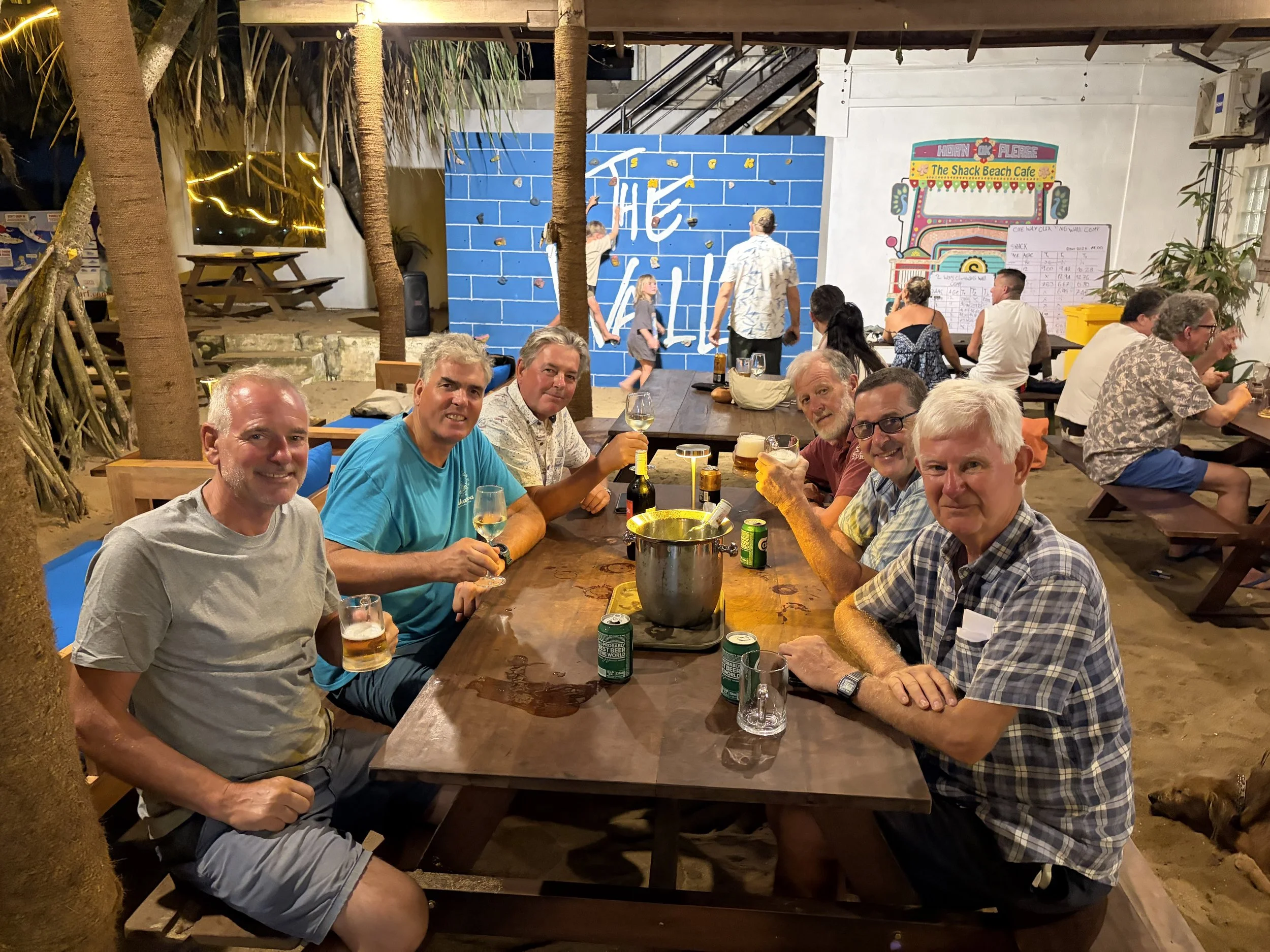
When we had enough we returned to Stormbird and changed and then went back to The Shack on the beach which had been recommended. At first they had no electricity so we had candles or little electric lights. However, they restored power and we had a nice meal on the beach and enjoyed ourselves. We had after all got here safe and sound.
We look forward to exploring more of this lovely island.
The picture of the day is of us enjoying dinner after arrival in Sri Lanka.
Need/Opportunity Year Three
In year three I will be going from Thailand to Sri Lanka, India, Maldives and then on to Mauritius, Reunion, Cape Town, St Helena, Azores and back to the UK.
I am looking for crew from Mauritius/ Reunion Island to Cape Town and from Cape Town to the UK. If of any interest do email me.
The blog will continue as we continue the journey. If you have any comments or suggestions about the blog then do email me on hine.nick9@gmail.com