Year 3 -13 January 2026 – Passage to Galle in Sri Lanka- Another good mileage day.
Rhys and I had the 2.00am to 5.00am watch and we were making good steady progress. The moon was out – about a third -which gave the water a silvery shine. There were many stars although there was a little bit of cloud. We had a relatively quiet watch in that there was no traffic until the end when a tanker was coming up our port side. However, I did the blog and we had a good chat about all sorts of subjects which helps pass the time.
We were flying the Blue Baron for the second night and it is a great sail pushing us along almost effortlessly between 7-10 kts is so it feels and the boat remains relatively flat and seems to lessen any swell.
We handed over and got some well needed sleep and I was up again about 8.00am. Keith had found two flying fish on deck and a squid who must have taken a jump out of the water. We considered eating them but really they were too small. We were going too fast to fish really.
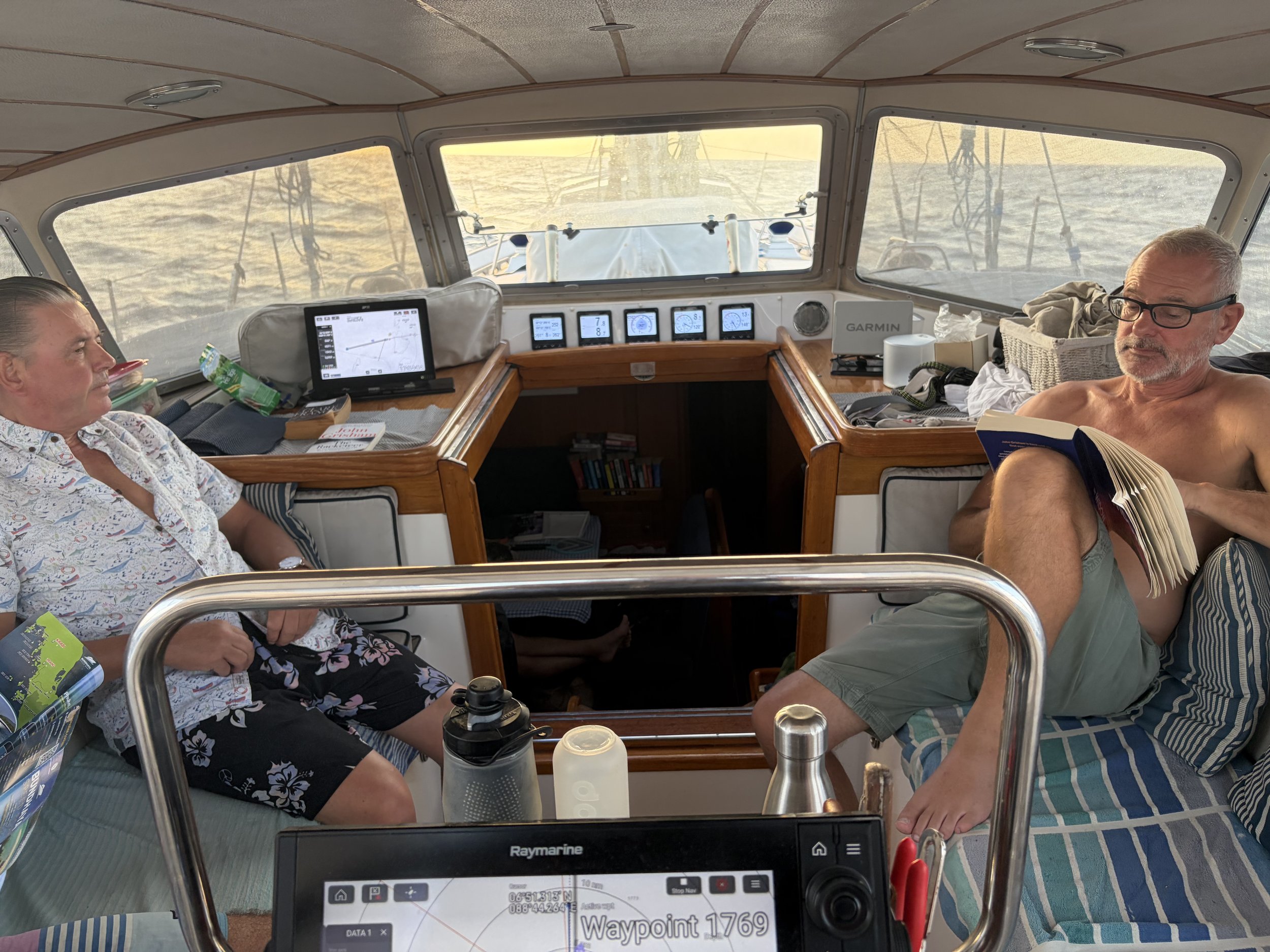
It was a lovely blue-sky day with the odd cloud and we were well into the routine now with our shifts and jobs we have to do. When you are not on watch you sleep, read or rest and/or chat in the cockpit which is like a den really. You all share the cooking and washing up and cleaning etc. You are surrounded by blue sea as far as the eye can see with nothing else around. We are really our own floating world and almost oblivious to what is going on in the rest of the world.
We were waiting for the 12 noon 24-hour run and we all made our guesses. It was another good run of 194nm. In fact when I talked about the 198 nm run- there were in fact two 24-hour periods when this was achieved.
I regularly look at the weather and check our route and the wind luckily stayed with us although at a lower level initially. The wind dropped for a period of 8-10 kts and the Blue Baron will just about fly in that. The wind came round more to the North and so we had to come closer to the wind which helped our speed and the fact that the wind was lower.
Rhys and I were on from 12noon to 4.00pm and we continued to sail well although we saw no traffic. We were visited by some dolphins later in the afternoon otherwise we saw no wildlife other than flying fish. We did try and fish for a while but we were unlucky again. Perhaps the lures we have are not suitable for these waters.
There was a lovely sunset which we were heading straight toward and we all watched the sun dip below the horizon leaving a yellow orange pink glow of sky before that faded to blackness.
We settled down for another night bringing us closer to Sri Lanka with some 230 odd miles to go to its Eastern shores. We were flying the Blue Baron for the third night running. We need to be careful as we approach for fishing vessels and the cargo/tanker ship motorway which runs East and West from Sri Lanka across to Thailand and down to the Malacca Strait which we came up leading to Malaysia, Singapore and beyond.
The wind continued to help us and as I write this it is blowing about 12-13 kts and we are making about 7-8 kts. We also have the help of a current which flows East to West across this part of the Indian Ocean.
The Indian Ocean is the third-largest of the world's five oceanic divisions, covering 70,560,000 km2 (27,240,000 sq mi) or approximately 20% of the water area of Earth's surface. It is bounded by Asia to the north, Africa to the west and Australia to the east. To the south it is bounded by the Southern Ocean or Antarctica, depending on the definition in use. The Indian Ocean has large marginal or regional seas, including the Andaman Sea, the Arabian Sea, the Bay of Bengal, and the Laccadive Sea.
Geologically, the Indian Ocean is the youngest of the oceans (being directly preceded by the Tethys Ocean, which fragmented into the Mediterranean Sea and the Indian Ocean only 20 million years ago), and it has distinct features such as narrow continental shelves. Its average depth is 3,741 m. It is the warmest ocean, with a significant impact on global climate due to its interaction with the atmosphere. Its waters are affected by the Indian Ocean Walker circulation, resulting in unique oceanic currents and upwelling patterns. The Indian Ocean is ecologically diverse, with important ecosystems such as coral reefs, mangroves, and sea grass beds. It hosts a significant portion of the world's tuna catch and is home to endangered marine species. The climate around the Indian Ocean is characterized by monsoons.
The Indian Ocean has been a hub of cultural and commercial exchange since ancient times. It played a key role in early human migrations and the spread of civilizations. In modern times, it remains crucial for global trade, especially in oil and hydrocarbons. Environmental and geopolitical concerns in the region include climate change, overfishing, pollution, piracy, and disputes over island territories.
Meridionally, the Indian Ocean is delimited from the Atlantic Ocean by the 20° east meridian, running south from Cape Agulhas, South Africa, and from the Pacific Ocean by the meridian of 146°49'E, running south from South East Cape on the island of Tasmania in Australia. The northernmost extent of the Indian Ocean (including marginal seas) is approximately 30°N in the Persian Gulf.
I shall be passing right through the Indian Ocean on my trip.
The picture of the day is Mark and Keith – who share a watch but they are here relaxing off watch and putting the world to rights.
Need/Opportunity Year Three
In year three I will be going from Thailand to Sri Lanka, India, Maldives and then on to Mauritius, Reunion, Cape Town, St Helena, Azores and back to the UK.
I am looking for crew from Mauritius/ Reunion Island to Cape Town and from Cape Town to the UK. If of any interest do email me.
The blog will continue as we continue the journey. If you have any comments or suggestions about the blog then do email me on hine.nick9@gmail.com