Year 3 -1 July 2026 -Day 9 -Durban -South Africa
We slept well and woke about 8.00am having had a good night’s sleep. It was still and sunny which was nice. We had some tea etc and then we decided to get on with the formalities before going to the Royal Natal Yacht Club for breakfast. We therefore headed over to the marina office and checked in. They then said they would email Immigration and we had to go there and then after that we would receive an email from customs.
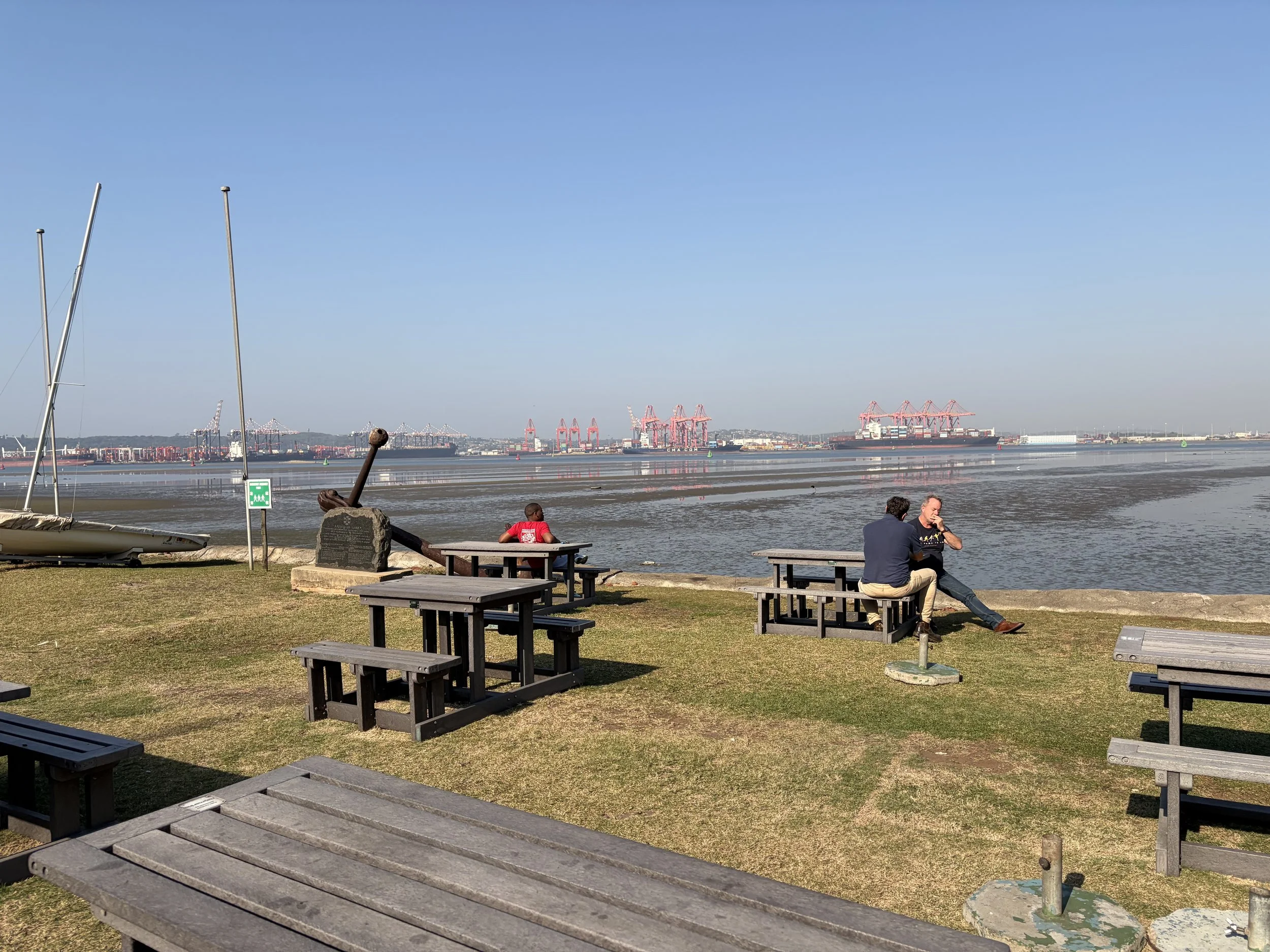
We were advised to get an Uber and not walk which we did. We finished the checking in with Immigration and then as it was only about 800 yards we walked back to the marina. We then went and had breakfast at the Royal Natal Yacht Club which had lawns looking right out over the harbour. There was a large shallow area in front of us and you could see the mud stretching out a long way due to the low tide. Then you could see large ships moored at the docks and it must get deep quickly at the end of the mud flats. Terry, John’s wife came to meet us at the club and had very kindly brought us some lunch from Woolworths. John lives only 30 minutes away and had decided to go home for a few days before our next passage down the coast.
We had a good cooked breakfast and we saw Vince again and using his information we contacted a fuel company who would come to fill us up with diesel. It was odd there was no alongside fuel berth her as it was a large marina. I therefore had to get my pump and filters out again and I set it up.
The fuel men came and over an hour or so we put in 400 lts and I thought it would be full but that is enough for now. Once we had done this and cleared away we prepared to leave the berth and to go to where we were allocated which was B 72. This meant a long walk to the marina office but apparently will be a good berth for us. There is another Southerly buster coming in on the 2nd July so we need to be secure. Our customs clearance came through and we took down the Q flag.
We slipped our lines and headed down the channel whilst the lines and fenders were switched over to the starboard side and then we entered the other channel and saw our berth. The pontoon was not long enough but we could manage.
I reversed in and we secured ourselves and we doubled up our lines due to the pending front. The electric box did not work so they sent someone down to turn it on.
We then had lunch which John and Terry had kindly brought which was very enjoyable. We then tidied up. Annoyingly the electric box would work for 10 minutes then stop. The office had gone home so they will have to fix it tomorrow.
Peter left to go home about 4.00pm. He lives in Johannesburg and could only manage the trip to Durban. It had been good to have him on board and he will be replaced by Mark Spittle who arrives on the 3rd July. Mark came on board in Australia for a month or two.
Hisham, Keith, Jenny and I decided to go to the Natal Yacht Club where the England Congo match was on. The end result was good but the Congo first goal was worrying and the Congo team did challenge England. I suppose credit to England – they kept their heads and ground out a win.
It was good to get to a flatbed again to catch up on more sleep.
I forgot to mention in yesterday’s blog that over the last few days we have been seeing Albatrosses flying around. They are such graceful birds and effortlessly glide across the waves and in between. You see them and then they disappear in the curve of a wave to appear again.
Albatrosses, of the biological family Diomedeidae, are large seabirds related to the procellariids, storm petrels, and diving petrels in the order Procellariiformes (the tubenoses). They range widely in the Southern Ocean and the North Pacific. They are absent from the North Atlantic, although fossil remains of short-tailed albatross show they lived there up to the Pleistocene, and occasional vagrants are found. Great albatrosses are among the largest of flying birds, with wingspans reaching up to 2.5–3.5 metres (8.2–11.5 ft) and bodies over 1 metre (3.3 ft) in length. The albatrosses are usually regarded as falling into four genera, but disagreement exists over the number of species.
Albatrosses are highly efficient in the air, using dynamic soaring and slope soaring to cover great distances with little exertion. They feed on squid, fish, and krill by either scavenging, surface seizing, or diving. Albatrosses are colonial, nesting for the most part on remote oceanic islands, often with several species nesting together. Pair bonds between males and females form over several years, with the use of "ritualised dances", and last for the life of the pair. A breeding season can take over a year from laying to fledging, with a single egg laid in each breeding attempt. A Laysan albatross named Wisdom on Midway Island is the oldest-known wild bird in the world. She was first banded in 1956 by Chandler Robbins.
While no albatrosses breed on the South African mainland, around 16 species—including the iconic Wandering Albatross visit the country's cold, nutrient-rich offshore waters to feed. Breeding is restricted to the remote, sub-Antarctic Prince Edward Islands.
So what about South Africa. South Africa, officially the Republic of South Africa (RSA), is the southernmost country in Africa. Its nine provinces are bounded to the south by 2,798 kilometres (1,739 miles) of coastline that stretches along the South Atlantic, and Indian Ocean; to the north by the neighbouring countries of Namibia, Botswana, and Zimbabwe to the east and northeast by Mozambique, and Eswatini, and it encloses Lesotho. Covering an area of 1,221,037 square kilometres (471,445 square miles), the country has a population of over 63 million people, making it the sixth-most populated country in Africa. Pretoria is the administrative capital, while Cape Town, as the seat of Parliament, is the legislative capital, and Bloemfontein is regarded as the judicial capital. The largest and most populous city is Johannesburg, followed by Cape Town and Durban.
Archaeological findings suggest that various hominid species existed in South Africa about 2.5 million years ago, and modern humans inhabited the region over 100,000 years ago. The first known people were the indigenous Khoisan, and Bantu-speaking peoples, who migrated in waves, from west and central Africa to the region 2,000 to 1,000 years ago. In the north, the Kingdom of Mapungubwe formed in the 13th century, and the Venda Kingdom in the 17th century. In 1652, the Dutch established the first European settlement at Table Bay, Dutch Cape Colony. Its invasion in 1795, and the Battle of Blaauwberg in 1806 led to British occupation. The Mfecane, a period of significant upheaval, led to the formation of various African kingdoms, including the Zulu Kingdom. The region was further colonised, and the Mineral Revolution saw a shift towards industrialisation and urbanisation. Following the Second Boer War, the Union of South Africa was created in 1910 after the amalgamation of the Cape, Natal, Transvaal, and Orange River colonies, becoming a republic after the 1961 referendum. The multi-racial Cape Qualified Franchise in the Cape was gradually eroded, and the vast majority of Black South Africans were not enfranchised until 1994.
The National Party imposed apartheid in 1948, institutionalising previous racial segregation. After a struggle by the African National Congress and other anti-apartheid activists, both inside and outside the country, the repeal of discriminatory laws began in the mid-1980s. Universalelectionstook place in 1994, following which all racial groups have held political representation in the country's liberal democracy, which comprises a parliamentary republic and nine provinces. Recognised as a middle power in international affairs, South Africa maintains significant regional influence and is a member of BRICS+, the African Union (hosting the seat of the Pan-African Parliament), SADC, SACU, the Commonwealth of Nations, and the G20.
A developing, and newly industrialised country, it has the largest economy in Africa by nominal GDP, is tied with Ethiopia for the most UNESCO World Heritage Sites in Africa, and is a biodiversity hotspot with unique biomes, plant, and animal life. South Africa encompasses a variety of cultures, languages, and religions, and has been called the "rainbow nation", especially in the wake of apartheid, to describe its diversity. Since the end of apartheid, government accountability and quality of life have substantially improved for non-white citizens. However, crime, violence, poverty, and inequality remain widespread, with about 32% of the population unemployed as of 2024, while some 56% lived below the poverty line in 2014. Having the highest Gini coefficient of 0.67, South Africa is considered one of the most economically unequal countries in the world.
South Africa is in southern Africa, with a coastline that stretches more than 2,500 km (1,553 mi) and along two oceans — the South Atlantic and the Indian Ocean. Excluding the Prince Edward Islands, the country lies between latitudes 22° and 35°S, and longitudes 16° and 33°E. The interior of South Africa consists of a large, and in most places almost flat, plateau with an altitude of between 1,000 m (3,300 ft) and 2,100 m (6,900 ft). It is highest in the east and slopes gently downwards towards the west and north, and slightly to the south and south-west. This plateau is surrounded by the Great Escarpment whose eastern, and highest, stretch is known as the Drakensberg. Mafadi in the Drakensberg is the highest peak in the country at 3,450 m (11,320 ft) above sea level. The KwaZulu-Natal–Lesotho international border is formed by the highest portion of the Great Escarpment which reaches an altitude of over 3,000 m (9,800 ft).
The south and south-western parts of the plateau (at approximately 1,100–1,800 m above sea level) and the adjoining plain below (at approximately 700–800 m above sea level – see map on the right) are together known as the Great Karoo, which consists of sparsely populated shrubland. To the north, the Great Karoo fades into the more arid Bushmanland, which eventually becomes the Kalahari Desert in the north-west of the country. The mid-eastern and highest part of the plateau is known as the Highveld. This relatively well-watered area is home to a great proportion of the country's commercial farmlands and contains its largest conurbation, Gauteng. To the north of the Highveld, from about the 25° 30' S line of latitude, the plateau slopes downwards into the Bushveld, which ultimately gives way to the Limpopo River lowlands, the Lowveld.
The coastal belt, below the Great Escarpment, moving clockwise from the northeast, consists of the Limpopo Lowveld, which merges into the Mpumalanga Lowveld, below the Mpumalanga Drakensberg (the eastern portion of the Great Escarpment). This is hotter, drier and less intensely cultivated than the Highveld above the escarpment. The Kruger National Park, located in the provinces of Limpopo and Mpumalanga in north-eastern South Africa, occupies a large portion of the Lowveld, covering 19,633 square kilometres (7,580 sq mi)
Drakensberg, the eastern and highest portion of the Great Escarpment which surrounds the east, south and western borders of the central plateau
.
The coastal belt below the south and south-western stretches of the Great Escarpment contains several ranges of Cape Fold Mountains which run parallel to the coast, separating the Great Escarpment from the ocean The land between the Outeniqua and Langeberg ranges to the south and the Swartberg range to the north is known as the Little Karoo, which consists of semi-desert shrubland similar to that of the Great Karoo, except that its northern strip along the foothills of the Swartberg Mountains has a somewhat higher rainfall and is, therefore, more cultivated than the Great Karoo.
The Little Karoo is famous for its ostrich farming around Oudtshoorn. The lowland area to the north of the Swartberg range up to the Great Escarpment is the lowland part of the Great Karoo, which is climatically and botanically almost indistinguishable from the Karoo above the Great Escarpment. The narrow coastal strip between the Outeniqua and Langeberg ranges and the ocean, known as the Garden Route, has a moderately high year-round rainfall, and hosts the most extensive area of forest in the country.
In the south-west corner of the country, the Cape Peninsula forms the southernmost tip of the coastal strip which borders the Atlantic Ocean and ultimately terminates at the country's border with Namibia at the Orange River. The Cape Peninsula has a Mediterranean climate, making it and its immediate surrounds the only portion of Sub-Saharan Africa which receives most of its rainfall in winter.
The coastal belt to the north of the Cape Peninsula is bounded on the west by the Atlantic Ocean and the first row of north–south running Cape Fold Mountains to the east. The Cape Fold Mountains peter out at about the 32° S line of latitude. after which the Great Escarpment bounds the coastal plain. The most southerly portion of this coastal belt is known as the Swartland and Malmesbury Plain, which is an important wheat-growing region, relying on winter rains. The region further north is known as Namaqualand, which becomes more arid near the Orange River. The little rain that falls tends to fall in winter, which results in one of the world's most spectacular displays of flowers carpeting huge stretches of veld in spring (August–September).
South Africa also has one offshore possession, the small sub-Antarctic archipelago of the Prince Edward Islands, consisting of Marion Island (290 km2 or 110 sq mi) and Prince Edward Island (45 km2 or 17 sq mi).
The picture of the day is the view from the Royal Natal Yacht Club.
Need/Opportunity Year Three
I am now on the way to Durban and will then head for Cape Town and then on to St Helena, Azores and back to the UK.
I have now found additional crew for the moment. If at all interested in joining me at some point please contact me on my email below or WhatsApp +44 7931360372.
The blog will continue as we continue the journey. If you have any comments or suggestions about the blog then do email me on hine.nick9@gmail.com