ear 3 -21 April 2026 –-Maa Haa Atoll - Himmufuschi -North Male Atoll – Maldives
It was still as a millpond when we woke and hot with little breeze. The water was very clear and we sat and had our morning tea etc. We had breakfast and I decided to make water as the water was so clean.
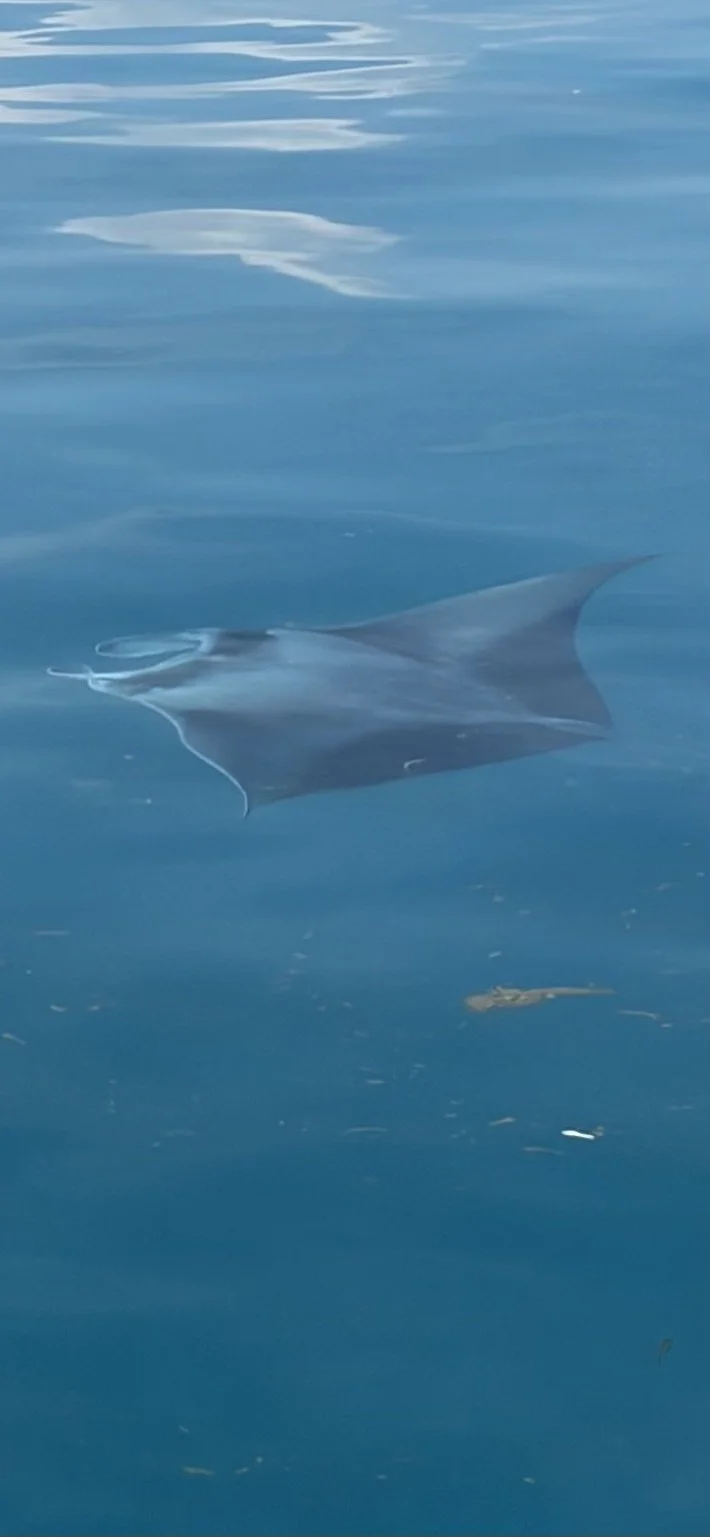
As we were watching we kept seeing a fin appear on the water and something swimming around or just on the surface of the water. We watched it over time and thought it was a shark but it was not displaying a shark type behaviour.
It came closer and then we saw it properly – it was a large manta ray swimming with its mouth open and the fins were the edges of his outer wings. It was a combination of black and white and about a metre across. It was lovely watching it and it swam so gracefully. This was a real treat.
Manta rays are large rays belonging to the genus Mobula. Three species are known: M. birostris, the largest at 7 m (23 ft) in width, M. yarae, which reaches 6 m (20 ft), and M. alfredi, the smallest at 5.5 m (18 ft). All three have triangular pectoral fins, horn-shaped cephalic fins and large, forward-facing mouths. They are classified among the Myliobatiformes (stingrays and relatives) and are placed in the family Myliobatidae (eagle rays). They have one of the highest brain-to-body ratio of all fish, and can pass the mirror test.
Mantas are found in warm temperate, subtropical and tropical waters. All three species are pelagic; migrate across open oceans, singly or in groups, while others tends to be resident and coastal. They are filter feeders and eat large quantities of zooplankton, which they gather with their open mouths as they swim. Gestation lasts over a year and mantas give birth to live pups. Mantas may visit cleaning stations for the removal of parasites. Like whales, they breach for unknown reasons.
The name "manta" is Portuguese and Spanish for mantle (cloak or blanket), a type of blanket-shaped trap traditionally used to catch rays. Mantas are known as "devilfish" because of their horn-shaped cephalic fins, which are imagined giving them an "evil" appearance.
Manta rays have broad heads, triangular pectoral fins, and horn-shaped cephalic fins located on both sides of their mouths. They have horizontally flattened bodies with eyes on the sides of their heads behind the cephalic fins, and gill slits on their ventral surfaces. Their tails lack skeletal support and are shorter than their disc-like bodies. The dorsal fins are small and at the base of the tail. Mantas can reach 1,350 kg (2,980 lb). In both species, the width is about 2.2 times the length of the body; Their skin is covered in mucus. Mantas normally have a "chevron" coloration. They are typically black or dark on top with pale markings on their "shoulders". Underneath, they are usually white or pale with distinctive dark markings by which individual mantas can be recognized, as well as some shading Individuals can also vary from mostly black (melanism) to mostly white (leucism) These color morphs appear to be products of neutral mutations and have no effects on fitness. A pink manta ray has been observed in Australia's Great Barrier Reef and scientists believe this could be due to a genetic mutation causing erythrism The fish, spotted near Lady Elliot Island, is the world's only known pink manta ray.
Mantas move through the water by the wing-like movements of their pectoral fins. Their large mouths are rectangular, and face forward. The spiracles typical of rays are vestigial and concealed by small flaps of skin, and mantas must keep swimming with their mouths open to keep oxygenated water passing over their gills The cephalic fins are usually spiralled but flatten during foraging. The fish's gill arches have pallets of pinkish brown gill rakers, which are made of spongy tissue that collects food particles. Mantas track down prey using visual and olfactory senses. They have one of the highest brain-to-body mass ratios and the largest brain size of all fish. Their brains have retia mirabilia which may serve to keep them warm.
Swimming behaviour in mantas differs across habitats: when travelling over deep water, they swim at a constant rate in a straight line, while further inshore, they usually bask or swim idly around. Mantas may travel alone or in groups up to 50. They may associate with other fish species, as well as sea birds and marine mammals. Mantas sometimes breach or leap out of the water. Individuals in a group may make aerial jumps in succession. Mantas may leap forward and re-enter headfirst, tail first or make somersaults. The reason for breaching is not known; possible explanations include communication, or the removal of parasites and remoras (suckerfish).
Mantas visit cleaning stations on coral reefs for the removal of external parasites. The ray adopts a near-stationary position close to the coral surface for several minutes while the cleaner fish feed. Such visits most frequently occur when the tide is high. Individual mantas may exhibit philopatry by revisiting the same cleaning station or feeding area repeatedly and appear to have cognitive maps of their environment. In addition, it has been confirmed that reef manta rays form a bond with a specific individual and act together.
Mantas may be preyed upon by large sharks, orcas and false killer whales. They may also harbour parasitic copepods.
Manta rays are filter feeders as well as macropredators. On the surface, they consume large quantities of zooplankton in the form of shrimp, krill, and planktonic crabs. In deeper depths, mantas consume small to medium-sized fish. Foraging mantas flatten their cephalic fins to channel food into their mouths. During filter feeding, small particles are collected by the tissue between the gill arches.[10] The standard method of feeding for a lone manta is simply swimming horizontally, turning 180 degrees to feed in the other direction. Up and down movements, sideways tilting and 360-degree somersaults are also observed.
Mating takes place at different times of the year in different parts of the manta's range. Courtship is difficult to observe in this fast-swimming fish, although mating "trains" with multiple individuals swimming closely behind each other are sometimes seen in shallow water. These mating trains often consist of multiple male rays simultaneously pursuing an individual female. The mating sequence may be triggered by a full moon and seems to be initiated by a male following closely behind a female while she travels at around 10 km/h (6.2 mph). He makes repeated efforts to grasp her pectoral fin with his mouth, which may take 20 to 30 minutes. Once he has a tight grip, he turns upside-down and presses his ventral side against hers. He then inserts one of his claspers into her cloaca, where it remains for 60–90 seconds. The claspers form a tube and a siphon propels semen from the genital papilla into the oviduct. The male continues to grip the female's pectoral fin with his teeth for a further few minutes as both continue to swim, often followed by up to 20 other males. The pair then parts, the female being left with scars on her fin.
The fertilized eggs develop within the female's oviduct. At first, they are enclosed in an egg case while the developing embryos absorb the yolk. After hatching, the pups remain in the oviduct and receive additional nutrition from milky secretions called histotroph With no umbilical cord or placenta, the unborn pup relies on buccal pumping to obtain oxygen. Brood size is usually one or occasionally two. The gestation period is thought to be 12–13 months. When fully developed, the pup resembles a miniature adult and is expelled from the oviduct with no further parental care. In wild populations, an interval of two years between births may be normal, but a few individuals become pregnant in consecutive years, demonstrating an annual ovulatory cycle. Female mantas appear to mature at 8–10 years. Manta rays may live as long as 50 year
We had some dips to keep us cool and snorkelled over some bommies nearer the reef which had a wide variety of fish on them. We waited until the water making was finished. We then upped the anchor which came up easily and we retraced our steps out of the lagoon. I had in mind going to an anchorage near a reef for lunch and then we would return to Hummafuschi.
As there was no wind we motored to this reef arriving about 12.45pm. There had been little traffic on way and we seemed to have the Maldives to ourselves.
We motored slowly into the shallow water and then went to put the anchor down – it made a funny noise and then the fuse went. This time the switch tripped but it did not blow the fuse. I went to check and clearly something was not right. I said let’s leave it and we then reversed out into deeper water with the anchor about a metre below the water. I was screaming in my head. It had been working perfectly and now why had it gone wrong again.
Once into deeper water we manually brought up the anchor using the snubber and winch on the mast. I immediately made contact with the engineers who messaged me back and said they would come to Hummafuschi tomorrow and then later said they would come the following day. What can I do- I just have to be patient and hope it is not the same problem.
We motored back to Hummafuschi so we had our lunch on the way. We came back through the pass and manually out down the anchor and settled. Stig and I had a swim and we could barely see the anchor. I had noticed a bit of water in the bilge and I pulled up the floor and water is coming in from somewhere. I suspected a joint somewhere in the rear part of the boat. I searched and checked my heads, shower and that it was not the same leak as before. I checked the rear shower hose pipe and think it must be somewhere in the engine room but that was clear too. I shall have to explore further.
We had a drink on the aft deck and we decided to go to the Safari Boat, as it is called in the bay. This is actually a bar on a boat and is tolerated as it is on a boat and not on land. We dinghied across and sat on its top deck drinking a Vietnamese beer. Once we had had a drink we went to the harbour and had supper at what is called Top Fun Place which was nice. It was Stig & Cari’s last night and they kindly treated Keith and I.
We returned to Stormbird and sat on the aft deck chatting before bed. I had asked Thaleem to come back and change the batteries over in the way I have previously described.
The picture of today is of course the Manta Ray we saw swimming around the boat.
Need/Opportunity Year Three
I will be going shortly from India to the Maldives and then on to Mauritius, Reunion, Cape Town, St Helena, Azores and back to the UK.
I am currently full which is great but if things change I will make this clear.
The blog will continue as we continue the journey. If you have any comments or suggestions about the blog then do email me on hine.nick9@gmail.com