Year 3 -23 January 2026 – Galle – Yala National Park-Sri Lanka
It was a good day but we were woken by a commercial boat probably about 5.00am but I went back to sleep.
When I woke all was quiet and the sun was coming up.
I made a mixed fruit smoothie which was good as always. I also used up our last papaya which was also delicious.
The man who is going to look after the boat when we are away came at about 9.00am and I showed him the things I want him to look after. We all tidied up and put things away. We packed our bags and by 10.30am we got our luggage up and on to the quay and then we trolleyed them to the entrance to the port.
We found Chinta our tour guide for the 2 weeks. Chinta drove Jules and I around when we came to Sri Lanka in 2019. He has organised a tour for us for 2 weeks. We put our bags in the van and then went to collect Paul and Judith from the fort.
We then drove along the coast road for about and hour and through Weligama that we had visited before. We went on to Melissa where Chinta suggested we went and looked at Coconut Tree Hill. This was a lovely hill on the edge of the coast which looked out to sea and along the coast. It was a wonderful view and there were a lot of great bars up there. We walked back down and then went to lunch at a local restaurant and we had great food.
We drove on and got to the dual carriageway which took us through lovely rural countryside which was so green with many paddy fields, jungle and other agricultural areas.
After a number of hours we came to the Yala National Park and entered it. We were then in wild animal territory and there were all sorts of signs up about this. We drove along the dirt track toward our hotel called Cinnamon Wild and saw grey linder monkeys sauntering about and lots of different birds including eagles, herons and egrets etc.
We eventually arrived at our hotel which was very nice. We were welcomed with a cold towel and a cold drink. We were then given a briefing about not walking alone around the hotel during the day and between 6.30pm and 6.00am you had to be escorted to your hut. We were shown to our rooms and some went to swim and others relaxed. There was a swimming pool and around the front of the hotel was a large lake and we were told not to go too close due to crocodiles.
As if to remind us that we were in the wild and about this warning Mark had been for a swim and he walked down to the edge of the lake. He saw a deer with antlers come down to the lake and it began to swim in it. However, within a short period of time he saw three crocodiles together drag this deer under the water and then it was gone.
We showered etc and met for a drink and then we had a great buffet supper which was good and filling. After 6.00pm we have to be escorted to our rooms by the staff due to the risk of a wild animal enc
I had also contacted a rigger in South Africa who is listed as a Selden Agent. He replied to me and said he may be able to send someone to India to fit the parts but he would be in touch about this. This was positive news but lets see what he suggests first.
We look forward to our safari tomorrow in Yala National Park.
Yala National Park is a national park in Sri Lanka, bordering the Indian Ocean and covering 979 km2 (378 sq mi). It was designated as a wildlife sanctuary in 1900. It hosts diverse ecosystems ranging from moist monsoon forests to freshwater and marine wetlands, and is important for the conservation of Sri Lankan elephants, Sri Lankan leopards and 44 mammal species. It is one of the 70 Important Bird Areas in Sri Lanka harbouring 215 bird species including six endemic species of Sri Lanka.
The area around Yala National Park has hosted several ancient civilizations. Two important Buddhist pilgrim sites, Sithulpahuwa and Magul Vihara, are situated within the park. The 2004 Indian Ocean earthquake and tsunami caused severe damage on the Yala National Park, and 250 people died in its vicinity.
On 1 March 1938, Yala became a national park when the Flora and Fauna Protection Ordinance was passed into law by D. S. Senanayake, the minister of agriculture. The park consists of five blocks. Subsequently, four other blocks were incorporated to the park. There are six national parks and three wildlife sanctuaries in the vicinity of Yala. Kumana National Park, Yala Strict Nature Reserve and Kataragama, Katagamuwa, and Nimalawa sanctuaries are continuous with the park.
Surface water becomes critical in the dry season
The Yala area is mostly composed of metamorphic rock belonging to the Precambrian era and classified into two series, Vijayan series and Highland series. Reddish brown soil and low humic grey soil are prominent among six soil types. Yala is situated in the lowest peneplain of Sri Lanka, which extends from Trincomalee to Hambantota. Topographically the area is a flat and mildly undulating plain that runs to the coast with elevation is 30 metres (98 ft) close to the coast while rising in the interior to 100–125 metres (328–410 ft). The national park is situated in the dry semi-arid climatic region and rain is received mainly during the northeast monsoon. The mean annual rainfall ranges between 500–775 millimetres (19.7–30.5 in) while the mean temperature ranges between 26.4 °C (79.5 °F) in January to 30 °C (86 °F) in April. It is windier in Yala, during the southwest monsoon compared to the wind during the northeast monsoon with wind speeds from 23 kilometres per hour (14 mph) to 15 kilometres per hour (9.3 mph).
Water is abundant after the northeast monsoon, but during the dry season surface water becomes an important factor. The bodies of surface water appear in the forms of streams, tanks, waterholes, rock pools, and lagoons. Waterholes occur in low lying places while rock pools of varying size are capable of containing water year-round, and are hence an important source of water for elephants. For many water birds and water buffaloes natural waterholes are ideal habitats.
Yala National Park lay in the direct path of the 2004 Indian Ocean earthquake, which impacted Sri Lanka 90 minutes after its generation. The tsunami caused severe but localized damage on the park, with around 250 people being killed. The tsunami wave was reported to be 20 feet (6.1 m) high. The tsunami waves reached inland only through the river-mouth gaps in the coastal dunes.
Wetlands are one of habitat types of Yala
Yala National Park has a variety of ecosystems including moist monsoon forests, dry monsoon forests, semi deciduous forests, thorn forests, grasslands, marshes, marine wetlands, and sandy beaches.
The great stone-curlew (great thick-knee) is a waterbird found in the park
Yala is one of the 70 Important Bird Areas (IBAs) in Sri Lanka. Of the 215 bird species of the park, seven are endemic to Sri Lanka. They are Sri Lanka grey hornbill, Sri Lanka junglefowl, Sri Lanka wood pigeon, crimson-fronted barbet, black-capped bulbul, blue-tailed bee-eater and brown-capped babbler. The number of waterbirds inhabiting wetlands of Yala is 90 and half of them are migrants. Waterfoul (lesser whistling duck, garganey), cormorants (little cormorant, Indian cormorant), large waterbirds (grey heron, black-headed ibis, Eurasian spoonbill, Asian openbill, painted stork), medium-sized waders Tringa spp., and small waders Charadrius spp. are among the most common waterbirds. Black-necked stork and lesser adjutant are many of the rare birds that can be seen in the park. The migrant great white pelican and resident spot-billed pelican are also have been recorded. Other waterbirds attracted to the Yala lagoons include lesser flamingo, pelicans, and rare species such as purple heron, night herons, egrets, purple swamphen, and Oriental darter. Thousands of waterfowls migrate to the lagoons of Yala during the northeast monsoon. They are northern pintail, white-winged tern, Eurasian curlew, Eurasian whimbrel, godwits, and ruddy turnstone. The visiting species mingled with residing lesser whistling duck, yellow-wattled lapwing, red-wattled lapwing, and great stone-curlew. Rock pigeon, barred buttonquail, Indian peafowl, black stork, black-winged stilt, and greater flamingo are among the other bird species. Crested serpent eagle and white-bellied sea eagle are the raptors of the park. The forest birds are orange-breasted green pigeon, hornbills, Old World flycatchers, Indian paradise flycatcher, Asian barbets, and orioles. Streams in the park can sustain a large herd of Sri Lankan elephants. Yala has the highest leopard concentration in the world
44 species of mammals are resident in Yala National Park, and it has one of the highest leopard population densities in the world. The Sri Lankan sloth bear, leopard, elephant, and wild water buffalo are all threatened mammals that Yala harbours. Although the water buffalo is indigenous to Sri Lanka, most populations contain genes of cattle or have descended from feral populations. Toque macaque, golden palm civet, red slender loris, and fishing cat are among the other mammals that can be seen in Yala. The elephant population of the park varies seasonally.
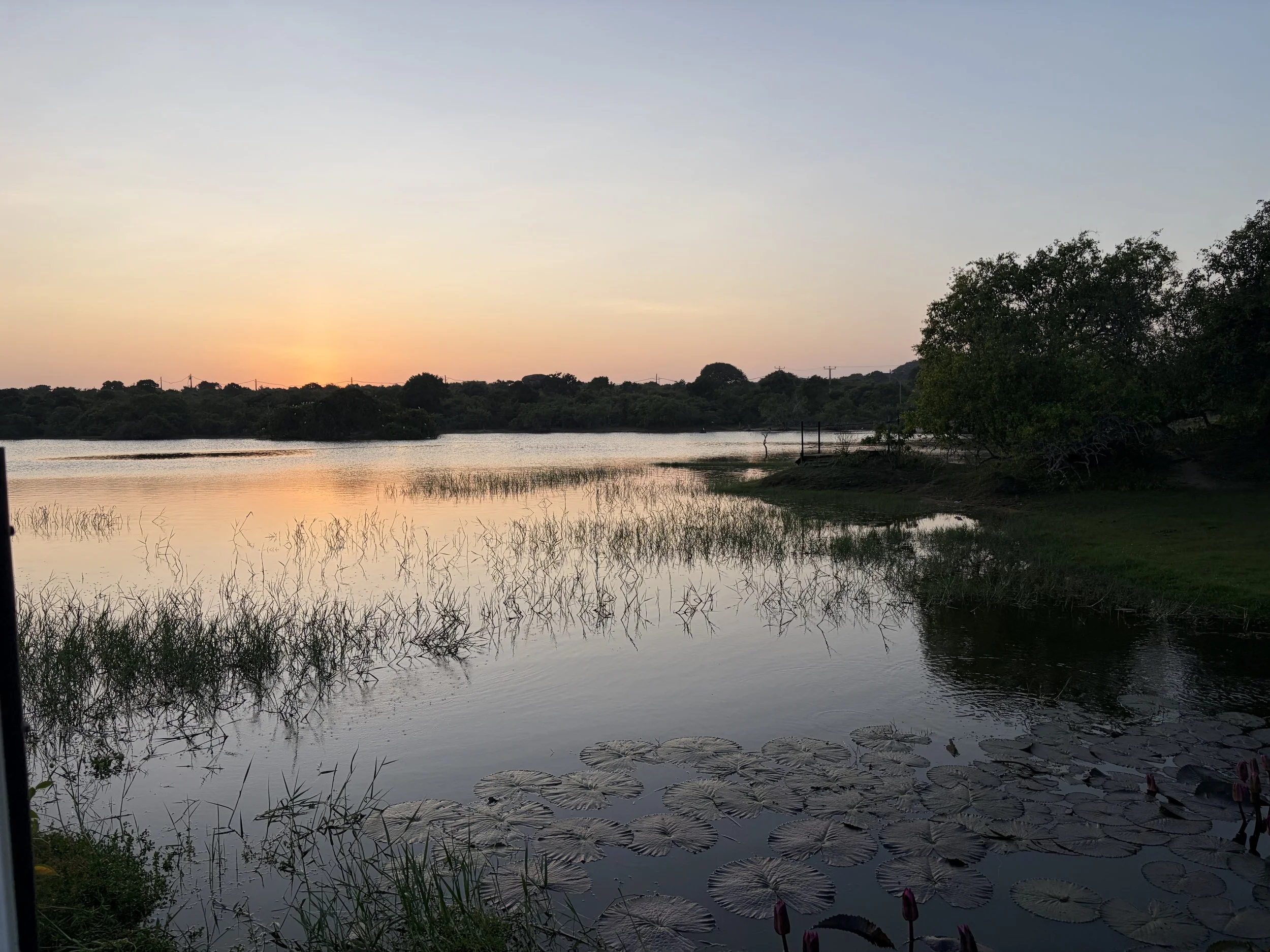
The picture of the day is of sunset at the Cinnamen Wild by the lake where the crocodiles attached.
Need/Opportunity Year Three
In year three I will be going from Thailand to Sri Lanka, India, Maldives and then on to Mauritius, Reunion, Cape Town, St Helena, Azores and back to the UK.
I am looking for crew from Mauritius/ Reunion Island to Cape Town (mid June to end of July) and from Cape Town to the Azores and then to the UK (mid August onwards). If of any interest do email me.
The blog will continue as we continue the journey. If you have any comments or suggestions about the blog then do email me on hine.nick9@gmail.com